Menelik II
Emperor of Ethiopia
Years: 1844 - 1913
Emperor Menelik II GCB, GCMG, (baptized as Sahle Maryam; 17 August 1844 – 12 December 1913), was Negus of Shewa (1866-1889), then Nəgusä Nägäst[nb 2] of Ethiopia from 1889 to his death.
At the height of his internal power and external prestige, the process of territorial expansion and creation of the modern empire-state has been completed by 1898.
Ethiopia is transformed under Nəgusä Nägäst Menelik.
The major signposts of modernization are put in place.
Externally, his victory over the Italians earns him great fame.
Following Adwa, recognition of Ethiopia’s independence by external power expresses itself in terms of diplomatic representation at the court of Menelik and delineation of Ethiopia’s boundaries with the adjacent colonies.
Related Events
Filter results
Showing 10 events out of 31 total
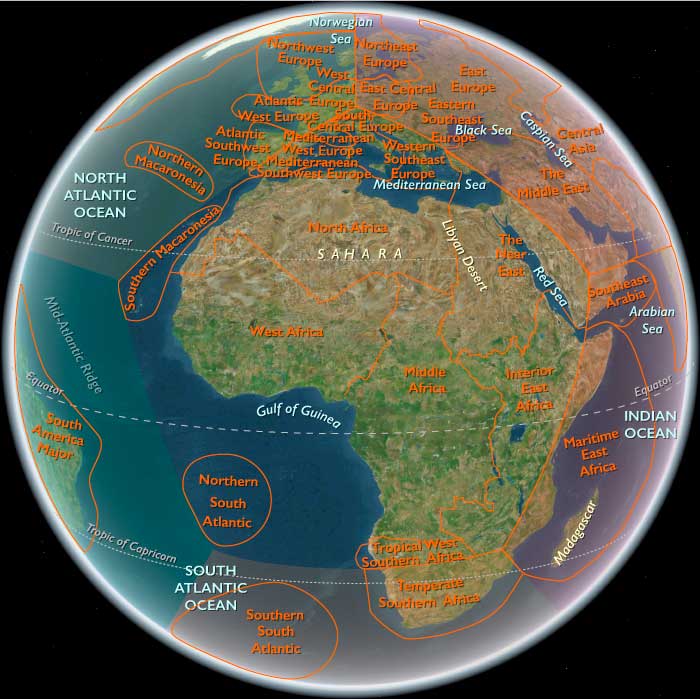
Interior East Africa (1828–1971 CE): Slave Caravans, Imperial Revival, and Colonial Partition
Geographic & Environmental Context
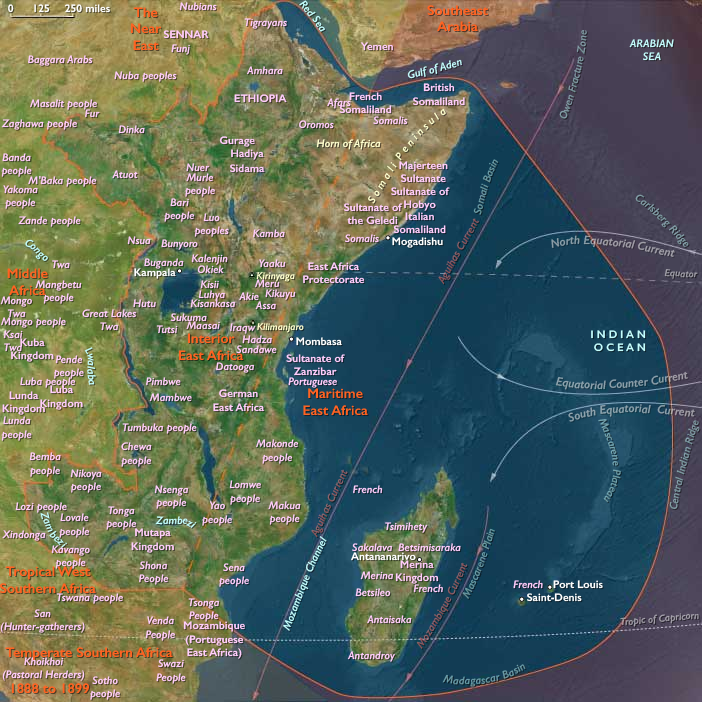
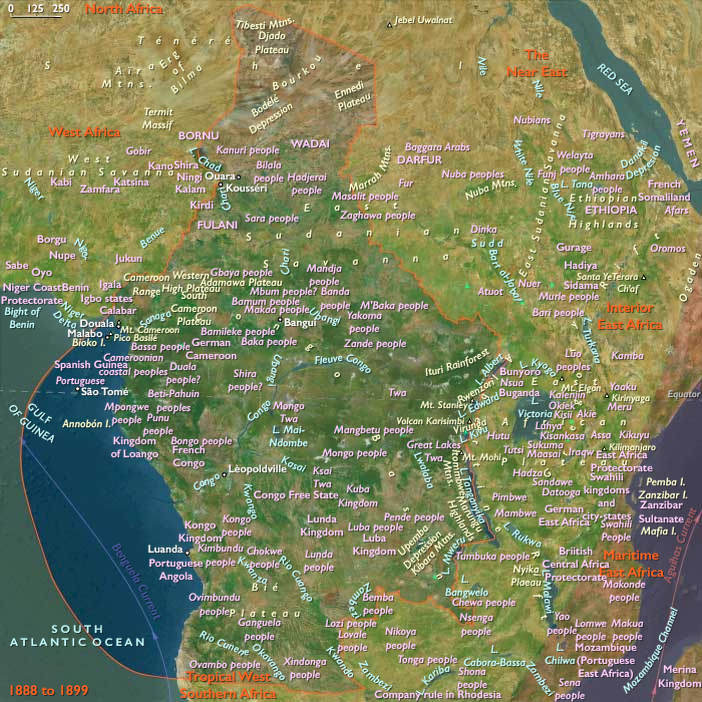
The subregion of Interior East Africa includes Eritrea, Djibouti, Ethiopia, South Sudan, Uganda, Rwanda, Burundi, Zambia, northern Zimbabwe, northern Malawi, northwestern Mozambique, inland Tanzania, and inland Kenya. Anchors included the Ethiopian highlands, the Great Rift lakes (Victoria, Tanganyika, Turkana, Kivu, Mweru), the interlacustrine kingdoms of Rwanda–Burundi–Uganda, the savanna–woodland mosaics of inland Tanzania and Zambia, and the Nile–Sudd marshes in South Sudan. By this period, the region was increasingly reshaped by Indian Ocean trade, European exploration, and later colonial boundaries.
Climate & Environmental Shifts
The 19th century saw alternating droughts and heavy rain years. The mid-1880s famine years devastated highland Ethiopia and the Great Lakes, tied to rinderpest outbreaks that decimated cattle. Fluctuating lake levels affected fisheries and floodplain cultivation. In the mid-20th century, population growth, soil depletion, and drought cycles placed further stress on subsistence systems, especially in pastoral belts of South Sudan and northern Kenya.
Subsistence & Settlement
-
Highlands (Ethiopia/Eritrea): Terrace agriculture of teff, barley, and wheat persisted; ox-plowing remained central. Coffee expanded as a cash crop. Sheep, goats, and cattle supplemented diets.
-
Great Lakes kingdoms (Buganda, Bunyoro, Rwanda, Burundi): Banana groves, sorghum, beans, and cattle supported dense populations. Tribute flows supplied royal courts.
-
Savanna zones (inland Tanzania–Zambia–Malawi–Mozambique): Sorghum, millet, and maize (now widespread) structured village subsistence; cassava spread as a famine reserve. Fisheries on Victoria and Tanganyika supported large communities.
-
Pastoral belts (South Sudan–Turkana–Karamoja): Cattle herding remained central; milk, hides, and bridewealth structured society. Grain was acquired via exchange with cultivators.
Technology & Material Culture
Iron hoes and knives remained vital, supplemented by imported textiles, beads, and firearms. Canoe fleets on the Great Lakes expanded for trade and warfare. Court regalia included drums, spears, and thrones, while Christian Ethiopia produced illuminated manuscripts and stone churches. In the 20th century, colonial regimes built roads, railways, and administrative compounds. Mission schools and printing presses introduced new literacies. Urban craft traditions developed in Kampala, Addis Ababa, Kigali, and Lusaka.
Movement & Interaction Corridors
-
19th-century caravan trade: From inland Tanzania and Zambia, ivory and enslaved people moved to coastal entrepôts like Bagamoyo, Kilwa, and Zanzibar, under Swahili and Omani merchant control.
-
Ethiopia: Caravans carried salt, coffee, and grain across the highlands to Red Sea ports; arms and textiles moved inland.
-
Nile–Sudd routes: Linked South Sudanese cattle and captives to Egyptian markets.
-
Colonial era: Railways tied Mombasa to Kampala, Dar es Salaam to Kigoma, and Benguela (Angola) to Zambian copper mines. Roads and steamers integrated Victoria and Tanganyika into wider circuits.
-
Air and road networks: By mid-20th century, Nairobi, Addis Ababa, Kampala, and Lusaka became aviation and trade hubs.
Cultural & Symbolic Expressions
-
Ethiopia: The Solomonic dynasty revived under Menelik II, who built Addis Ababa and symbolized Christian kingship. The victory over Italy at the Battle of Adwa (1896) became a touchstone of African resistance.
-
Great Lakes kingdoms: Courtly rituals of drums, regnal names, and oral epics remained central, while Christianity and Islam spread through missions and traders.
-
Colonial missions: Introduced Christian festivals, hymnody, and schools, while Islamic brotherhoods deepened ties across the Nile and Sahel.
-
Postcolonial culture: Writers, musicians, and political leaders articulated national identity—Congolese rumba influenced Uganda and Rwanda, while Ethiopia projected imperial grandeur through Haile Selassie’s court rituals.
Environmental Adaptation & Resilience
Communities diversified crops—cassava and maize buffered famine risk. Pastoralists rebuilt herds after rinderpest, adjusted transhumance routes, and negotiated pasture rights. Fisherfolk smoked and dried catches to stabilize diets. Colonial governments attempted irrigation (Gezira scheme, Tanganyika sisal estates), though often favoring export crops. Kinship, clan systems, and cooperative labor traditions sustained resilience, supplemented by missions and churches that organized relief during famine.
Technology & Power Shifts (Conflict Dynamics)
-
Ethiopia: Menelik II expanded territory southward; the empire endured Italian invasion attempts, defeating them at Adwa (1896). Later, Haile Selassie I modernized state institutions, only to face Italian occupation (1936–1941) before liberation with Allied support.
-
Great Lakes: Buganda expanded under British alliance; Rwanda and Burundi fell under German, then Belgian rule. Colonial indirect rule reshaped clan and clientship systems.
-
Savannas and Zambia: Caravans gave way to colonial railroads; copper mining in Katanga and Zambia drew massive labor migrations.
-
Resistance and nationalism: Maji Maji Rebellion (1905–1907) in Tanzania resisted German rule; later independence movements mobilized unions, churches, and student groups. Uganda (1962), Tanzania (1961), Zambia (1964), Malawi (1964), Rwanda (1962), and Burundi (1962) emerged as new states; Ethiopia and Liberia stood as symbols of African sovereignty.
Transition
By 1971 CE, Interior East Africa was a patchwork of newly independent nations and enduring monarchies. Ethiopia remained an empire under Haile Selassie, though unrest grew. The Great Lakes had transitioned from kingdoms to fragile republics. Zambia and Tanzania led pan-African movements, while Uganda under Idi Amin (from 1971) entered authoritarian rule. Across the region, legacies of caravans, Christian and Islamic traditions, and resilient subsistence systems met the challenges of sovereignty, development, and Cold War geopolitics.
Interior East Africa (1852–1863 CE): Consolidation, Conflict, and Rising European Presence
Between 1852 and 1863, Interior East Africa experienced significant political realignment, intensified trade, and the growing influence of European explorers and missionaries. Ethiopia began a notable re-centralization under Tewodros II, while southern and central regions continued to be shaped by the consequences of the slave trade, regional conflicts, and external interventions.
Ethiopia: Tewodros II and Reunification Efforts
In Ethiopia, Emperor Tewodros II (Kassa Hailu), crowned officially in 1855, aggressively pursued the reunification and centralization of the fragmented Ethiopian Empire following the prolonged Zemene Mesafint (Era of Princes). He sought to restore the monarchy's power and prestige through administrative reforms, military modernization, and revitalization of the Ethiopian Orthodox Church.
One of Tewodros’s earliest campaigns targeted the semi-independent kingdom of Shewa, which had maintained significant autonomy. He subdued Shewa and imprisoned its prince, the young Menelik, who later emerged as a powerful ruler in his own right. Despite early successes, Tewodros faced persistent resistance and rebellions across the empire, particularly in regions with powerful nobility and entrenched Oromo interests, limiting his broader ambitions.
Southern Sudan: Intensified Slave Raids and Humanitarian Attention
In the territories of present-day South Sudan, the brutal northern slave raids escalated dramatically, devastating communities such as the Dinka, Nuer, Murle, Bari, and neighboring Nilotic peoples. Tens of thousands were enslaved annually and transported northward toward markets in Egypt and the Middle East. The severity of these raids drew increasing international humanitarian attention, notably from British and European observers who publicized the region’s plight, laying groundwork for later interventions.
The Great Lakes Region: Inter-Kingdom Rivalries
In the Great Lakes region, centralized states like Buganda and Bunyoro experienced intensified rivalries as they expanded and solidified their control. These powerful kingdoms asserted their influence over neighboring ethnic groups, including the Luo, Luhya, Kisii, Mari, and Twa, through conquest, alliances, and strategic intermarriages. Internal administrative reforms enhanced their military capabilities and governance structures, further reinforcing their dominance.
Maasai Territorial Expansion and Regional Shifts
The pastoral Maasai continued territorial expansion across the plains of present-day Kenya and northern Tanzania. Their influence compelled neighboring agricultural and pastoral groups—such as the Kikuyu, Kamba, Kalenjin, Akie, Datooga, Iraqw, Hadza, and Sandawe—to adapt by either aligning with Maasai authority, retreating into marginal territories, or intensifying defensive and economic strategies. This reshaped local trade routes and regional economies, increasingly integrated into broader commercial networks.
Southern Interior: Transformations through Trade and Conflict
In present-day Malawi, Zambia, and southern Tanzania, societies experienced rapid transformations due to intensified trade and the devastating impacts of the slave trade. The Yao people, now established as major trade intermediaries between the interior and Arab coastal traders, dominated regional commerce. Trading networks in ivory and enslaved people dramatically altered social and economic landscapes, impacting neighboring societies including the Chewa, Tumbuka, Nsenga, Tonga, Fipa, and Nkoya.
During this period, explorer and missionary activity significantly increased, bringing deeper external engagement. Notably, Scottish explorer David Livingstone continued his expeditions in the Zambezi region, highlighting the region's potential for commerce and missionary efforts, while vocally opposing the slave trade.
European Exploration and Influence: Livingstone and Humanitarianism
The increased presence of European explorers and missionaries, especially David Livingstone, had profound impacts across the southern and central interior. In 1855, Livingstone became the first European to document the spectacular waterfalls on the Zambezi River, naming them Victoria Falls after Queen Victoria. His vivid descriptions drew heightened European interest and focused international attention on both the humanitarian crises associated with slavery and the economic opportunities in the region.
Livingstone's advocacy for the "3 Cs"—Christianity, Commerce, and Civilization—significantly shaped European perceptions and future policy towards Interior East Africa. His calls for intervention influenced subsequent British and European humanitarian and colonial actions in the region.
External Pressures: Egypt and the Horn of Africa
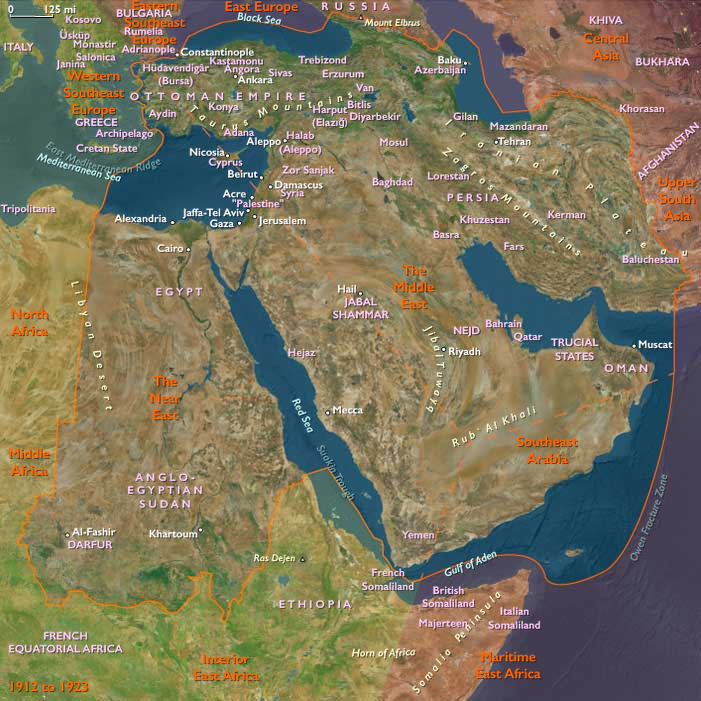
Along Ethiopia’s eastern and northern frontiers, external powers, particularly Egypt, sought greater influence. Egypt’s repeated attempts to dominate strategic Red Sea ports heightened tensions and competition with Ethiopian and Somali coastal entities. Simultaneously, British and French ambitions in the Horn of Africa increased significantly, driven by both commercial interests and strategic considerations, further complicating regional politics.
Tewodros's first task is to bring Shewa under his control.
During the Era of the Princes, Shewa has been, even more than most provinces, an independent entity, its ruler even styling himself negus.
In the course of subduing the Shewans, Tewodros imprisons a Shewan prince, Menelik, who will later become emperor himself.
Despite his success against Shewa, Tewodros faces constant rebellions in other provinces.
In the first six years of his reign, the new ruler manages to put down these rebellions, and the empire is relatively peaceful from about 1861 to 1863.
The energy, wealth, and manpower necessary to deal with regional opposition, however, limits the scope of Tewodros's other activities.
Interior East Africa (1864–1875 CE): Regional Conflict, Shifting Alliances, and Foreign Influence
Between 1864 and 1875, Interior East Africa experienced heightened regional conflicts, intensified foreign incursions, and significant internal transformations. Ethiopia faced profound political realignments following the death of Tewodros II, while other regions navigated internal consolidation, slave raids, and increased European and Egyptian influence.
Ethiopia: The Fall of Tewodros II and Rise of Yohannes IV
Emperor Tewodros II, despite his ambition to centralize and modernize Ethiopia, faced continual rebellion and internal opposition. His controversial efforts to reform the church, tax clergy lands, and maintain a professional army alienated powerful constituencies. Desperate for European support, Tewodros proposed ambitious plans—such as a joint expedition with Britain to conquer Jerusalem. However, diplomatic misunderstandings led him to take British envoys hostage. The resulting British military expedition in 1868 stormed his fortress at Magdala, leading Tewodros to commit suicide, dramatically ending his reign.
After Tewodros’s death, Ethiopia faced renewed fragmentation but avoided a return to full regionalism (Zemene Mesafint). Rival claimants competed for power: Tekla Giorgis assumed temporary control over the central highlands, while Menelik of Shewa, having escaped from imprisonment, declared himself negus, securing Shewan autonomy. Ultimately, Kasa Mercha, governor of Tigray, defeated Tekla Giorgis decisively due to superior weaponry. Kasa Mercha was crowned Yohannes IV in 1872 at the ancient capital of Aksum, marking the rise of a new centralized power.
Egyptian Expansion and Ethiopian Resistance
Egypt’s ambitious Khedive Isma'il Pasha sought a "Greater Egypt" that extended southward into Ethiopia. Egyptian forces launched incursions from multiple directions: from present-day Djibouti, Harar, and the coastal city of Mitsiwa (Massawa). However, their campaign was largely unsuccessful. Afar tribesmen annihilated one Egyptian column inland from Djibouti. Egyptian occupation forces briefly held Harar, though they failed to penetrate further into Ethiopia. Yohannes IV’s Tigrayan warriors decisively defeated Egyptian troops near Mitsiwa in 1875 and again in 1876, preserving Ethiopian independence.
Southern Sudan: Intensifying Slave Raids and Egyptian Administration
Southern Sudan endured intensified slave raids, largely sponsored by northern Sudanese and Egyptian authorities. Annual expeditions captured tens of thousands from non-Muslim ethnic groups, especially the Dinka, Nuer, Azande, and Bari, severely disrupting local societies. Under Khedive Isma'il, Egypt established the province of Equatoria in southern Sudan in the early 1870s, further institutionalizing slave raiding and economic exploitation.
The Azande, under their renowned leader King Gbudwe, fiercely resisted external encroachments by the Egyptians, French, Belgians, and Mahdists, maintaining their independence despite intense pressure.
Great Lakes Region: Bunyoro, Buganda, and the Ivory Trade
In present-day Uganda, the powerful kingdoms of Bunyoro and Buganda faced new challenges and opportunities due to external trade interests. Buganda emerged as a regional powerhouse under the kabaka (king), whose centralized administration, well-maintained infrastructure, and professional military and naval forces provided significant political stability. The 1875 visit of explorer Henry M. Stanley revealed the extent of Buganda’s military strength, observing over one hundred thousand troops and a sophisticated naval fleet.
By contrast, Bunyoro struggled against Egyptian incursions seeking ivory and slaves. Egypt dispatched British explorer Samuel Baker to assert Egyptian dominance over Bunyoro in the 1870s, but fierce resistance forced Baker into retreat. This conflict tarnished Bunyoro’s image internationally, resulting in later British biases against the kingdom.
Other ethnic groups in northern Uganda, such as the Acholi, adapted swiftly to increasing Egyptian demand for ivory, acquiring firearms and using them to reinforce local independence, though this caused new internal inequalities.
Kenya and Tanzania: Maasai Expansion and Shifting Societal Dynamics
The Maasai pastoralists continued to expand across the plains of Kenya and Tanzania, influencing local power dynamics profoundly. Neighboring agricultural and pastoral communities—the Kikuyu, Kamba, Kalenjin, Akie, Datooga, Iraqw, Hadza, and Sandawe—adapted variously through cooperation, conflict, or strategic withdrawal, reshaping regional trade and territorial boundaries.
Southern Interior and Lake Malawi: Explorations and Missions
The mid-nineteenth century explorations by British missionary and explorer David Livingstone brought significant international attention to Lake Malawi (Lake Nyasa) and the Shire Highlands, identified by Livingstone as suitable for European settlement. As a direct result, numerous Anglican and Presbyterian missions were established in this area through the 1860s and 1870s, marking the beginnings of sustained European settlement.
The regional slave trade intensified during this period, notably by the Arab traders at Nkhotakota, significantly affecting local ethnic groups such as the Yao, Chewa, Tumbuka, and Nsenga. These developments, coupled with increasing missionary presence, significantly reshaped local societies.
External Influences and Growing European Interest
The presence of explorers, missionaries, and traders dramatically increased foreign influence in Interior East Africa. Trade routes brought American-made mericani cloth from Zanzibar into Buganda and Bunyoro, exchanging these textiles and firearms for ivory, profoundly transforming local economies and political power structures.
Explorer narratives, particularly Stanley’s reports from Buganda and Baker’s contentious writings on Bunyoro, shaped European attitudes toward East African kingdoms, laying groundwork for future colonial attitudes and interventions.
Johannes has to meet attacks from Egyptian forces on three fronts in 1875.
The khedive in Egypt envisions a "Greater Egypt" that will encompass Ethiopia.
In pursuit of this goal, an Egyptian force moves inland from present-day Djibouti but is annihilated by Afar tribesmen.
Other Egyptian forces occupy Harer, where they will remain for nearly ten years, long after the Egyptian cause had been lost.
Tigrayan warriors defeat a more ambitious attack launched from the coastal city of Mitsiwa in which the Egyptian forces are almost completely destroyed.
A fourth Egyptian army will be decisively defeated in 1876 southwest of Mitsiwa.
Tewodros encounters difficulties with the European powers in addition to his conflicts with rebels and rivals.
Seeking aid from the British government (he proposes a joint expedition to conquer Jerusalem), he becomes unhappy with the behavior of those Britons whom he had counted on to advance his request, and he takes them hostage.
In 1868, as a British expeditionary force sent from India to secure release of the hostages storms his stronghold, Tewodros commits suicide.
Tewodros had never realized his dream of restoring a strong monarchy, although he had taken some important initial steps.
He sought to establish the principle that governors and judges must be salaried appointees.
He also had established a professional standing army, rather than depending on local lords to provide soldiers for his expeditions.
He had also intended to reform the church, believing the clergy to be ignorant and immoral, but he was confronted by strong opposition when he tried to impose a tax on church lands to help finance government activities.
His confiscation of these lands had gained him enemies in the church and little support elsewhere.
Essentially, Tewodros was a talented military campaigner but a poor politician.
The kingdom at Tewodros's death is disorganized, but those contending to succeed him are not prepared to return to the Zemene Mesafint system.
One of them, crowned Tekla Giorgis, takes over the central part of the highlands.
Another, Kasa Mercha, governor of Tigray, declines when offered the title of ras in exchange for recognizing Tekla Giorgis.
The third, Menelik of Shewa, comes to terms with Tekla Giorgis in return for a promise to respect Shewa's independence.
Tekla Giorgis, however, seeks to bring Kasa Mercha under his rule but is defeated by a small Tigrayan army equipped with more modern weapons than those possessed by his Gonder forces.
In 1872 Kasa Mercha is crowned negusa nagast in a ceremony at the ancient capital of Aksum, taking the throne name of Johannes IV.
Interior East Africa (1876–1887 CE): Imperial Expansion, Regional Rivalries, and Intensifying Foreign Influence
From 1876 to 1887, Interior East Africa became increasingly entangled in the imperial ambitions of Europe's great powers, marked by aggressive territorial acquisitions, local resistance movements, religious rivalries, and growing strategic competition. The region witnessed heightened European and Egyptian influence, further destabilizing indigenous political structures and reshaping local economies and societies.
Ethiopia: Johannes IV, Menelik, and Italian Encroachment
Emperor Johannes IV faced persistent internal and external challenges throughout his reign. Initially occupied by internal divisions, particularly with Menelik of Shewa, Johannes struggled to consolidate Ethiopia under his control. Menelik, who traced his Solomonic lineage to Emperor Lebna Dengel, had declared himself King of Shewa and steadily expanded his authority into Oromo territories to the south and west, creating alliances with local chiefs and securing European firearms.
By 1878, despite Menelik’s rising strength, Johannes compelled him into submission; Menelik agreed to recognize Johannes’s overlordship and pay tribute. In return, Johannes formally recognized Menelik as Negus (king), granting him a free hand south of Shewa. This truce, however, remained fragile. Menelik continued to strengthen his position, even maintaining diplomatic contacts with Johannes’s foreign adversaries.
The region's precarious balance was disturbed by external threats, notably from Egypt and Italy. In 1884, Johannes IV signed an accord with Britain, facilitating the evacuation of Egyptian forces from Ethiopian territories along the Red Sea and the Somali littoral. Yet the power vacuum encouraged further European intrusion, especially Italy’s ambitions toward Ethiopia.
The Italian government, having taken control of the port of Aseb in 1882 and then Mitsiwa (Massawa) in 1885, aggressively expanded inland toward Tigray. In 1887, Ethiopian forces under Ras Alula, governor of northeastern Tigray, delivered a resounding defeat to Italian troops at Dogali, temporarily halting Italian expansion. Nonetheless, Italy soon reinforced its position, setting the stage for future confrontations.
Sudan: Egyptian Rule, Slave Raids, and the Mahdist Revolt
Egypt’s administration under Khedive Isma'il Pasha significantly impacted southern Sudan. Egypt had attempted to control the region through governors like Sir Samuel Baker (appointed governor of Equatoria Province in 1869) and Charles George Gordon, who followed in 1874. Baker and Gordon suppressed much of the slave trade and imposed relative stability. However, after Gordon resigned in 1880 due to political turmoil in Egypt, his reforms collapsed, allowing the slave trade to revive and instability to spread.
Isma'il’s inconsistent policies had earlier empowered infamous slave traders such as Rahina Mansur al-Zubayr in Bahr al-Ghazal province. Al-Zubayr, initially an Egyptian governor, defied Cairo, building a private army and resisting removal until Gordon forcibly disarmed and ousted him.
The chaotic situation worsened with the rise of the Mahdist movement, a radical Islamic rebellion against Egyptian rule, which by 1887 penetrated Ethiopian provinces (Gojam and Begemdir). Johannes IV’s forces engaged and defeated the Mahdist forces at the Battle of Metema (1889), but Johannes himself was fatally wounded, plunging Ethiopia into renewed succession disputes.
Buganda and Bunyoro: Religious Rivalries and European Interest
The Kingdom of Buganda, under Kabaka Muteesa I, continued to benefit from increased foreign engagement. European explorers and missionaries praised Buganda's advanced administration and centralized power structure. Following the visits of John Hanning Speke (1862) and Henry Morton Stanley (1875), the kingdom drew growing European interest.
In 1877, Stanley convinced the British Church Missionary Society (CMS) to establish a mission in Buganda. Shortly thereafter, French Catholic White Fathers arrived, introducing religious competition alongside existing Muslim influences from Zanzibar-based Arab traders. By the mid-1880s, Christianity (both Protestant and Catholic) and Islam had significant followings at the Baganda royal court, generating intense rivalries and laying foundations for future conflicts.
Neighboring Bunyoro faced different challenges. Khedive Isma'il’s Egyptian agents had sought to annex Bunyoro to establish an empire along the Upper Nile. Samuel Baker, dispatched by Egypt in the 1870s, was repulsed by determined Banyoro resistance. Baker's bitter account of Bunyoro influenced later British colonial attitudes, significantly harming Bunyoro's international image and political position.
French Expansion in the Horn of Africa
France, forced from Egypt by Britain, strategically established naval footholds along the Red Sea to support its empire in Indochina and challenge Britain's ambitions for a contiguous Cairo-to-Cape Town colonial corridor. In 1884, French governor Léonce Lagarde proclaimed a protectorate around Obock and the Gulf of Tadjoura, triggering protests from British officials in nearby Zeila. The French protectorate established under Lagarde significantly expanded French influence in the Horn, later evolving into the colony of French Somaliland (modern-day Djibouti).
Southern Interior and Malawi: British and Portuguese Rivalry
Portugal, historically dominant in coastal Angola and Mozambique, faced limitations on its territorial claims set by the Berlin Conference of 1884. Britain pressured Portugal to withdraw from areas such as Nyasaland (Malawi), Northern Rhodesia (Zambia), and Southern Rhodesia (Zimbabwe), asserting its own regional dominance. British presence grew through the establishment of missions and trade outposts, notably the settlement at Blantyre (1876) and the establishment of the African Lakes Company (1878), facilitating British commercial and strategic interests.
Great Lakes Region and Ivory Trade Dynamics
Ivory continued driving regional transformations. By this period, caravans from Zanzibar significantly shaped Buganda’s internal economy and external relations, supplying firearms and luxury goods in exchange for ivory. The resulting prosperity, however, intensified competition with rival kingdoms, notably Bunyoro, which sought to replicate Buganda's success but faced internal strife and external threats from Egyptian interests.
To the north, the Acholi capitalized on Egyptian ivory demands, rapidly acquiring firearms and maintaining autonomy, though internal inequalities grew due to uneven weapon distribution.