Mithridates I of Parthia
"Great King" of Parthia
Years: 195BCE - 138BCE
Mithridates or Mithradates I (ca. 195 BCE? - 138 BCE) is the "Great King" of Parthia from ca.
171 BCE - 138 BCE, succeeding his brother Phraates I.
His father is King Phriapatius of Parthia, who dies ca. 176 BCE).
Mithridates I makes Parthia into a major political power by expanding the empire to the east, south, and west.
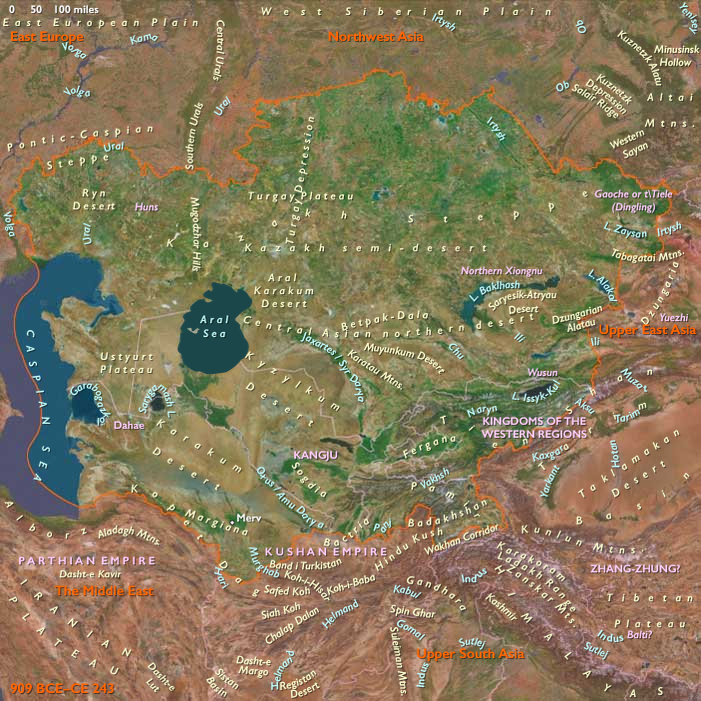
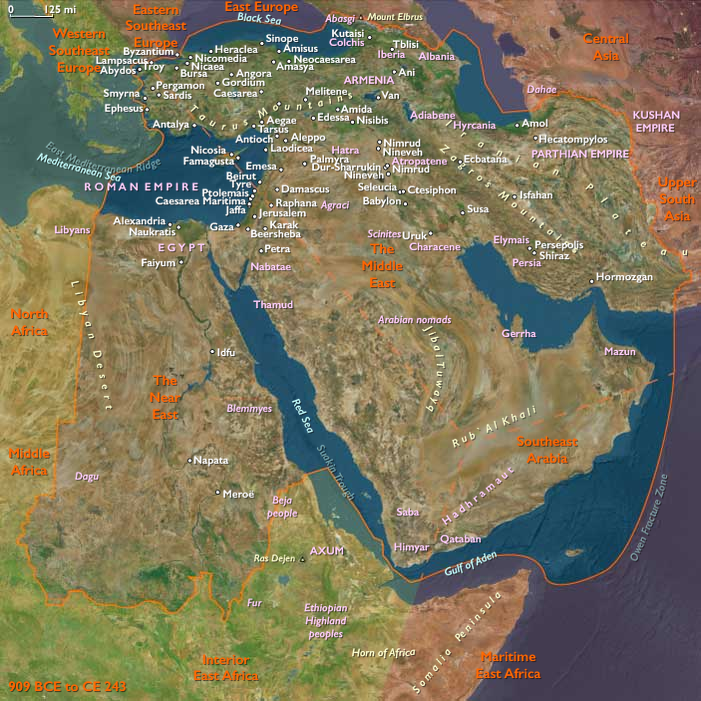
During his reign the Parthians take Herat (in 167 BCE), Babylonia (in 144 BCE), Media (in 141 BCE) and Persia (in 139 BCE).


Related Events
Filter results
Showing 10 events out of 35 total
The Middle East: 177–166 BCE
The Sixth Syrian War and the Ascendancy of Roman Influence
The era from 177 to 166 BCE is marked by the turbulent events of the Sixth Syrian War, a critical confrontation between the Seleucid Empire under Antiochus IV Epiphanes and Ptolemaic Egypt. The causes of this war are somewhat obscure, but the immediate provocation arises in 170 BCE when the two regents of Egypt's young king Ptolemy VI Philometor, Eulaeus and Lenaeus, declare war against the Seleucids.
Initially successful, Antiochus swiftly captures strategic positions, notably the fortress city of Pelusium. Realizing the disastrous course of their strategy, the Egyptians depose the original regents, replacing them with Comanus and Cineas, who seek peace negotiations. Antiochus exploits the turmoil by taking Ptolemy VI, his nephew, under his guardianship and effectively assumes control over Egypt. The people of Alexandria, however, reject this arrangement and proclaim Ptolemy VIII Physcon as the sole ruler.
Antiochus responds by besieging Alexandria, but unable to sever its supply lines, he withdraws by the end of 169 BCE. In his absence, reconciliation occurs between Ptolemy VI and his brother, undermining Antiochus' position and prompting a renewed Seleucid invasion. Facing imminent conquest, the Egyptians appeal to Rome, marking a critical turning point.
In 168 BCE, Roman envoy Gaius Popilius Laenas confronts Antiochus near Alexandria. In a dramatic scene at Eleusis, Popilius famously draws a circle around Antiochus, demanding a decision on the Roman Senate’s ultimatum—immediate withdrawal from Egypt and Cyprus. Antiochus, cornered by Rome's authority, concedes, marking the event remembered as the "Day of Eleusis," effectively ending Seleucid ambitions in Egypt.
This era also sees the continued consolidation of the Parthian kingdom under Phraates I, who expands Parthian control beyond the Gates of Alexander and captures strategic locations like Apamea Ragiana. The groundwork laid during his reign paves the way for the extensive territorial expansion that will soon be realized by his successor, Mithridates I.
Thus, the era 177–166 BCE signifies the waning of Seleucid power, the consolidation of Roman authority in Mediterranean geopolitics, and the rising prominence of Parthia, reshaping the geopolitical landscape of the Middle East significantly.
The causes of the Sixth Syrian War are obscure.
Eulaeus and Lenaeus, the two regents of the young king of Egypt, Ptolemy VI Philometor, declare war on the Seleucid ruler Antiochus IV Epiphanes in 170.
Ptolemy's younger siblings Ptolemy VIII Physcon and Cleopatra II are in the same year declared co-rulers in order to bolster the unity of Egypt.
Military operations do not begin until 169, when Antiochus quickly gains the upper hand, seizing the important strategic town of Pelusium.
The Egyptians realize their folly in starting the war, Eulaeus and Lenaeus are overthrown and replaced by two new regents, Comanus and Cineas, and envoys are sent to negotiate a peace treaty with Antiochus.
Antiochus takes Ptolemy VI (who is his nephew) under his guardianship, giving him effective control of Egypt.
However, this is unacceptable to the people of Alexandria, who respond by proclaiming Ptolemy Physcon as sole king.
Antiochus besieges Alexandria but he is unable to cut communications to the city so, at the end of 169, he withdraws his army.
In his absence, Ptolemy VI and his brother are reconciled.
Antiochus, angered at his loss of control over the king, invades again.
The Egyptians send to Rome asking for help and the Senate dispatches Gaius Popilius Laenas to Alexandria.
Meanwhile, Antiochus has seized Cyprus and Memphis and is marching on Alexandria.
At Eleusis, on the outskirts of the capital, he meets Popilius Laenas, with whom he had been friends during his stay in Rom, but instead of a friendly welcome, Popilius offers the king an ultimatum from the Senate: he must evacuate Egypt and Cyprus immediately.
Antiochus begs to have time to consider but Popilius draws a circle round him in the sand with his cane and tells him to decide before he steps outside it.
Antiochus chooses to obey the Roman ultimatum.
The "Day of Eleusis" ends the Sixth Syrian War and Antiochus' hopes of conquering Egyptian territory.
Phraates I is recorded as expanding Parthia's control past the Gates of Alexander and occupying Apamea Ragiana, the locations of which are unknown, yet the greatest expansion of Parthian power and territory takes place during the reign of his brother and successor Mithridates I of Parthia.
The Seleucids and the Parthians vie for control of the independent Bactrian state.
In 170, Antiochus dispatches a force under Eucratides to conquer Bactria.
Parthia’s Mithridates I attacks Bactria’s frontiers while its ruler, Demetrius, is occupied with repelling the Seleucid invasion.
Eucratides, either a general of Demetrius or an ally of the Seleucids, manages to overthrow the Euthydemid dynasty and establish his own rule around 170 BCE, probably dethroning Antimachus I and Antimachus II.
The Indian branch of the Euthydemids try to strike back.
Demetrius (very likely Demetrius II), king of Bactria, the son and successor of Euthydemus, who ruled, according to some scholars, from about 190 to about 167 BCE, is said to have returned to Bactria with sixty thousand men to oust the usurper, but he apparently is defeated and killed in the encounter in 167.
Eucratides now rules Bactria as military governor, but resistance continues.
The slight historical evidence for the reign of Demetrius s open to varying interpretations.
Demetrius had earlier made such extensive conquests in northern India that for a brief time he virtually reestablished there the great Mauryan Empire that had collapsed about 184.
Other scholars, however, contend that it was a younger Demetrius (likewise a Bactrian king but not directly related to the son of Euthydemus) who made conquests in India, of a less extensive kind, and lost his kingdom to Eucratides after reigning from about 180 to 165.
The fact that one of these two men was the first to strike coins with a bilingual inscription in Greek and Prakrit suggests that he pursued a policy of treating the Indian peoples and the Bactrian Greeks as equals.
Mithridates, an Arsacid who had become ruler of Parthia in 171, first expands Parthia's control eastward by defeating King Eucratides of the Greco-Bactrian Kingdom.
This gives Parthia control over Bactria's territory west of the Arius river, the regions of Margiana and Aria (including the city of Herat in 167 BCE).
"The satrapy Turiva and that of Aspionus were taken away from Eucratides by the Parthians."
(Strabo XI.11.2) These victories give Parthia control of the overland trade routes between east and west (the Silk Road and the Persian Royal Road).
This control of trade will become the foundation of Parthia's wealth and power and be jealously guarded by the Arsacids, who will attempt to maintain direct control over the lands through which the major trade routes passed.
The Middle East: 165–154 BCE
The Maccabean Revolt and the Fragmentation of Seleucid Power
The era from 165 to 154 BCE witnesses profound political and religious upheaval in the Middle East, epitomized by the Maccabean Revolt, a pivotal event highlighting Jewish resistance to Greek cultural hegemony under the Seleucid Empire. Antiochus IV Epiphanes’ aggressive promotion of Hellenism reaches a climax with his desecration of the Temple in Jerusalem, erecting a statue of Zeus there in 167 BCE—an act seen as intolerable sacrilege by the Jewish population.
This incendiary act triggers the uprising in 165 BCE, initiated by Mattathias the Hasmonean, a rural Jewish priest from Modiin. Mattathias vehemently rejects Antiochus' decrees banning traditional Jewish religious practices, notably circumcision and Sabbath observance. When a fellow Jew attempts to sacrifice to a Greek idol under pressure from Seleucid representatives, Mattathias intervenes violently, killing the man. He flees into the wilderness of Judah with his five sons, beginning the armed resistance.
Following Mattathias’ death in 166 BCE, his son Judah Maccabee takes command, adopting guerrilla warfare tactics that prove highly effective against the Seleucid military. Judah’s forces earn the moniker "Maccabees," meaning "hammer," signifying their tenacious resistance and military prowess. The Maccabean campaign initially targets Hellenized Jews, forcibly reinstating Jewish law and religious traditions across rural areas.
In 164 BCE, after a series of successful battles, Judah Maccabee and his forces recapture Jerusalem, ritually cleanse the desecrated Temple, and restore traditional Jewish worship. This momentous event is commemorated by the Jewish festival of Hanukkah. Subsequently, Judah appoints his brother Jonathan Maccabee as high priest, marking a crucial political as well as religious victory.
The Seleucid response is formidable, dispatching a large army under commander Lysias to suppress the revolt. However, internal Seleucid crises following the death of Antiochus IV in 164 BCE distract Lysias, forcing him to negotiate rather than fight prolonged battles. Recognizing the futility of continued conflict, Lysias agrees to a political compromise, restoring religious freedom to the Jews and effectively granting a significant measure of autonomy.
This era further sees the accelerating fragmentation of Seleucid control, exemplified by the loss of strategic territories such as Commagene in Syria and Judea in Palestine. The Maccabean Revolt serves as a catalyst for broader political fragmentation, as local leaders throughout the region increasingly assert independence from Seleucid authority.
Thus, the period from 165 to 154 BCE signifies a pivotal moment in Middle Eastern history, characterized by the rise of Jewish self-governance under the Hasmonean dynasty, the erosion of Seleucid imperial cohesion, and the emergence of new regional powers that will shape the region’s political landscape for decades to come.
Antiochus IV Epiphanes, having mounted a campaign against the Parthians who are threatening the Seleucid empire in the east, recovers the income from that area, and …
…forces Artaxias of Armenia to recognize his suzerainty.
An unsuccessful attempt to end the division of Armenia into an eastern and a western part is made about this time, when Artaxias seeks to suppress his rival in Sophene.
Mithridates I of Parthia, taking advantage of Antiochus' western problems, had attacked from the east and seized the city of Herat in 167 BCE, disrupting the direct trade route to India and effectively splitting the Greek world in two.
Antiochus, recognizing the potential danger in the east but unwilling to give up control of Judea, had sent a commander named Lysias to deal with the Maccabees, while the King himself is to lead the main Seleucid army against the Parthians.
Setting out in 164 BCE on an expedition to the Arabian coast, he funds the city of Antioch on the Persian Gulf, where its mint is to serve the trade along the sea route between India and the district at the mouth of the great Mesopotamian rivers.
Near the end of the year, the fifty-one-year-old monarch of an illness at Tabae (or Gabae, probably present Isfahan) in Persis.
(Many believers see his death as a punishment for his attempt to loot the shrine of Nanaia in Elam, but this story seems to be baseless.