Muhammad II of Khwarezm
Shah of Khwarezm
Years: 1165 - 1220
Ala ad-Din Muhammad II is the Shah of the Khwarezmian Empire from 1200 to 1220.
His ancestor was a Turkic slave who eventually became a viceroy of a small province named Khwarizm.
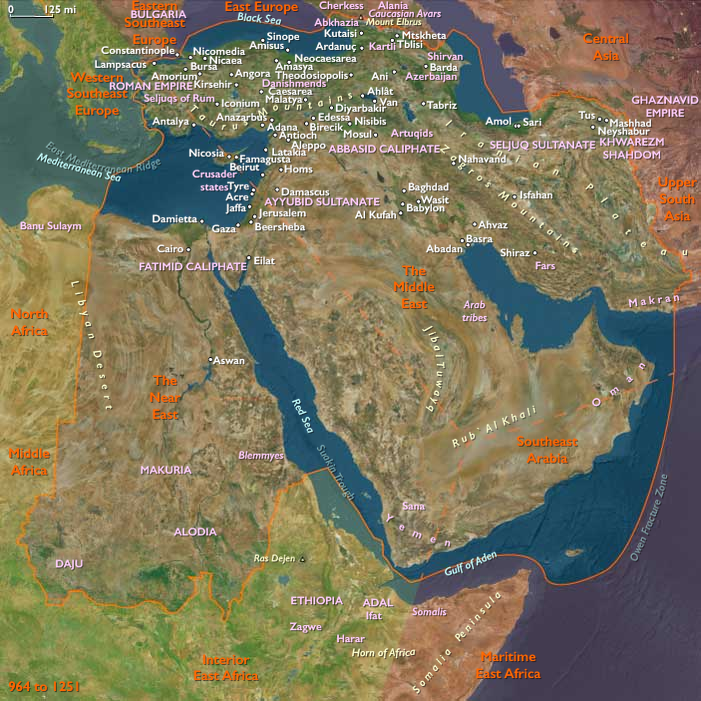
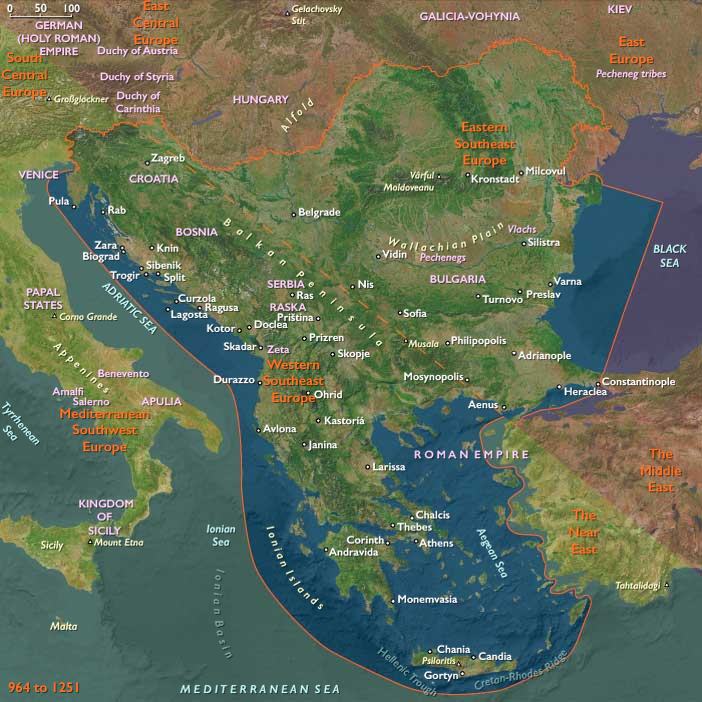
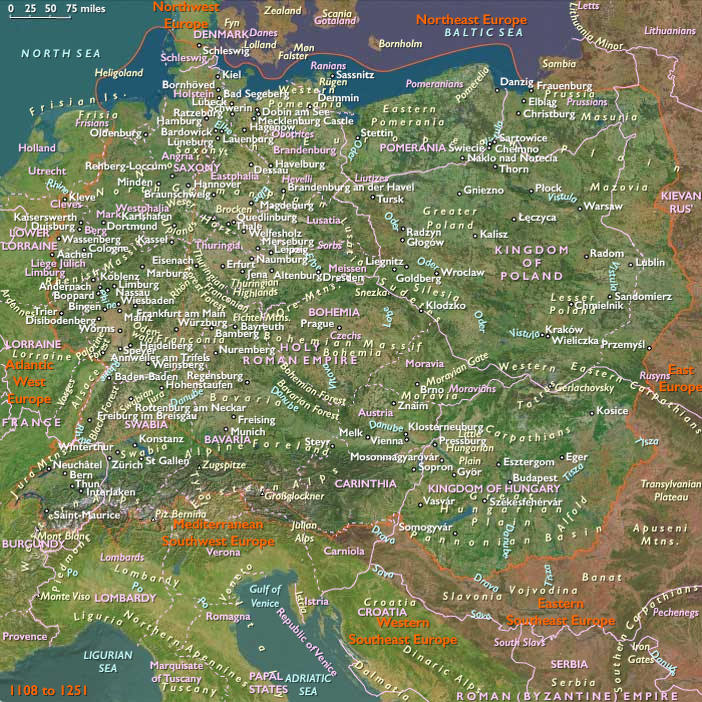

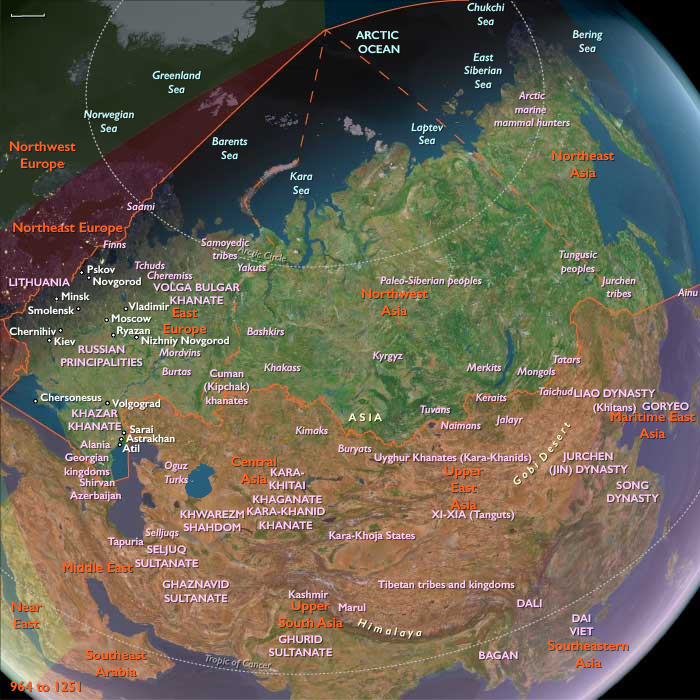
Related Events
Filter results
Showing 10 events out of 21 total
Mawarannahr continues to be prosperous and rich under the rule of the Khwarezm shah Qutb ad-din Muhammad and his descendant Muhammad II.
A new incursion of nomads from the north soon changes this situation, however.
The invader this time is Genghis Khan with his Mongol armies.
The Mongol invasion of Central Asia is one of the turning points in the history of the region.
This event leaves imprints that will still be discernible in the early twentieth century.
The Mongols have such a lasting impact because they establish the tradition that the legitimate ruler of any Central Asian state can only be a blood descendant of Genghis Khan.
The Mongol conquest of Central Asia, which takes place from 1219 to 1225, leads to a wholesale change in the population of Mawarannahr.
The conquest quickens the process of Turkification in the region because, although the armies of Genghis Khan are led by Mongols, they are made up mostly of Turkic tribes that had been incorporated into the Mongol armies as they encountered them in their southward sweep.
As these armies settle in Mawarannahr, they intermix with the local populations, increasingly making the Iranians a minority.
Another effect of the Mongol conquest is the large-scale damage the warriors inflict on cities such as Bukhara and on regions such as Khwarezm.
As the leading province of a wealthy state, Khwarezm is treated especially severely.
The irrigation networks in the region suffer extensive damage that will not be repaired for several generations.
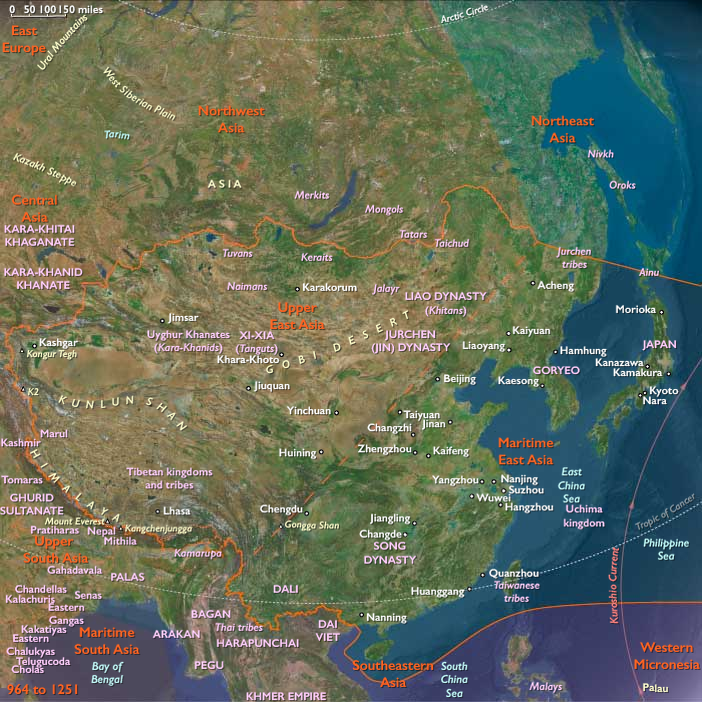
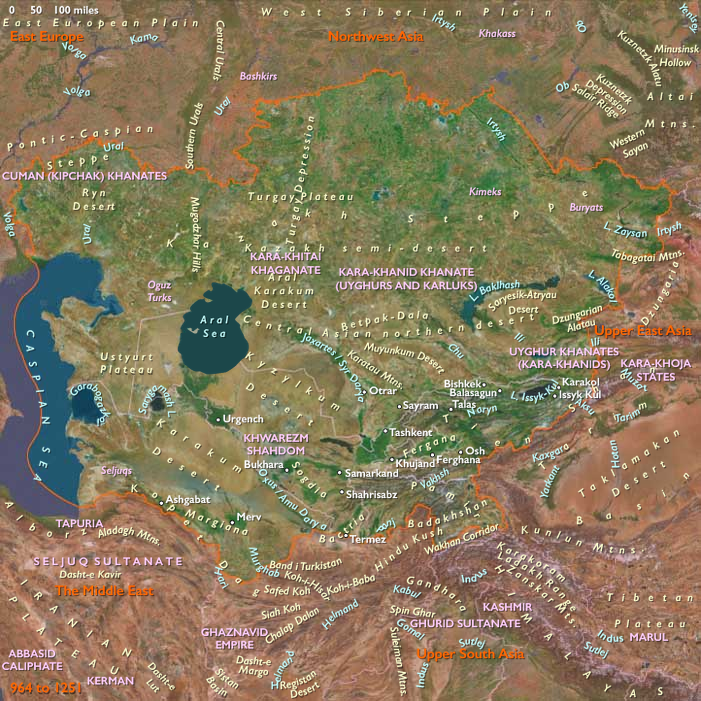
The Kara-Khitans rule from their capital at Balasagun (in today's Kyrgyzstan), directly controlling the central region of the empire.
The rest of their empire consists of highly autonomous vassalized states, primarily Khwarezm, the Karluks, the Kara-Khoja Kingdom of the Uyghurs, the Qanglï, and the Western, Eastern, and Fergana Kara-Khanids.
The late-arriving Naimans have also become vassals.
The Khitan rulers adopt many administrative elements from the Liao Dynasty, including the use of Confucian administration and imperial trappings.
The empire also adopts the title of Gurkhan (universal Khan).
The Khitans use the Chinese calendar, maintain Chinese imperial and administrative titles, give its emperors reign names, use Chinese-style coins, and send imperial seals to its vassals.
Although most of its administrative titles are derived from Chinese, the empire also adopts local administrative titles, such as tayangyu (Turkic) and vizier.
The Khitans maintain their old customs, even in Central Asia.
They remain nomads, adhere to their traditional dress, and maintain the religious practices followed by the Liao Dynasty Khitans.
The ruling elite tries to maintain the traditional marriages between the Yelü king clan and the Xiao queen clan, and are highly reluctant to allow their princesses to marry outsiders.
The Kara-Khitai Khitans follow a mix of Buddhism and traditional Khitan religion, which includes fire worship and tribal customs, such as the tradition of sacrificing a gray ox with a white horse.
In an innovation unique to the Kara-Khitai, the Khitans pay their soldiers a salary.
The empire rules over a diverse population that is quite different from its rulers.
The majority of the population is sedentary, although the population suddenly becomes more nomadic during the end of the empire, due to the influx of Naimans.
The majority of their subjects are Muslims, although a significant minority practices Buddhism and Nestorianism.
Although Chinese and Khitan are the primary languages of administration, the empire also administers in Persian and Uyghur.
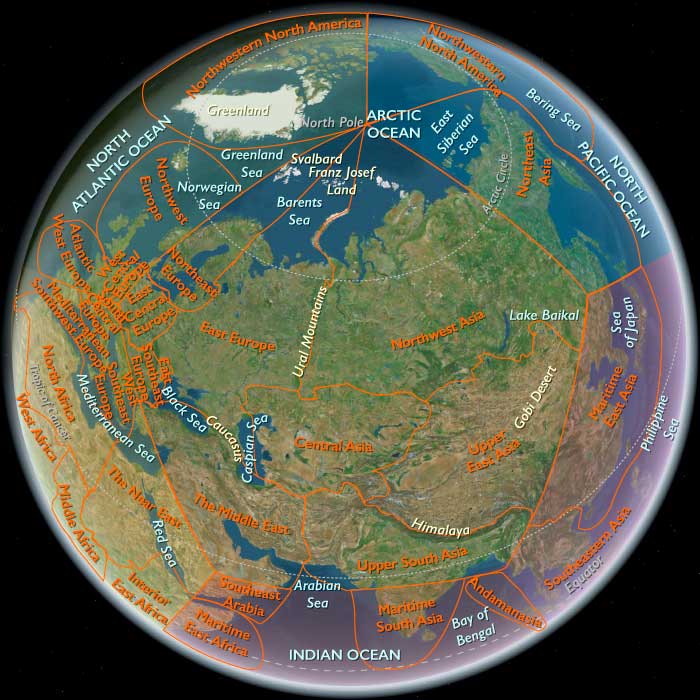
The decline of the Seljuqs following their defeat by the Kara-khitans had allowed the Khwarezmids, then a vassal of the Kara-Khitans, to expand into former Seljuq territory.
The citizens of Bukhara revolt in 1207 against the sadrs (leaders of the religious classes), which the Khwarezm-Shah 'Ala' ad-Din Muhammad uses as a pretext for invading and taking Bukhara.
Muhammad now forms an alliance with the Western Kara-Khanid ruler Uthman (who will later marry Muhammad's daughter) against the Kara-Khitans.
Muhammad II, the Khwarezm-Shah, takes Samarkand in 1210 after the Kara-Khitans retreat to deal with the rebellion from the Naiman Kuchlug, who had seized the Kara-Khitans' treasury at Uzgen.
The Khwarezm-Shah defeats the Kara-Khitans near Talas.
Muhammad and Kuchlug had, apparently, agreed to divide up the Kara-Khitan's empire.
The Kara-Khitan Khanate had not destroyed the Karakhanid dynasty.
Instead, the Khitans had stayed at Semirech'e with their headquarters near Balasaghun, and allowed some of the Karakhanids to rule as vassals in Samarkand and Kashgar, with the Karakhanids acting as their tax-collectors and administrators on Muslim sedentary populations (the same practice will be adopted by the Golden Horde on the Russian Steppes).
The Kara-Khitans are Buddhists and shamanists ruling over largely Muslim Karakhanids, although they are considered fair-minded rulers whose reign is marked by religious tolerance.
Islamic religious life has continued uninterrupted and Islamic authority has been preserved, while Kashgar is a Nestorian metropolitan see and Christian gravestones in the Chu valley appear beginning this period.
The population of Samarkand stages a revolt in 1212 against the Khwarezmians, a revolt that Uttman supports, and massacres them.
The Khwarezm-Shah returns, recaptures Samarkand and executes Uthman.
He demands the submission of all leading Karakhanids, and finally extinguishes the Western Karakhanid state.
The Mongol Empire’s original intention was not to invade the Khwarezmid Empire.
According to the Persian historian Juzjani, Genghis Khan had originally sent a message to the Khwarezm Shah Empire, Ala ad-Din Muhammad, seeking trade, greeted him as his neighbor.
The Mongols' original unification of the nomadic tribes in Mongolia, followed by Turkmens and other nomadic peoples, had come with relatively little bloodshed, and almost no material loss.
Even his invasions of China, to that point, had involved no more bloodshed than previous nomadic invasions had caused.
Shah Muhammad had reluctantly agreed to this peace treaty, but it was not to last.
The war starts less than a year later, when a Mongol caravan and its envoys are massacred in the Khwarezmian city of Otrar.
In this brief war, lasting less than two years, not only is a huge empire destroyed utterly, but Genghis Khan introduces the world to tactics that will not be seen again until the Germans use them so well in the Second World War—indirect attack, and the complete and utter terrorization and wholesale slaughter of entire populations.
Genghis Khan, having conquered the Jin capital of Beijing, interrupts his fighting with the Jin conquest to come to the aid of Muslim Turks opposed in Kara-Khitai by the usurper Kuchlug, the former king of the Naimans, deposed earlier in the century.
After two Mongol divisions liberate Kara-Khitai in 1218, Genghiz Khan sends a peaceful Mongol trade mission to the ambitious and oppressive shah of Khwarezm, a Turkish Muslim principality to the west of Kara-Khitai.
Having only recently conquered two-thirds of what will one day be China, Genghis is looking to open trade relations, but the Shah, having heard exaggerated reports of the Mongols, believes this gesture is only a ploy to invade his land.
Genghis sends emissaries to Khwarezm (reports vary—one stating a group of one hundred Muslim merchants with a single Mongol leading them, others state four hundred and fifty) to emphasize his hope for a trade road.
The caravan sent by Genghis Khan is robbed of its rich goods upon arrival in Otrar in accordance with orders by Shah Muhammed to Inalchik Kair-khan, the governor of the town.
He thinks spies are secreted in the caravan.
Genghis, trying to maintain diplomacy, sends an envoy of three men to the Shah, to give him a chance to disclaim all knowledge of the governor's actions and hand him over to the Mongols for punishment.
The shah executes the envoy (again, some sources claim one man was executed, some claim all three were), and then immediately has the Mongol merchant party (Muslim and Mongol alike) put to death.
Genghis Khan, receiving no reparations from the Khwarezem Shah, declares war on Persia, consisting at this time of Khwarezm, Transoxiania, and Khorasan.
The Mongol troops approach the walls of Otrar in autumn 1219.
Shortly before, the Mongols had appeared in Kunya Urgench, the capital of the Khwarezmian Empire, where a war council had taken place and where one of the commanders had proposed to open the battle against the Mongols, but Muhammed II has chosen another way, dispersing his troops by garrisons throughout the towns, allowing the commanders to fight singly.
Despite a heroic defense of the city, its fate is sealed.
The town is destroyed and its population massacred and partially enslaved.
The one hundred thousand- to to one hundred and fifty thousand-man Mongol army, looting and destroying all cities that refuse to surrender, spares only artisans and engineers (whom they recruit, eventually taking them back to their tent-capital at Karakorum to help construct their civilization) as it shatters Otrar and …