Nominoë, Duke of Brittany
Duke of Brittany
Years: 795 - 851
Nominoe or Nomenoe (French: Nominoë; Breton: Nevenoe; b. 763, d. 7 March 851) is the first Duke of Brittany from 846 to his death. He is the Breton pater patriae and to Breton nationalists he is known as Tad ar Vro ("father of the country").

Related Events
Filter results
Showing 10 events out of 22 total
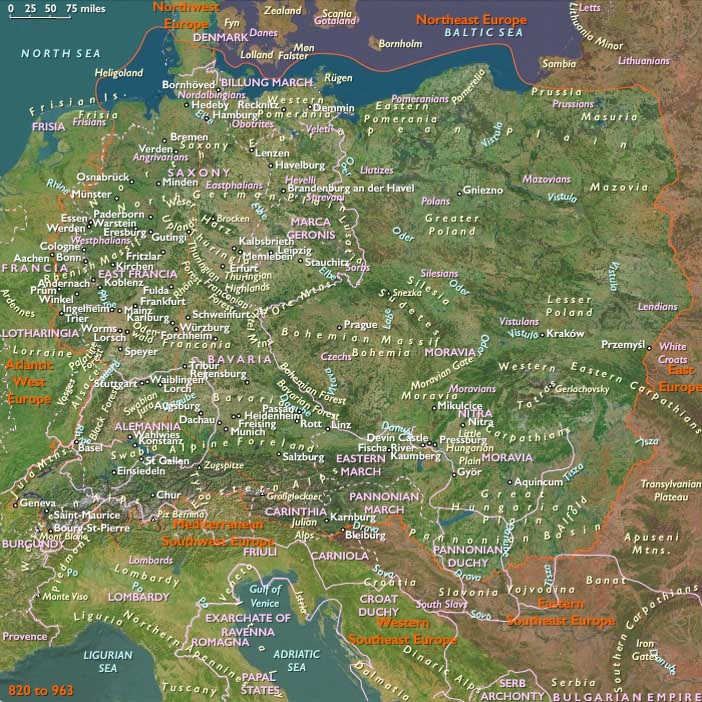
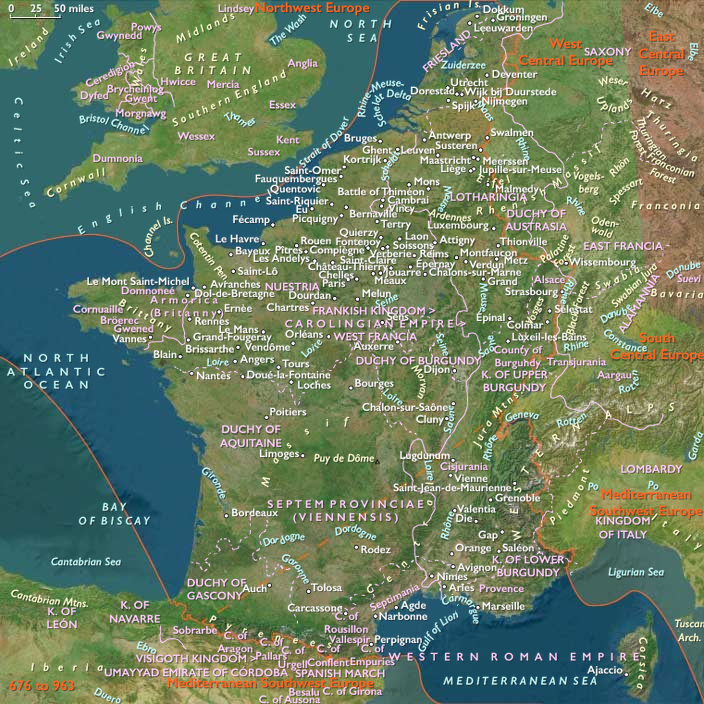
Atlantic West Europe (820 – 963 CE): Carolingian Heartlands, Viking Raids, and Monastic Reforms
Geographic and Environmental Context
Atlantic West Europe spans northern France and the Low Countries.
-
Anchors: the Seine basin (Paris, Rouen), the Loire Valley (Tours, Nantes, Orléans), Burgundy (Dijon, Cluny), the Channel coasts (Brittany, Normandy, Flanders), and the Scheldt delta (Ghent, Bruges, Antwerp).
Climate and Environmental Shifts
-
Early Medieval Warm Period lengthened growing seasons; fertile plains of Île-de-France and Flanders expanded.
-
Frequent Viking raids exploited navigable rivers (Seine, Loire, Scheldt).
Societies and Political Developments
-
Carolingian fragmentation after Verdun (843) split the region into West Francia, Burgundy, and Lotharingian borderlands.
-
Paris emerged as a defensive stronghold against Viking fleets.
-
Vikings plundered Rouen, Nantes, Paris, Ghent; permanent settlements in Normandy after Treaty of Saint-Clair-sur-Epte (911) created the Duchy of Normandy under Rollo.
-
Flanders developed as a marcher county balancing West Frankish and Lotharingian ties.
-
Monastic reform: Cluny Abbey (910) in Burgundy set a pan-European spiritual movement.
Economy and Trade
-
Loire and Seine valleys: cereals, wine; Burgundy: vineyards, salt.
-
Channel fisheries and salt pans supported local markets.
-
Flanders/Low Countries: wool processing began; Scheldt trade routes tied to Rhine–Meuse.
Belief and Symbolism
-
Monastic reform (Cluny) reshaped religious life.
-
Relics and cathedrals in Tours, Reims, and Chartres anchored pilgrimages.
Long-Term Significance
By 963, Normandy was established, Flanders fortified, Cluny launched reform, and Paris was poised to rise as a Capetian capital.
Atlantic West Europe, 820–831: Dynastic Consolidation and Carolingian Stability
Between 820 and 831, Atlantic West Europe—which included Brittany, Aquitaine, Normandy, Burgundy, central France, Alsace, Franche-Comté, and the Low Countries—experienced a period of relative stability under Carolingian rule, although internal tensions foreshadowed future divisions.
Political and Military Developments
-
Carolingian Empire: Rule of Louis the Pious
- Louis the Pious (r. 814–840) continued to govern the vast Carolingian Empire from Aachen, maintaining imperial unity but increasingly challenged by succession disputes among his sons.
- Attempts to provide inheritance for his sons (Lothair, Pepin I of Aquitaine, Louis the German, and Charles the Bald) initiated complex internal dynamics, undermining central authority.
-
Aquitaine: Semi-Autonomous Rule
- Pepin I, as King of Aquitaine (817–838), enjoyed substantial regional autonomy, laying the foundations for Aquitaine’s distinct political identity within the empire.
-
Brittany: Independent Struggles
- Brittany, under Nominoë, asserted independence from Frankish overlordship, beginning a protracted struggle for autonomy that characterized much of the ninth century.
Economic and Social Developments
- Carolingian Economic Stability
- The Carolingian economic renaissance continued from Charlemagne’s era, with sustained agricultural productivity, trade, and monetization, supporting urban growth, particularly around key centers such as Tours, Orléans, and Nantes.
Religious and Cultural Developments
-
Monastic and Intellectual Continuity
- Monasteries, notably Saint Martin of Tours, preserved and expanded their cultural and intellectual role, copying manuscripts and promoting Carolingian learning and literacy.
-
Continued Carolingian Renaissance
- The Carolingian Renaissance's cultural flowering continued, fostering artistic and literary works, scriptoria productivity, and scholarly efforts, particularly in monastic centers.
Legacy
This era provided stability but also revealed underlying dynastic fragility that would soon lead to fragmentation, notably in the coming disputes among Louis the Pious's heirs. Atlantic West Europe enjoyed a continuation of Carolingian cultural and economic flourishing, even as seeds of political division were sown.
A general assembly is held at Ingelheim in May 831 after the suppression of the general rebellion that had enveloped the entire Carolingian Empire.
It is probably here that the emperor Louis the Pious appoints Nominoe, a Breton, to rule the Bretons (which corresponds to "almost all" of Brittany).
Atlantic West Europe, 832–843: Fragmentation and the Birth of West Francia
Between 832 and 843, Atlantic West Europe saw the Carolingian Empire descend into fragmentation through internal family struggles, significantly reshaping the political landscape and laying the foundations of distinct regional identities, notably in West Francia.
Political and Military Developments
-
Carolingian Civil Wars
- Emperor Louis the Pious’s sons—Lothair I, Pepin of Aquitaine, Louis the German, and later Charles the Bald—fought fiercely over succession rights, plunging the empire into civil wars.
- At the Battle of Fontenoy (841), near Auxerre, Charles the Bald and Louis the German defeated their brother Lothair, weakening centralized authority.
-
Treaty of Verdun (843)
- The Treaty of Verdun partitioned the Carolingian Empire among Louis the Pious's surviving sons, decisively splitting the empire:
- Charles the Bald received West Francia (later France), shaping the future identity of Atlantic West Europe.
- Louis the German took East Francia (later Germany).
- Lothair retained Middle Francia (stretching from Italy to the Low Countries), creating a buffer that would be contested throughout the medieval era.
- The Treaty of Verdun partitioned the Carolingian Empire among Louis the Pious's surviving sons, decisively splitting the empire:
-
Brittany’s Increasing Autonomy
- Nominoë of Brittany strengthened his autonomy amidst Carolingian turmoil, positioning Brittany for de facto independence.
Economic and Social Developments
- Economic Disruption
- The civil wars damaged trade networks and agricultural productivity, though Atlantic coastal trade in cities such as Nantes and Bordeaux persisted, maintaining some economic stability.
Religious and Cultural Developments
- Cultural Fragmentation
- The unity of the Carolingian Renaissance weakened, but monastic centers, particularly in Tours and Saint-Benoît-sur-Loire, preserved intellectual traditions amidst political unrest.
Legacy
This era’s pivotal event, the Treaty of Verdun, established lasting political and cultural boundaries. West Francia emerged as the direct precursor to the Kingdom of France, laying the groundwork for Atlantic West Europe's distinct medieval identity.
The Breton Rebellion and the Battle of Messac (843): The Rise of an Independent Brittany
The Armorican peninsula—modern-day Brittany—had long been inhabited by Gallic tribes, known in Latin as the Armorici, before falling under Roman rule. By the 4th to 7th centuries, waves of Britonnes migrants from Roman Britain arrived, blending with the local population to form the Bretons.
Carolingian Conquest and the Rise of Nominoe
- The Carolingian Empire conquered Brittany between 748 and 799, integrating it into its administrative framework, centering on Rennes, Nantes, and Vannes.
- Despite Frankish efforts, their hold on Brittany remained weak, as local rulers retained autonomy.
- Carolingian technology, culture, and Church structures began influencing Brittany.
- In 831, Emperor Louis the Pious appointed Nominoe, Count of Vannes, as ruler of the Bretons and imperial missus (royal envoy), an attempt to secure loyalty.
Brittany’s Rebellion Against West Francia
- Following the breakup of the Carolingian Empire, Nominoe rebels against the rule of Charles the Bald, seeking to expand Breton autonomy into Frankish lands.
- Charles appoints Renaud as Count of Nantes to secure the border, which angers Lambert II of Nantes, who sees himself as the rightful heir.
- Lambert aligns with Nominoe and his son Erispoe, creating a Frankish-Breton alliance against Charles.
The Battle of Messac (May 24, 843)
- Renaud, believing Nominoe is incapacitated by illness, marches from Nantes to strike a preemptive blowagainst Erispoe’s army near the Vilaine River.
- Erispoe’s forces, caught mid-crossing at Messac, are routed, suffering heavy casualties.
The Arrival of Lambert and the Breton Counterattack
Sources differ on the exact events that follow:
-
Version One (Messac Counterattack):
- Lambert, having raised troops in Anjou, arrives in time to reinforce Erispoe at Messac.
- The combined Breton and Frankish rebel army counterattacks, encircling and destroying Renaud’s army.
-
Version Two (Ambush at Blain):
- Believing he has defeated the Bretons, Renaud withdraws to Blain to rest.
- Erispoe and Lambert pursue him, launching a surprise attack on resting Frankish forces at the Isac River, massacring them.
Regardless of the version, Renaud is killed, and the Frankish army is annihilated.
Possible Viking Involvement
- A Viking force under Hastein may have joined the Bretons, though some sources suggest they arrived later to raid the battlefield.
- This marks an early instance of Viking-Breton cooperation, foreshadowing future alliances against West Francia.
Aftermath and the Strengthening of Brittany
- Charles the Bald replaces Renaud with Amaury as Count of Nantes.
- Nominoe strengthens Breton independence, laying the foundation for the emergence of a unified Kingdom of Brittany.
- The victory at Messac solidifies Erispoe’s leadership, allowing him to later secure recognition of Breton independence at the Treaty of Angers (851).
The Battle of Messac (843) is a pivotal moment in Breton resistance against Carolingian rule, signaling the decline of Frankish influence and the rise of an independent Brittany.
Lambert’s Struggle for Nantes and the Viking Sack of the City (843–845)
After the Battle of Messac (843), Lambert II of Nantes seizes control of Nantes, aligning himself with Nominoe and the Bretons against West Francia. However, his rule proves tenuous, as the city soon faces external threats, particularly from Viking raiders.
The Viking Sack of Nantes (845)
- Lambert struggles to maintain control, as political instability and weakened defenses leave Nantes vulnerable.
- In 845, a Viking force attacks and plunders the city, taking advantage of the ongoing Frankish-Breton conflict.
- The Vikings kill Bishop Gohard of Nantes, who reportedly dies while leading prayers inside his cathedral, refusing to abandon his flock.
Consequences of the Attack
- The destruction of Nantes weakens Frankish influence in the region, allowing Breton expansion to continue unchecked.
- Viking presence along the Loire River intensifies, as they establish raiding bases for further inland incursions into West Francia.
- Lambert’s failure to defend Nantes contributes to his declining power, eventually leading to his loss of authority in the region.
The fall of Nantes in 845 highlights the growing Viking threat to Carolingian rule and marks another turning point in the rise of an independent Brittany.
Atlantic West Europe, 844–855: Consolidation Amid Viking Incursions and Regional Autonomy
Between 844 and 855, Atlantic West Europe—encompassing West Francia, Aquitaine, Brittany, Burgundy, Normandy, and the Low Countries—faced intensifying Viking raids, regional autonomy movements, and initial steps toward political and military stabilization.
Political and Military Developments
-
Viking Incursions Intensify
- Viking attacks escalated, notably the sacking of Nantes (843) and repeated raids along the Loire Valley, Aquitaine, and into the Low Countries. Coastal regions, especially Normandy, began to see more permanent Viking presence.
-
Charles the Bald's Defensive Strategies
- Charles the Bald (King of West Francia, 843–877) struggled to organize effective resistance, relying heavily on fortified towns and localized defenses.
- His efforts marked the beginning of early medieval castle-building in the Loire and Seine valleys.
-
Rise of Breton Independence
- Nominoë of Brittany (r. 845–851) decisively defeated Charles the Bald's forces at the Battle of Ballon (845), securing Breton autonomy and establishing Brittany as an independent principality under his son, Erispoë (851–857).
Economic and Social Developments
-
Economic Disruption and Adaptation
- Viking attacks severely disrupted inland trade and agriculture, prompting towns and monasteries to enhance fortifications.
- Increased security needs accelerated development of local markets around fortified towns (castra), laying early foundations for medieval urbanization.
-
Emergence of Feudal Structures
- Local leaders and nobles gained increased prominence by providing protection and security, advancing the development of feudal relationships in West Francia and Aquitaine.
Religious and Cultural Developments
-
Monastic Vulnerability and Cultural Preservation
- Monasteries and religious centers, such as Tours and Saint-Benoît-sur-Loire, fortified themselves against Viking attacks, preserving important manuscripts and cultural continuity.
-
Bishops as Local Leaders
- Bishops in West Francia, notably at Rheims and Tours, assumed increased administrative and defensive responsibilities, reflecting growing secular authority.
Legacy
Between 844 and 855, persistent Viking incursions, the rise of local feudal powers, and Breton independence significantly reshaped Atlantic West Europe's political landscape, setting the stage for increased regionalism and feudalism in subsequent decades.
Nominoe, Imperial Governor of Brittany, and His Relationship with Charles the Bald (841–842)
Initially, Nominoe, the imperial governor of Brittany, maintains an amicable relationship with Charles the Bald, who becomes King of West Francia after the death of Louis the Pious in 840.
Nominoe's Position in Brittany
- Nominoe's power base is in the Vannetais, and two charters refer to him as Count of Vannes, though it is unclear whether he held this title as early as 819 or as late as 834.
- He may not have controlled land outside of Vannes, and his ability to collect revenue from Breton-speaking territories appears to be no greater than that of other regional aristocrats.
- His loyalty to the Carolingians makes him a key figure in maintaining Frankish influence in Brittany, a historically independent-minded region.
Charles the Bald’s Approach to Nominoe (841–842)
- In spring 841, during a revolt in Neustria, Charles sends emissaries from Le Mans to determine whether Nominoe would submit to his rule.
- Nominoe agrees to submit, but according to Nithard’s account, this is not due to compulsion—suggesting that Nominoe is too powerful to be coerced.
- Later in 841, Nominoe rebuffs Emperor Lothair I, who claims Neustria, showing his continued allegiance to Charles.
Nominoe’s Continued Loyalty (842)
- On January 25, 842, Nominoe makes a donation “in alms for the king” to the Abbey of Redon, demonstrating his commitment to Charles the Bald.
- Breton soldiers, along with Gascons, take part in the military display at the Oaths of Strasbourg (842), further reinforcing their support for Charles’ alliance with Louis the German against Lothair I.
The Fragile Alliance and the Future of Brittany
While Nominoe remains loyal to Charles in these early years, his regional power base continues to grow, and tensions between Breton independence and Frankish rule will eventually surface. In the coming years, Nominoe will rebel, setting the stage for Brittany’s struggle for autonomy against the Carolingians.
Breton Defiance and Nominoe’s Raids Against Charles the Bald (843–844)
By 843, the initially amicable relationship between Nominoe, governor of Brittany, and Charles the Bald begins to break down. Nominoe, once a loyal Carolingian appointee, increasingly asserts Breton independence, leading to open conflict.
Charles’ Failed Campaign Against Brittany (November 843)
- In an attempt to compel Breton submission, Charles the Bald marches as far as Rennes in November 843.
- Despite his efforts, he fails to bring Brittany under direct Frankish control.
- The Bretons refuse to yield, and Charles is unable to achieve a decisive victory.
Breton Troops and the Conflict in Neustria (844)
- In Neustria, Breton forces fight under Lambert II of Nantes, one of Charles’ enemies.
- This signals that Nominoe is actively siding against Charles, supporting Frankish rebels as well as conducting his own military campaigns.
Nominoe’s Raid into Maine (June 844)
- While Charles is besieging Toulouse in June 844, ...
...
- Nominoe seizes the opportunity to raid into Maine, a key region in western Francia.
- Breton forces plunder the territory, demonstrating that Nominoe is no longer acting as a loyal vassal but rather as an independent ruler expanding his influence into Frankish lands.
The Beginning of Breton Independence
- These actions mark the start of a full-scale Breton revolt against Carolingian authority.
- Nominoe will continue his military campaigns, leading to further Frankish-Breton conflicts and the eventual establishment of Brittany as an autonomous entity.
- Charles the Bald, already facing Viking incursions and internal revolts, struggles to maintain control over the region, foreshadowing Brittany’s long-term resistance to Frankish rule.
The events of 843–844 solidify Nominoe’s position as the de facto ruler of an independent Brittany, setting the stage for continued Breton defiance and expansion.