Patrice Lumumba
1st Prime Minister of the Democratic Republic of the Congo
Years: 1925 - 1961
Patrice Émery Lumumba (born Élias Okit'Asombo; July 2, 1925 – 17 January 1961) is a Congolese independence leader and the first democratically elected Prime Minister of the Republic of the Congo, after he helps win its independence from Belgium in June 1960.
Only twelve weeks later, Lumumba's government is deposed in a coup during the Congo Crisis.
The main reason why he is ousted from power was his opposition to Belgian-backed secession of the mineral-rich Katanga province.
He is subsequently imprisoned by state authorities under Joseph-Desiré Mobutu and executed by firing squad under the command of the secessionist Katangan authorities.
The United Nations, which he had asked to come to the Congo, does not intervene to save him.
It has been stated that the killing was committed with the assistance of a foreign government or governments; the governments of Belgium, the United States (via the CIA) and Great Britain have all been stated to have been involved, by various accounts.


Related Events
Filter results
Showing 4 events out of 4 total
Middle Africa (1828–1971 CE): Abolition, Partition, Extraction, and Independence
Geographic & Environmental Context
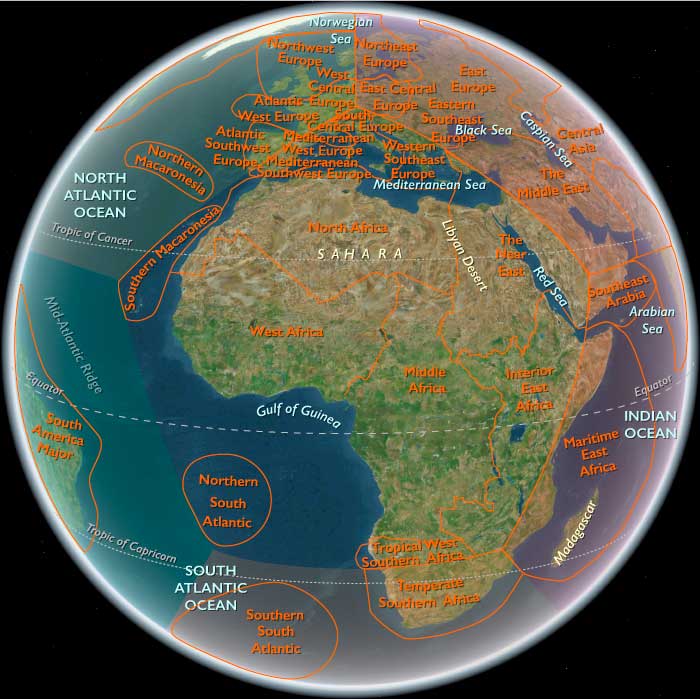
The subregion of Middle Africa includes Chad, the Central African Republic, Cameroon, Equatorial Guinea, São Tomé and Príncipe, Gabon, the Republic of the Congo, the Democratic Republic of the Congo, and Angola.Anchors included the Congo–Kasai–Ubangi river system and ports (Matadi, Léopoldville/Kinshasa, Brazzaville), the Atlantic harbors of Luanda, Lobito, Pointe-Noire, Libreville, Douala, the Cameroon Highlands and forest massifs, the northern savanna and Lake Chad basin, and the Gulf of Guinea islands (São Tomé, Príncipe, Bioko). From equatorial rainforest to Sahelian margin, the region’s corridors were re-engineered by abolition’s aftermath, the Scramble for Africa, and 20th-century state formation.
Climate & Environmental Shifts
With the retreat of the Little Ice Age, rainfall belts oscillated. Congo basin forests stayed humid, but dry-season length varied by decade; high river years expanded floodplain farming yet raised erosion risk. The Lake Chad basin swung between flood and shrinkage pulses (notably late 1960s drought). Along the Atlantic, heavy rains alternated with stormy seasons that reshaped estuaries and mangroves. Logging, plantation clearance, and later oil extraction intensified local micro-climate and watershed stress.
Subsistence & Settlement
Abolition redirected labor from slave corridors to plantations, mines, and ports.
-
Forest and riverine belts: Cassava (by now a staple famine reserve), plantain/banana, yam, taro, maize, oil palm, groundnuts, and beans anchored household nutrition; fishing and smoked/dried fish stores remained vital. Cocoa and coffee spread in Cameroon, Gabon, and on São Tomé and Príncipe, where plantation monoculture dominated.
-
Savanna and Lake Chad: Millet, sorghum, rice, and cattle herding persisted, with recession farming along floodplains.
-
Urbanization: Port and rail towns (Douala, Pointe-Noire, Libreville, Léopoldville/Kinshasa, Brazzaville, Luanda) expanded around docks, depots, and workshops; mining towns rose in Katanga (copper, cobalt), Kasai (diamonds), and the Angolan interior (iron, diamonds).
Technology & Material Culture
Colonial regimes laid railways that reoriented trade: the Congo–Ocean Railway (1921–1934) to Pointe-Noire; the Benguela Railway linking Katanga to Lobito; Douala–Nkongsamba and other lines in Cameroon. River steamers, dredged channels, and ports (Matadi, Boma) integrated the Congo corridor with the Atlantic. Concession companies built mills for palm oil, timber yards, and mining plants; mission presses, schools, and clinics proliferated. Forced-labor systems supplied roads, rails, and estates—prestations in French Equatorial Africa, contract labor and chibalo in Portuguese Angola, with coerced migration to São Tomé and Príncipe cocoa roças (sparking early 1900s boycotts). Household craft and market production—blacksmithing, weaving, pottery, canoe carpentry—adapted to cash economies; urban workshops forged a new artisanal landscape.
Movement & Interaction Corridors
-
River and rail grids funneled palm products, timber, copper/cobalt, diamonds, and cocoa to Atlantic ports.
-
Atlantic lanes connected Luanda, Lobito, Pointe-Noire, Douala, Libreville, and São Tomé with Lisbon, Antwerp, Marseille, and later New York.
-
Labor migrations moved workers from savannas to mines, plantations, and docks; seasonal and contract flows tied the Lake Chad fringe to forest and port towns.
-
Mission and medical circuits (sleeping-sickness campaigns) penetrated deep inland. Late in the period, roads and airstrips extended state reach; large projects (e.g., Inga on the lower Congo, planned in the 1960s) heralded hydro-modernity at decade’s end.
Cultural & Symbolic Expressions
Mission Christianity spread schooling, print, and new associational life; prophetic and African-initiated churches transformed religious landscapes—Kimbanguism (founded 1921) in the lower Congo became a mass church by mid-century; later Angolan movements (e.g., Tokoist strands) blended biblical and local idioms. Urban music and dance forged modern publics: Congolese rumba/soukous, Cameroonian makossa, Angolan semba, all carried ngoma drum lineages into amplified nightlife. Writers (e.g., Ferdinand Oyono, Mongo Beti) and painters chronicled colonial contradiction. Court and village arts endured—masks, nkisi figures, raffia and cotton textiles—now circulating through markets and museums alike.
Environmental Adaptation & Resilience
Households hedged risk with multicropping (cassava as standing reserve), compound gardens, and fish smoking/drying. Forest communities rotated fields and protected sacred groves; savanna herders shifted grazing with the rains; floodplain cultivators followed river pulses. During epidemics and forced labor drives, kin networks rehomed dependents; mutual-aid societies, mission parishes, and later unions buffered shocks. Conservation began as colonial game reserves and national parks (e.g., Odzala 1930s) and post-colonial protected areas; fisheries and forest regulations emerged unevenly under pressure from urban markets.
Technology & Power Shifts (Conflict & Polity Dynamics)
The Atlantic slave trade collapsed, but concessionary regimes (rubber, ivory) in the Congo Free State (1885–1908)produced catastrophic violence—amputation terror and demographic collapse—before annexation as the Belgian Congo. France consolidated French Equatorial Africa; Germany took Kamerun (later partitioned to France/Britain after World War I); Spain held Equatorial Guinea; Portugal deepened rule in Angola and on São Tomé and Príncipe. After 1945, anticolonial nationalism surged: strikes, student leagues, churches, and cultural clubs nurtured parties and fronts.
Key turning points:
-
Congo–Léopoldville independence (1960): crisis—Patrice Lumumba, Katanga secession (1960–1963), UN intervention, and the 1965 coup by Joseph-Désiré Mobutu; the country was renamed Zaire in 1971.
-
Congo–Brazzaville, Gabon, Chad, Central African Republic, Cameroon: 1960 independence, followed by one-party consolidations and, in places, insurgencies (UPC in Cameroon; conflict in Chad from 1965).
-
Equatorial Guinea: independence (1968), authoritarian turn under Francisco Macías Nguema.
-
Angola: anticolonial war from 1961 (MPLA, FNLA, UNITA), still under Portuguese rule within our span.
-
São Tomé and Príncipe: plantations persisted under Portugal; independence would follow after 1971.
Transition
By 1971 CE, Middle Africa had traversed coerced extraction, partition, and a turbulent decolonization. New states—Cameroon (federation of 1961), Congo-Brazzaville, Gabon, Chad, the Central African Republic, Equatorial Guinea, and Zaire—stood astride river and rail grids built for export, now reimagined for nation-building. Angola fought a widening independence war; São Tomé and Príncipe remained under plantation rule; Gabon entered an oil economy; Kinshasa’s rumba and Brazzaville’s dance bands broadcast urban modernities from riverbanks to continents. Beneath the rush of copper and oil, timber and cocoa, household multicropping, river fisheries, and kin solidarities still sustained everyday life—resilient repertoires forged across forests and floodplains, now tasked with the work of sovereignty.
Middle Africa (1936–1947 CE): World War II, Economic Exploitation, and Rising National Consciousness
Between 1936 and 1947 CE, Middle Africa—comprising modern Chad, Cameroon, Central African Republic, Equatorial Guinea, São Tomé and Príncipe, Gabon, Republic of the Congo, Democratic Republic of the Congo (DRC), and Angola (including the Cabinda enclave)—experiences intensified colonial economic demands related to World War II, increased infrastructural development, forced labor policies, and growing nationalist sentiments in response to European exploitation.
Impact of World War II and Intensified Colonial Exploitation
French Equatorial Africa and Free French Alignment
Following France’s defeat in 1940, French Equatorial Africa (including Chad, Ubangi-Shari, Gabon, and Middle Congo) becomes a crucial center of resistance when Governor-General Félix Éboué, the first black colonial administrator in French Africa, pledges allegiance to General Charles de Gaulle and the Free French Forces. Brazzaville in Middle Congo serves as the capital of Free France’s colonial empire, significantly increasing the region’s strategic importance.
Despite their strategic alignment with the Allied cause, these colonies experience intensified economic exploitation to meet wartime needs. Forced labor recruitment escalates, as tens of thousands of Africans are conscripted into military units or labor battalions, constructing roads, airports, and railways crucial to Allied operations in North Africa and the Mediterranean.
In Chad, Félix Éboué and his successor, Gabriel Lisette, work to modernize administrative practices, promoting limited social and educational reforms intended to reinforce French control, yet unintentionally fostering an educated elite receptive to nationalist ideals.
British and French Cameroon during the War
In British Cameroons, colonial authorities exploit the territory’s strategic location, reinforcing airfields and supply lines, yet fail to undertake significant economic or social development. This neglect contributes to deepening economic stagnation.
Conversely, French Cameroun experiences harsher wartime demands, including compulsory cultivation of strategic cash crops (especially rubber and palm products) and intensified forced labor for public works. This period sees increased urbanization, notably in Douala and Yaoundé, where new social classes emerge and nationalist ideas gain traction among mission-educated Africans and returning soldiers.
Belgian Congo: Wartime Resource Extraction and Economic Boom
The Belgian Congo plays a critical economic role in the Allied war effort through massive extraction of minerals, particularly copper from Katanga Province, tin, and uranium—the latter crucial for the Manhattan Project and the development of atomic weapons. The uranium mined in Shinkolobwe provides raw materials for the bombs dropped on Hiroshima and Nagasaki in 1945.
Colonial authorities, under Governor-General Pierre Ryckmans (1934–1946), increase demands on Congolese labor. Although Belgium claims improved working conditions and wages, reality often diverges, with extensive forced recruitment and harsh treatment remaining commonplace. Nonetheless, rapid urbanization occurs around mining centers like Elisabethville (Lubumbashi), fostering a new urban proletariat and an incipient nationalist consciousness, particularly among mission-educated and politically aware Congolese.
Portuguese Angola: Harsh Wartime Labor Conditions and Resistance
In Portuguese Angola, World War II significantly exacerbates forced labor conditions. Portugal’s neutrality during the war allows it to benefit economically, as exports of agricultural products, especially coffee, sisal, and rubber, to Allied nations increase dramatically. Indigenous Angolans are subjected to brutal coercion through contract labor systems, forced to meet export quotas while suffering extreme hardship.
Resistance movements emerge sporadically among groups such as the Ovimbundu and Mbundu, with rural revolts and resistance to forced labor recruitment becoming increasingly common. Although quickly suppressed by Portuguese authorities, these episodes signal growing opposition to colonial rule.
Spanish Guinea and São Tomé and Príncipe: Continued Exploitation
Spanish Guinea (modern Equatorial Guinea) remains economically isolated and heavily exploited, with harsh labor conditions persisting in cocoa plantations, particularly on Fernando Pó (Bioko). Wartime economic isolation exacerbates hardships for local populations, deepening resentment toward Spanish colonialism.
Similarly, São Tomé and Príncipe, under Portuguese rule, continues its exploitative plantation economy, with African workers from Angola subjected to coercive labor practices. Despite limited international condemnation, Portugal resists meaningful reform, maintaining an oppressive colonial regime on the islands throughout this period.
Growth of African Nationalism and Post-War Discontent
The wartime and immediate post-war years contribute significantly to the growth of nationalist sentiment across Middle Africa. Africans who fought alongside Europeans or served as laborers during World War II return home with broader perspectives and heightened expectations, increasingly unwilling to accept second-class status in their own territories.
Brazzaville Conference and Post-War Expectations
In January 1944, General Charles de Gaulle convenes the landmark Brazzaville Conference to discuss the future of France’s African colonies. Although reforms discussed are limited and fail to promise self-determination or independence, the conference inadvertently heightens expectations among educated African elites. Subsequent disillusionment fuels growing anti-colonial sentiment.
Formation of Early Nationalist Movements
In territories like French Cameroun, early nationalist parties, notably the Union of the Peoples of Cameroon (UPC) founded by Ruben Um Nyobé in 1948 (building upon groundwork laid in the preceding years), reflect growing anti-colonial and nationalist consciousness. Similar developments emerge more slowly in the Belgian Congo, where Joseph Kasa-Vubu, Patrice Lumumba, and others begin organizing political associations that challenge Belgian paternalism and demand more meaningful social and political rights.
Although early nationalist movements remain relatively small and often suppressed, they mark a significant shift in African political consciousness. The wartime period has laid essential groundwork for intensified anti-colonial activism in subsequent decades.
Thus, the period 1936–1947 CE represents a crucial transitional phase in Middle Africa, defined by intensified colonial demands arising from World War II, the harsh exploitation of African labor and resources, and growing nationalist aspirations that increasingly challenge the legitimacy and sustainability of European colonial rule.
Middle Africa (1948–1959 CE): Nationalist Mobilization, Colonial Reforms, and Prelude to Independence
Between 1948 and 1959 CE, Middle Africa—comprising modern Chad, Cameroon, Central African Republic, Equatorial Guinea, São Tomé and Príncipe, Gabon, Republic of the Congo, Democratic Republic of the Congo (DRC), and Angola (including the Cabinda enclave)—experiences profound transformations characterized by increased nationalist mobilization, hesitant colonial reforms, and escalating tensions paving the way toward eventual independence.
Rising Nationalist Movements in French Equatorial Africa
Cameroon and the UPC Rebellion
In French Cameroun, the nationalist movement significantly intensifies, spearheaded by the Union des Populations du Cameroun (UPC), founded by Ruben Um Nyobé in 1948. Advocating immediate independence and social justice, the UPC quickly gains widespread support, particularly among the Bamileke and Bassa ethnic groups.
The UPC’s escalating demands provoke fierce colonial repression. The French administration outlaws the UPC in 1955, driving it underground. A protracted guerrilla conflict—known as the UPC Rebellion or Cameroon War of Independence—begins, with French colonial forces conducting violent counterinsurgency campaigns. Ruben Um Nyobé is killed by French forces near Boumyebel in 1958, but the rebellion continues under successors such as Félix-Roland Moumié, marking Cameroon’s trajectory toward a turbulent independence.
Chad, Gabon, Ubangi-Shari, and Middle Congo: Moderate Reforms
In Chad, under leaders like Gabriel Lisette and François Tombalbaye, moderate nationalist organizations gain prominence, particularly the Chadian Progressive Party (PPT) founded in 1947. They focus initially on greater autonomy within the French Union rather than immediate independence, though nationalist sentiment steadily grows.
Similarly, Middle Congo, Gabon, and Ubangi-Shari (Central African Republic) witness the emergence of nationalist movements, though typically more moderate in tone. Leaders such as Barthélemy Boganda in Ubangi-Shari and Jean-Hilaire Aubame in Gabon advocate constitutional reform and eventual self-government through political engagement with French colonial authorities, achieving increased local political representation by the late 1950s.
Belgian Congo: Nationalist Awakening and Social Upheaval
Formation of Political Movements
In the Belgian Congo, profound social and political changes emerge in the 1950s as the colony’s urban population rapidly expands and becomes increasingly politicized. Educated Congolese leaders such as Patrice Lumumba, Joseph Kasa-Vubu, and Joseph-Désiré Mobutu begin organizing political parties and labor unions to demand political rights and reforms. Lumumba co-founds the influential Mouvement National Congolais (MNC) in 1958, rapidly gaining mass support.
The Léopoldville Riots (1959)
Tensions escalate dramatically when, in January 1959, large-scale riots erupt in Léopoldville (Kinshasa), triggered by colonial repression of nationalist demonstrations. The riots, a turning point in Congolese history, mark the colonial authority’s loss of control and force Belgium into accelerated political negotiations. Following this upheaval, Belgium begins hastily preparing the Congo for eventual independence.
Portuguese Colonies: Angola and São Tomé and Príncipe
Angola: Rising Resistance and Early Nationalist Organizations
In Portuguese Angola, political activity and anti-colonial resistance gain momentum. Early nationalist groups emerge clandestinely, most notably the Movement for the Liberation of Angola (MPLA), founded in 1956 by intellectuals such as Agostinho Neto and Mário Pinto de Andrade. These groups challenge Portugal’s authoritarian rule, demanding immediate independence, and facing brutal repression from Portuguese secret police (PIDE).
Forced labor conditions on plantations and infrastructural projects continue to fuel resentment and periodic rural rebellions, setting the stage for the later Angolan independence wars of the 1960s.
São Tomé and Príncipe: Persistent Labor Exploitation
In São Tomé and Príncipe, conditions on plantations remain harsh, marked by forced labor practices and ongoing exploitation despite mounting international condemnation. Limited nationalist activity begins discreetly among educated elites, who begin to question Portuguese rule and labor practices openly, setting the groundwork for future independence movements.
Spanish Guinea: Isolation and Early Signs of Nationalism
In Spanish Guinea (Equatorial Guinea), the Franco regime maintains tight political and economic control, severely limiting nationalist organization. Nevertheless, a small, educated elite influenced by external events and decolonization movements elsewhere in Africa quietly begins organizing nationalist circles by the late 1950s, challenging colonial rule in limited ways and preparing for future activism.
The Road to Decolonization: Constitutional Reforms and Political Evolution
Across French colonies in Middle Africa, the implementation of the French Loi-Cadre (Framework Law) of 1956 establishes limited local autonomy, enabling African political leaders to assume greater responsibility in government and administration. This legislation, though intended to preserve French influence, inadvertently accelerates demands for full independence.
By 1958, French territories—including Chad, Gabon, Ubangi-Shari, and Middle Congo—become autonomous republics within the new French Community, a step closer to independence.
Thus, the era of 1948–1959 CE in Middle Africa is characterized by escalating nationalist movements, uneven colonial responses, and intensifying tensions between colonial authorities and African populations. This transformative period sets the stage for imminent independence and profound political shifts across the region.
Middle Africa (1960–1971 CE): Independence, Turmoil, and Nation-Building
Between 1960 and 1971 CE, Middle Africa—comprising modern Chad, Cameroon, Central African Republic, Equatorial Guinea, São Tomé and Príncipe, Gabon, Republic of the Congo, Democratic Republic of the Congo (DRC), and Angola (including the Cabinda enclave)—experiences dramatic transitions marked by independence, violent conflicts, political upheaval, and profound struggles to build stable national institutions.
Independence Across French Equatorial Africa
Cameroon: Violent Decolonization and the Rise of Ahidjo
French-administered Cameroun gains independence on January 1, 1960, under President Ahmadou Ahidjo. However, the ongoing UPC Rebellion, led after Ruben Um Nyobé’s death by Félix Moumié and Ernest Ouandié, continues into the mid-1960s. Ahidjo responds with harsh military measures, violently suppressing the insurgency. In 1961, British-administered Southern Cameroons joins the Republic, forming the bilingual Federal Republic of Cameroon. Ahidjo centralizes power, establishing a single-party state under the Cameroon National Union (UNC) in 1966, effectively silencing opposition.
Chad: Instability and Civil War
Chad achieves independence on August 11, 1960, with François Tombalbaye as president. Tombalbaye’s increasingly authoritarian rule, ethnic favoritism, and southern bias quickly alienate northern populations, sparking insurgencies by the mid-1960s, notably from groups such as the Front de Libération Nationale du Tchad (FROLINAT), established in 1966. The resulting conflict plunges Chad into protracted civil war and destabilization.
Central African Republic: From Boganda to Bokassa
In the Central African Republic, independence arrives on August 13, 1960, under President David Dacko, following the death of nationalist leader Barthélemy Boganda in a plane crash (1959). In 1966, Army Chief Jean-Bédel Bokassa stages a coup, replacing Dacko. Bokassa’s regime quickly devolves into a repressive dictatorship characterized by lavish self-indulgence and violent suppression of dissent.
Gabon: Stability under Léon M’ba and Omar Bongo
Gabon attains independence on August 17, 1960, under Léon M’ba, who establishes an authoritarian but relatively stable regime. Following M’ba’s death in 1967, Vice President Albert-Bernard (Omar) Bongo assumes power, continuing the single-party rule and maintaining close political and economic ties with France, fostering relative stability and economic prosperity through petroleum revenues.
Republic of the Congo (Congo-Brazzaville): Political Volatility
The Republic of the Congo gains independence on August 15, 1960, with President Fulbert Youlou. Youlou’s government soon faces widespread unrest, leading to his ousting in the revolutionary "Trois Glorieuses" uprising of 1963. A socialist regime under Alphonse Massamba-Débat follows, introducing Marxist-Leninist policies. Another military coup occurs in 1968, bringing Major Marien Ngouabi to power, who establishes the People’s Republic of the Congo (1969), strengthening ties with the Soviet bloc.
Democratic Republic of the Congo: Crisis, Conflict, and Mobutu
The Congo Crisis (1960–1965)
The Belgian Congo becomes independent as the Republic of the Congo (later Democratic Republic of the Congo) on June 30, 1960, under President Joseph Kasa-Vubu and Prime Minister Patrice Lumumba. The immediate post-independence period, known as the Congo Crisis, erupts in political chaos, secessionist wars (notably in Katanga under Moïse Tshombe and in South Kasai), and international intervention involving the UN, Belgium, the United States, and the Soviet Union. Lumumba is assassinated (1961) amid Cold War intrigues.
Mobutu’s Rise and Consolidation (1965–1971)
In 1965, Army Chief of Staff Joseph-Désiré Mobutu seizes power through a coup, imposing strict order and suppressing rebellions. Mobutu establishes an authoritarian regime, renaming the country Zaire (1971), promoting the philosophy of "Authenticité", and cultivating a personality cult, becoming one of Africa’s most enduring dictators.
Portuguese Colonies: Angola and São Tomé and Príncipe
Angola: Intensifying Nationalist Struggle
In Angola, nationalist groups such as the MPLA (led by Agostinho Neto), the FNLA (Holden Roberto), and later UNITA (Jonas Savimbi) intensify guerrilla warfare against Portuguese colonial rule. In 1961, the Angolan War of Independence dramatically escalates, beginning with widespread uprisings and massacres by both colonial forces and rebel groups. Despite harsh repression, resistance persists throughout the decade, setting the stage for independence struggles and civil war in the 1970s.
São Tomé and Príncipe: Growing Nationalist Consciousness
In São Tomé and Príncipe, nationalist sentiment rises quietly, inspired by broader African liberation movements. The islands experience increasing agitation against the exploitative plantation economy and forced labor conditions, with educated locals forming small, clandestine nationalist groups by the late 1960s, laying groundwork for independence movements in subsequent years.
Equatorial Guinea: Harsh Spanish Rule and Independence
From Spanish Guinea to Independent Dictatorship
Spanish Guinea gains independence on October 12, 1968, as the Republic of Equatorial Guinea, under President Francisco Macías Nguema. Initially popular, Macías quickly becomes one of Africa’s most brutal dictators, abolishing opposition parties, violently persecuting political rivals, and plunging the country into isolation and severe repression, causing massive emigration and economic decline.
Economic Development, Foreign Intervention, and Legacies of Colonialism
Throughout 1960–1971, Middle African nations face immense difficulties in achieving stable governance and economic development. Former colonial powers, notably France, Belgium, and Portugal, as well as Cold War superpowers, intervene directly or indirectly, shaping political outcomes and contributing to persistent instability. Economic exploitation and lack of infrastructure, legacies of colonial rule, continue to hamper development efforts.
This period, 1960–1971 CE, thus sees Middle Africa transitioning from colonial rule into a tumultuous independence era, struggling with political crises, ethnic conflicts, and authoritarian regimes. Although some states achieve a degree of stability, most enter the subsequent decades burdened by unresolved conflicts and deep-seated political and economic challenges inherited from their colonial past.