Philip V of Spain
King of Spain
Years: 1683 - 1746
Philip V (Spanish: Felipe V; French: Philippe de France; 19 December 1683 – 9 July 1746) is King of Spain from 1 November 1700 to 15 January 1724, when he abdicates in favor of his son Louis, and from 6 September 1724, when he assumes the throne again upon his son's death, to his death.
Before his reign, Philip occupies an exalted place in the royal family of France as a grandson of King Louis XIV.
His father, Louis, the Grand Dauphin, has the strongest genealogical claim to the throne of Spain when it becomes vacant in 1700.
However, since the Grand Dauphin and Philip's older brother, Louis, Duke of Burgundy, cannot be displaced from their place in the succession to the French throne, King Charles II of Spain names Philip as his heir in his will.
It is well known that the union of France and Spain under one monarch would upset the balance of power in Europe, such that other European powers would take steps to prevent it.
Philip is the first member of the House of Bourbon to rule as king of Spain.
The sum of his two reigns, 45 years and 21 days, is the longest in modern Spanish history.

Related Events
Filter results
Showing 10 events out of 134 total
The death of Charles II of Spain in 1700 ends the Spanish Habsburg line.
Spain's steady decline throughout the seventeenth century has already led to minor armed conflicts aimed at a realignment of power among European countries, and these rivalries blossoms into the War of the Spanish Succession (1701-14).
Both Leopold I and King Louis XIV of France, Charles's two nearest relatives, hope to establish a junior branch of his own dynasty in Spain, but neither is willing to rule out the possibility that a single heir might someday inherit the lands of both the principal line and its Spanish offshoot.
The strong central government and political institutions of France make the possible union of Spain and France a far greater threat to other European countries than the possible union of Spain and the Habsburg lands in Central Europe.
Thus, when the dying Spanish king names as his heir Louis's grandson, Philip, Duke of Anjou, England and a number of other European countries rally to the Habsburg cause.
The Habsburg allies, despite early victories by the Austro-English alliance, are unable to install the Austrian Archduke Charles on the Spanish throne.
As the war drags on, the alliance begins to unravel, especially when, after the death of Leopold's elder son, Charles becomes Holy Roman Emperor in 1711.
The actual unification of the Habsburg lines in Charles VI (r. 1711-40) poses a greater threat to other European powers than does the possible union of war-weakened France and Spain.
Austria's allies make peace with France in 1713 and sign the Treaty of Utrecht.
Because his former allies negotiate a treaty to protect their own interests, the settlement Charles receives when he finally abandons the war in 1714 is meager: the Spanish Netherlands (present-day Belgium) and various Italian territories.
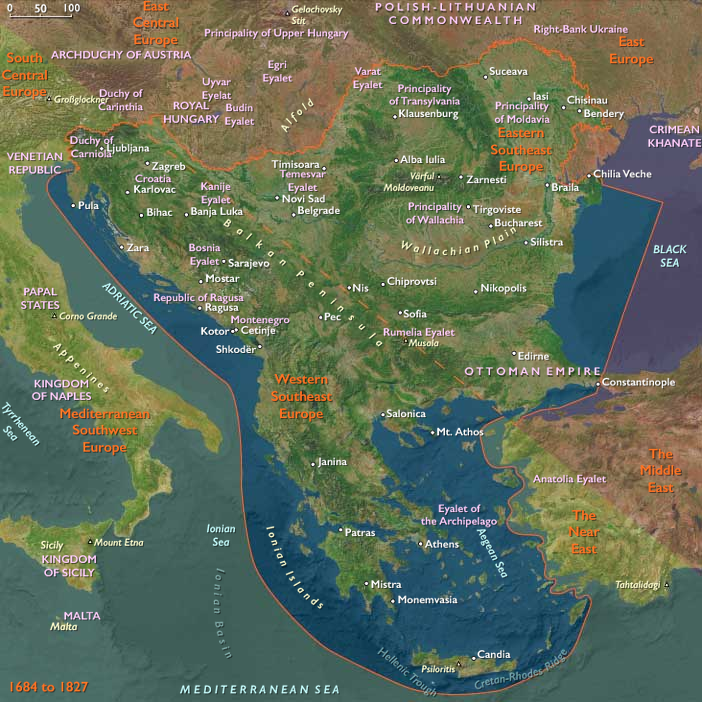
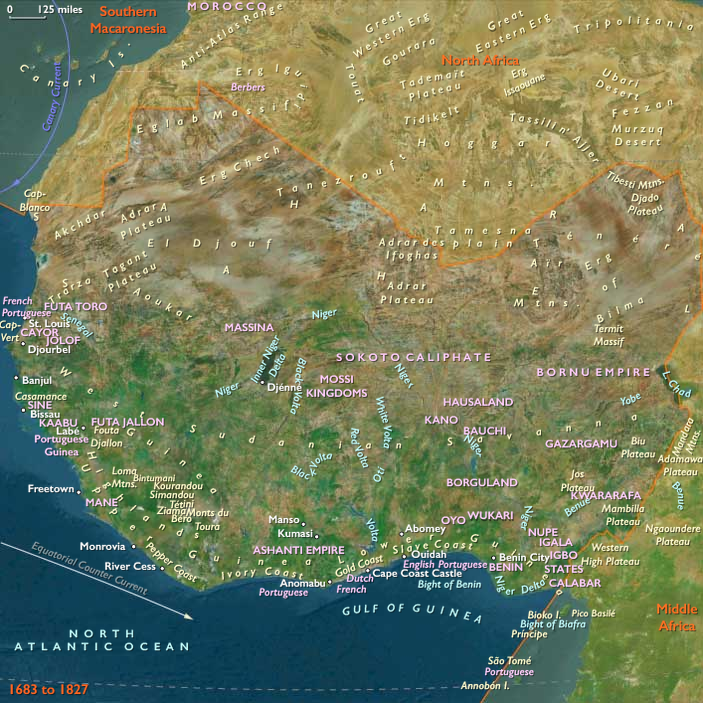
Atlantic Southwest Europe (1684–1827 CE): Port Cities, Iberian Shifts, and the Atlantic Grain–Wine Trade
Geography & Environmental Context
Atlantic Southwest Europe encompasses northern Spain (Galicia, Asturias, Cantabria, and León) and central to northern Portugal, including Lisbon. Anchors include the Galician Rías (Ría de Vigo, A Coruña), the Cantabrian Coast, the Minho and Douro valleys, the Tagus estuary at Lisbon, and the rugged mountains of León and northern Portugal. This is a region of Atlantic-facing coasts, fertile river basins, and upland pastures, with maritime corridors tying Iberia to the broader Atlantic world.
Climate & Environmental Shifts
The tail of the Little Ice Age brought heavy rains and cooler winters. Coastal Asturias and Galicia endured storm surges and erratic fishing seasons. In Portugal, alternating droughts and floods affected the Tagus and Douro, stressing vineyards and grain harvests. The Tambora eruption (1815) caused harvest failures and famines in 1816–1817, driving food shortages and migration. Despite shocks, the region remained buffered by mixed farming and Atlantic fisheries.
Subsistence & Settlement
-
Agriculture: Grain (rye, maize, wheat) dominated northern Spain’s uplands, while vineyards along the Douro Valley produced the famous port wines increasingly exported to Britain. Olive groves and orchards dotted Portugal’s hills.
-
Livestock: Cattle and sheep grazed in León and northern Portugal, supporting cheese and wool exports.
-
Fishing & maritime life: Cod and sardines sustained coasts; Galician fisheries supplied local markets.
-
Urban centers: Lisbon was the linchpin, linking Brazilian sugar, gold, and coffee to Europe; Porto thrived on the wine trade; A Coruña, Santander, Bilbao grew as shipping points for wool, timber, and iron. Rural hamlets persisted in Galicia’s valleys and Portuguese interior, producing subsistence crops and artisanal goods.
Technology & Material Culture
Stone terraces stabilized vineyards in the Douro; irrigation and watermills supported grain processing in León and Galicia. Shipyards along the Tagus and Douro built ocean-going vessels; Portuguese navigational expertise fed the empire. Urban Lisbon rebuilt in grand style after the 1755 earthquake, with wide boulevards and Pombaline architecture. Material culture blended maritime tools, peasant implements, and luxury imports—Brazilian gold funded churches, palaces, and decorative arts.
Movement & Interaction Corridors
-
Transatlantic links: Lisbon was Europe’s primary gateway to Brazil, channeling sugar, gold, diamonds, tobacco, and coffee. The Douro–Porto corridor tied hinterland vineyards to British buyers under the Methuen Treaty (1703), which gave Portuguese wines privileged access to English markets.
-
Spanish Atlantic ports: A Coruña, Bilbao, and Santander shipped wool and iron to northern Europe. Galicia supplied emigrants to the Americas.
-
Inland trade: Mules carried wine, wool, and grain over mountain passes to port cities.
-
War disruptions: During the Peninsular War (1807–1814), French invasions disrupted Portugal and northern Spain, but British naval supremacy kept Lisbon and Porto tied into Atlantic commerce.
Cultural & Symbolic Expressions
-
Religion: Catholicism framed life; pilgrimage routes to Santiago de Compostela remained vital. Monasteries in Galicia and León managed estates and provided poor relief.
-
Urban culture: Lisbon’s intellectual salons and Porto’s mercantile guilds reflected Enlightenment currents; Coimbra University fostered reformist thinkers.
-
Folk traditions: Galician bagpipe (gaita) music, Portuguese fado songs, and rural festivals preserved local identity.
-
Architecture: Baroque churches in Braga, Porto, and Santiago embodied both religious devotion and mercantile prosperity.
Environmental Adaptation & Resilience
-
Diversification: Maize introduction expanded caloric bases in Galicia and Portugal, reducing famine risk.
-
Vineyard specialization: The Douro’s terraced slopes maximized limited arable land, producing high-value exports.
-
Fisheries: Cod and sardine fisheries provided fallback protein during poor harvests.
-
Charitable networks: Monasteries, confraternities, and parish relief assisted during famines and war dislocation.
Transition
From 1684 to 1827, Atlantic Southwest Europe remained both peripheral and central—a rugged agrarian landscape tied to a global empire through Lisbon and Porto. Portuguese fortunes hinged on Brazil until independence (1822), while Porto’s wine trade locked northern Portugal into Britain’s orbit. Northern Spain’s ports grew modestly, sending wool and emigrants to the Atlantic world, while Galicia remained a land of subsistence peasants and pilgrims. Wars, earthquakes, and famines tested resilience, yet the region adapted through maize, wine, fisheries, and Atlantic trade, foreshadowing new realignments in the 19th century as Iberian empires fragmented and Atlantic economies shifted.
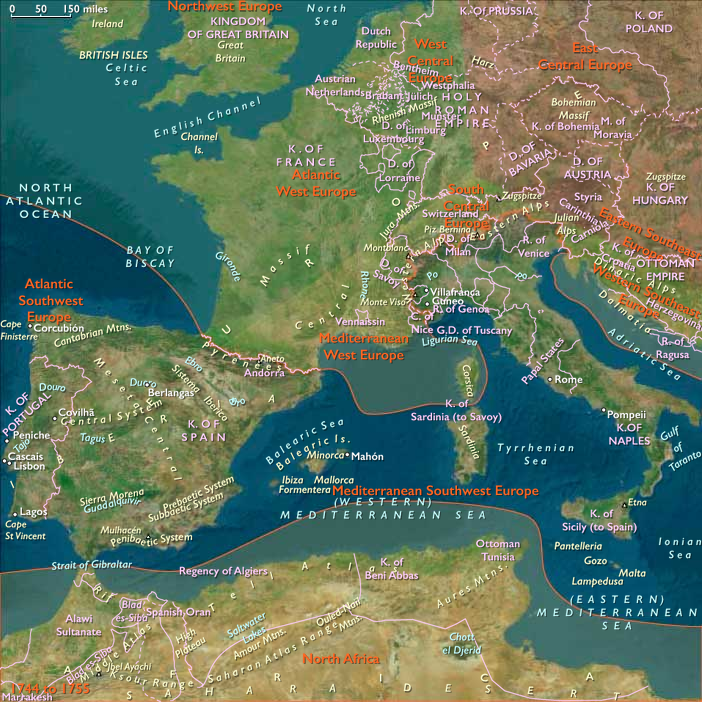
Mediterranean Southwest Europe (1696–1707 CE): Dynastic Shifts and Cultural Innovations
The era 1696–1707 CE in Mediterranean Southwest Europe is shaped by significant dynastic changes, intensified political struggles, and vibrant cultural developments that lay critical foundations for the eighteenth century.
Spain: The End of the Habsburg Dynasty and Succession Crisis
In Spain, the death of Charles II in 1700 marks the end of the Spanish Habsburg line. Severely affected by generations of intermarriage, Charles II's inability to produce an heir triggers a major succession crisis. Despite Habsburg claims, Charles II wills the throne to his grand-nephew, Philip of Anjou, a Bourbon and grandson of Louis XIV of France. Philip ascends as Philip V (1700–1746), igniting fears across Europe of a Franco-Spanish union. The resulting tensions erupt into the War of the Spanish Succession (1702–1714), the first significant European conflict of global scale.
An Anglo-Austrian coalition opposes Bourbon control, supporting Archduke Charles of Austria. Although Castile warmly accepts Philip, Catalonia resists Bourbon centralization, aligning with the Austrians to defend their traditional liberties (fueros). This internal division underscores deep-seated tensions between centralized monarchy and regional autonomy, significantly impacting Spain's internal political landscape.
Italy: Papal Reforms and Cultural Vibrancy
In Italy, the pontificate of Pope Innocent XII (Antonio Pignatelli, 1691–1700) emphasizes moral and administrative reform. Innocent XII vigorously combats nepotism with his landmark bull, Romanum decet Pontificem (1692), promoting meritocracy and austere governance. His successor, Pope Clement XI (Giovanni Francesco Albani, 1700–1721), assumes leadership during turbulent times, navigating between French and Austrian interests amid the Spanish succession turmoil.
This period also witnesses key cultural innovations. In Florence, the invention of the piano by Bartolomeo Cristofori around 1700 revolutionizes musical expression and performance. The vibrant cultural scene continues in cities like Venice and Rome, nurturing the arts, architecture, and opera, even as political uncertainties loom.
Malta: Strategic Consolidation and Medical Leadership
Malta continues its strategic consolidation under the Knights Hospitaller, significantly expanding and fortifying Valletta. Following the previous era's medical advancements, Malta solidifies its reputation in public health through continued improvements at the renowned Sacra Infermeria. These developments enhance Malta's resilience against health crises, reinforcing its strategic importance and cultural sophistication in the Mediterranean.
Broader Cultural and Intellectual Shifts
Throughout Mediterranean Southwest Europe, the influence of the early Enlightenment grows steadily. The ongoing influx of global commodities like coffee, introduced through Venetian commerce with the Ottoman Empire, continues to fuel vibrant intellectual exchanges in coffeehouses across the region. Moreover, theatrical traditions, notably the commedia dell'arte, remain influential, reflecting broader social themes and artistic creativity.
Legacy and Transformation
The era 1696–1707 CE thus represents a dynamic period of dynastic transition, cultural innovation, and intellectual ferment. Spain's succession crisis reshapes European diplomacy, while Italy and Malta experience cultural and strategic advancements. Collectively, these developments set the stage for pivotal transformations in the coming decades.
The acceptance of the Spanish crown by Philip V in the face of counterclaims by Archduke Charles of Austria, who is supported by Britain and the Netherlands, is the proximate cause of the War of the Spanish Succession (1702-14), the first "world war" fought by European powers.
In 1705 an Anglo-Austrian force lands in Spain.
A Franco-Castilian army halts its advance on Madrid, but the invaders occupy Catalonia.
Castile enthusiastically receives the Bourbon dynasty, but the Catalans oppose it, not so much out of loyalty to the Habsburgs as in defense of their fueros against the feared imposition of French-style centralization by a Castilian regime.
Charles II of Spain, the product of generations of inbreeding, is unable to rule and remains childless.
The line of Spanish Habsburgs comes to an end at his death in 1700.
Habsburg partisans argue for allocating succession to the Austrian branch of the Habsburg dynasty, but Charles II, in one of his last official acts, leaves Spain to his nephew, Philip of Anjou, a Bourbon and the grandson of Louis XIV.
This solution appeals to Castilian legitimists because it complies with the principle of succession to the next in the bloodline.
Spanish officials have been concerned with providing for the succession in such a way as to guarantee an integral, independent Spanish state that, along with its possessions in the Netherlands and in Italy, would not become part of either a pan-Bourbon or a pan-Habsburg empire.
''The Pyrenees are no more," Louis XIV rejoices at his grandson's accession as Philip V (r. 1700-46).
The prospect of the Spanish Netherlands falling into French hands, however, alarms the British and the Dutch.
The acceptance of the Spanish crown by Philip V in the face of counterclaims by Archduke Charles of Austria, who is supported by Britain and the Netherlands, is the proximate cause of the War of the Spanish Succession (1702-14), the first "world war" fought by European powers.
In 1705 an Anglo-Austrian force lands in Spain.
A Franco-Castilian army halts its advance on Madrid, but the invaders occupy Catalonia.
Castile enthusiastically receives the Bourbon dynasty, but the Catalans oppose it, not so much out of loyalty to the Habsburgs as in defense of their fueros against the feared imposition of French-style centralization by a Castilian regime.
The matter of Habsburg or Bourbon control of the Spanish crown had been further confused following the death of Joseph Ferdinand of smallpox in 1699 at the age of six, reopening the issue of the Spanish succession.
England and France soon ratify the Second Partition Treaty, assigning the Spanish throne to the Archduke Charles.
The Italian territories will go to France, while the Archduke will receive the remainder of the Spanish empire.
The Austrians, who are not party to the treaty, are displeased, for in the first case they have openly vied for the whole of Spain and its possessions, and in the second it is the Italian territories that interest them most, being richer, closer to Austria, and more governable.
Distaste for the treaty is even greater in Spain; the courtiers are unified in opposing partition, but are divided on whether the throne should go to a Habsburg or a Bourbon.
Pro-French statesmen, however, are in the majority, and Charles II agrees in October 1700 to bequeath all of his territory to the Dauphin's second son, the Duke of Anjou.
Charles takes steps to prevent the potential union of France and Spain; should Anjou by chance inherit the French throne, Spain is to go to his younger brother, the Duc de Berri, and thereafter Archduke Charles will be next in the line of succession.
When the French court first learns of the will of the dying Charles II of Spain, despite the paper victory for the Bourbons, Louis XIV's advisors argue that it is safer to accept the terms of the Second Partition Treaty than to risk war by claiming the whole Spanish inheritance.
However, Jean-Baptiste Colbert, the French foreign minister, successfully argues that whether France accepts all or a part of the Spanish Empire, it will still have to fight Austria, which does not accept the nature of the partition described by the Treaty of London.
Furthermore, the terms of Charles' will stipulate that Anjou is to be offered the choice of the whole Spanish Empire or nothing; if he refused, the entire inheritance is to go to Anjou's younger brother Charles, Duke of Berry or to Archduke Charles of Austria if the Duke of Berry refuses.
Knowing that the Maritime Powers (England and the United Provinces) will not side with France in a fight to impose the partition treaty on the unwilling Austrians and Spanish, Louis determines to accept his grandson's inheritance.
Charles II dies on November 1, 1700, and on November 24, Louis XIV proclaims Anjou as Philip V, King of Spain.
The new King is declared ruler of the entire Spanish empire, contrary to the provisions of the Second Partition Treaty.
The War of the Spanish Succession begins in 1701.
It is an international retaliation to Louis XIV’s acceptance in 1700 of the Spanish crown on behalf of his grandson Philip of Anjou, who has become Philip V, first Bourbon king of Spain.
Leopold I, Holy Roman Emperor, forms the Grand Alliance with England, the Netherlands, Denmark, Portugal, Savoy and Prussia.
Louis XIV allies France with Spain and Bavaria.
Joseph Sauveur, a member of the French Academy, coins the French word acoustique, from which the English word acoustics is derived.
Most European rulers accept Philip as King of Spain, though some only reluctantly.
Depending on one's views of the war as inevitable or not, Louis acts reasonably or arrogantly.
He confirms that Philip V retains his French rights despite his new Spanish position.
Admittedly, he may only have been hypothesizing a theoretical eventuality and not attempting a Franco-Spanish union, but his actions are certainly not read as being innocent.
Moreover, Louis has also sent troops to the Spanish Netherlands, evicting Dutch garrisons and securing Dutch recognition of Philip V. In 1701, he transfers the asiento to France, alienating English traders.
As tensions mounted, Louis decided to acknowledge James Stuart, James II's son, as king on the latter's death, infuriating William III.
These actions enrage England and the United Provinces.