Pope Clement V
head of the Catholic Church
Years: 1264 - 1314
Pope Clement V, born Raymond Bertrand de Got (also occasionally spelled de Guoth and de Goth) (c. 1264 – 20 April 1314) is Pope from 1305 to his death.
He is memorable in history for suppressing the order of the Knights Templar and executing some of its members, and as the Pope who moves the Curia from Rome to Avignon, ushering in the period known as the Avignon Papacy.




Related Events
Filter results
Showing 10 events out of 31 total
King Denis and the Resolution of the Church-Crown Conflict (1279–1325)
The long-standing conflict between the Portuguese Crown and the Church over property rights was finally settled during the reign of King Denis (r. 1279–1325). Determined to assert royal authority over the kingdom’s land and resources, Denis took decisive action to curb the Church’s unchecked accumulation of property.
The Deamortization Laws and Excommunication (1284–1285)
- In 1284, King Denis launched a new round of inquiries into Church landholdings.
- The following year (1285), he issued deamortization laws, which prohibited the Church and religious orders from purchasing land and required them to sell all properties acquired since the start of his reign.
- This action led to Denis’s excommunication, following the precedent of his father (Afonso III) and grandfather (Afonso II), both of whom had clashed with the papacy over land reform.
- Unlike his predecessors, however, Denis refused to submit to papal authority, securing once and for all the Portuguese Crown’s control over royal patrimony.
The Nationalization of Military Orders
Denis’s assertion of royal supremacy over land extended to military-religious orders, which had amassed vast wealth and influence during the Reconquista. By nationalizing these orders, Denis ensured that their resources would serve the kingdom rather than remain under foreign or papal control.
- The Order of Avis (1280s) – Originally a Castilian military order (the Calatravans), the knights became effectively Portuguese when King Afonso II granted them the town of Avis. Under Denis, the Order of Avis remained a dedicated military force, later playing a key role in Portugal’s independence from Castile.
- The Order of Saint James (Santiago) (1288) – Although founded in Castile, the Portuguese knights of the order elected their own master in 1288, effectively separating themselves from Castilian control.
- The Suppression of the Templars and the Order of Christ (1312) – When Pope Clement V dissolved the Templars, their immense landholdings were initially transferred to the Hospitallers. However, King Denis successfully petitioned the pope to grant the Templars’ Portuguese wealth to a new military-religious order, the Order of Christ, founded in 1319 and originally based at Castro Marim before moving to Tomar.
The Legacy of the Military Orders
After their nationalization, most of these military-religious orders transitioned into chivalric landowning institutions, becoming quasi-celibate noble orders responsible for governing vast estates. However, two orders retained military significance:
- The Order of Avis remained a combat-ready force, playing a major role in securing Portugal’s independence from Castile.
- The Order of Christ retained military and religious functions, but more importantly, its vast wealth later funded Prince Henry the Navigator’s early voyages of discovery, financing Portugal’s maritime expansion in the 15th century.
Conclusion
King Denis’s bold assertion of royal control over land, wealth, and military orders ensured that Portugal’s resources remained under the Crown’s authority rather than the Church’s influence. His reforms not only strengthened the monarchy but also laid the foundations for Portugal’s later dominance in exploration and global trade.
The Election of Clement V and the Beginning of the Avignon Papacy (1305–1309)
The deadlocked papal conclave of 1305 culminated in the election of Clement V, a Frenchman, following a period of intense political strife between Pope Boniface VIII and King Philip IV of France. The conflict had reached its peak in 1303, when Boniface was briefly captured and humiliated at Anagni by agents of Philip IV. His successor, Benedict XI, reigned for only eight months before dying in 1304, deepening the crisis.
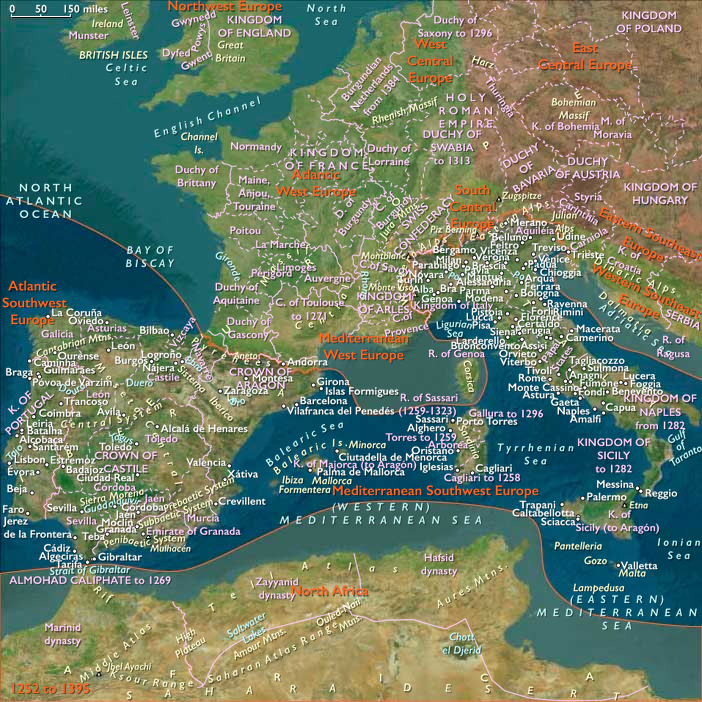
When the conclave finally settled on Clement V—who was not even present at the proceedings in Perugia—his election marked a significant shift in papal politics. Instead of relocating to Rome, he remained in France, avoiding the turbulent factional struggles of the Italian city-states. In 1309, he officially moved the papal court to Avignon, a papal enclave on the Rhone River, where the papacy would remain for sixty-seven years, a period later known as the Avignon Papacy (1309–1376).
This decision significantly weakened Rome's status as the center of Christendom and placed the papacy under increased French influence, a situation that would fuel tensions with both Italian factions and the Holy Roman Empire. The Avignon Papacy would eventually give rise to the Western Schism (1378–1417), deepening divisions within the Catholic Church.
The Decline of the Templars and Rising Suspicion (c. 1304)
By 1304, the Knights Templar, once a powerful and revered military order, had become increasingly vulnerableas their original crusading mission waned. Though the order remained wealthy, influential, and deeply integrated into daily life across Christendom, tensions with European rulers, particularly King Philip IV of France, were beginning to rise.
The Templars' Ongoing Influence and Growing Hostility
- Over two centuries, the Templars had established a vast network of estates, farms, vineyards, and businesses, making them a central part of the medieval economy.
- Hundreds of Templar Houses across Europe functioned as banks, safe storage facilities, and administrative centers, meaning that ordinary people interacted with the order regularly.
- Despite their economic and social presence, the Templars remained independent of local authorities, directly accountable only to the Pope, making them a “state within a state.”
- Their standing army, though no longer serving a clear military mission, could move freely across borders, further alarming European rulers and nobility.
Tensions Over Templar Expansion and Monastic State Ambitions
- The Templars' influence rivaled that of secular and ecclesiastical rulers, leading to suspicions and resentment among European nobility.
- There were indications that the order was considering founding its own monastic state, similar to:
- The Teutonic Knights in Prussia, who had established a quasi-sovereign crusader state.
- The Knights Hospitaller in Rhodes, who were consolidating their independent stronghold in the eastern Mediterranean.
- The idea of an independent Templar-controlled territory posed a direct threat to monarchs who already resented the order’s exempt status and financial power.
The Rise of Accusations and Rumors (1304)
- By 1304, rumors began to spread throughout Europe, alleging that the Templars engaged in irreligious and blasphemous practices during their secret initiation rites.
- These accusations—likely false—suggested acts of heresy, including denying Christ, spitting on the cross, and engaging in unnatural rites.
- Though initially dismissed as slander, such rumors would later be weaponized by King Philip IV of France in his campaign to dismantle the Templars.
Jewish Persecution in Northern France (1304)
Meanwhile, in northern France, Jewish communities, many of whom were recent émigrés from England after their expulsion in 1290, faced new legal restrictions:
- While Jews were still permitted to live in France, they were subjected to increasingly severe bans on economic activity and residency.
- Philip IV had heavily taxed Jewish communities before their temporary expulsion in 1306, further destabilizing their presence in the region.
A Pivotal Moment: The Templars at Risk
By 1304, the Templars stood at a precarious crossroads:
- Their once-glorious military role was fading, but they remained a powerful economic and political force.
- Rivalries with monarchs, particularly Philip IV, combined with growing rumors of heresy, foreshadowed their impending downfall.
- In just a few years (1307), the order would face one of the most infamous mass arrests in medieval history, leading to its dissolution in 1312.
Meanwhile, Jewish communities in France faced intensifying persecution, signaling a broader trend of financial exploitation and forced displacement that would culminate in their expulsion in 1306.
Pope Benedict XI had lasted only nine months before dying in exile.
After an eleven-month interregnum occasioned by the disputes between the French and Italian cardinals, who are nearly equally balanced in the conclave, which had had to be held at Perugia, the conclave decides in June on Raymond Bertrand de Got.
Born in Villandraut, Aquitaine, Bertrand had been canon and sacristan of the Cathedral of Saint-André in Bordeaux, then vicar-general to his brother, the archbishop of Lyon, who in 1294 had been created Cardinal Bishop of Albano.
He had then been made bishop of St-Bertrand-de-Comminges, the cathedral church of which he was responsible for greatly enlarging and embellishing; and chaplain to Pope Boniface VIII, who had made him archbishop of Bordeaux in 1297.
Bertrand is neither Italian nor a cardinal, and his election might have been considered a gesture towards neutrality.
The contemporary chronicler Giovanni Villani reports gossip that he had bound himself to King Philip IV of France by a formal agreement previous to his elevation, made at St. Jean d'Angély in Saintonge.
Whether this is true or not, it is likely that the future Pope Clement V has conditions laid down for him by the conclave of cardinals.
Bertrand, at Bordeaux, had been formally notified of his election and urged to come to Italy, but he selects Lyon for his coronation, November 14, 1305, which is celebrated with magnificence and attended by Philip IV.
He takes the name Clement V. Among his first acts is the creation of nine French cardinals.
Rumors about the Templars' secret initiation ceremony have created mistrust, and Philip IV of France, deeply in debt to the Order, takes advantage of the situation.
The new Pope sends letters to both the Templar Grand Master Jacques de Molay and the Hospitaller Grand Master Fulk de Villaret to discuss the possibility of merging the two Orders.
Neither is amenable to the idea but Pope Clement persists.
Clement also threatens Jews with an economic boycott in an attempt to force them to stop charging Christians interest on loans.
The Foundation of the University of Orléans and Its Recognition (1230–1306)
The University of Orléans emerged as one of the earliest universities in France, with its origins tracing back to the early 13th century. Initially a center for legal studies, the university played a significant role in medieval scholarship, particularly in canon and civil law.
Origins and Early Development (1230–1268)
-
In 1230, during a period of unrest at the University of Paris, many teachers and disciples sought refuge in Orléans, establishing a thriving intellectual community there.
-
The institution was formally founded in 1235, making it:
- One of the earliest universities outside Italy.
- The second oldest university in France, after the Sorbonne (Paris).
- Founded only two years after Cambridge (1233) and Toulouse (1233).
-
The University of Orléans quickly gained prestige, particularly in the study of law, and became a recognized center for both civil and canon law instruction.
Papal Involvement and Academic Recognition
- In 1268, when Pope Boniface VIII promulgated the Sixth Book of the Decretals, he designated the doctors of Bologna (the foremost center of legal studies) and the doctors of Orléans to provide commentaries on the text, demonstrating the university’s growing importance in legal education.
- St. Yves of Tréguier (1253–1303), later revered as the patron saint of lawyers, studied civil law at Orléans, further reinforcing its reputation.
- Clement V, who later became pope (1305–1314), also studied law and letters at Orléans, highlighting the university’s role in shaping key ecclesiastical figures.
Papal Recognition as a University (1306)
- On January 27, 1306, Pope Clement V issued a Papal Bull at Lyon, officially granting the Orléans institutes the title and privileges of a university.
- This recognition formally elevated Orléans to the same status as Paris and Bologna, consolidating its role as a leading center for legal scholarship in medieval Europe.
Legacy
- The University of Orléans remained one of Europe’s foremost institutions for legal studies, particularly during the late medieval and early Renaissance periods.
- Its graduates influenced legal thought across Europe, contributing to the development of civil and canon law traditions.
- The papal recognition in 1306 solidified Orléans as one of the premier centers of higher education in France, second only to Paris' Sorbonne in prestige.
The formal establishment of the University of Orléans in 1306 was a significant milestone in medieval academia, reinforcing France’s prominence in legal education and shaping the intellectual landscape of Europe for centuries to come.
Pope Clement had invited both Grand Masters to France in 1306 to discuss the matter of the accusations against them.
De Molay had arrived first in early 1307, but de Villaret had been delayed for several months.
While waiting, De Molay and Clement have discussed charges that had been made two years prior by an ousted Templar.
It is generally agreed that the charges are false, but Clement sends King Philip IV of France a written request for assistance in the investigation.
King Philip is already deeply in debt to the Templars from his war with the English and decides to seize upon the rumors for his own purposes.
He begins pressuring the Church to take action against the Order, as a way of freeing himself from his debts.
On Friday, October 13, 1307, Philip orders de Molay and scores of other French Templars to be simultaneously arrested, and sequesters all the Templars' property in France.
The Templars are charged with numerous heresies and tortured to extract false confessions of blasphemy.
The trials are based on these confessions, despite having been obtained under duress, caused a scandal in Paris.
After more bullying from Philip, Pope Clement then issues the bill Pastoralis Praeeminentiae on November 22, 1307, which instructs all Christian monarchs in Europe to arrest all Templars and seize their assets.
The University of Perugia, one of the "free" universities of Italy, is established as a studium generale on September 8, 1308, by the Bull "Super specula" of Clement V. A school of arts had existed by about 1200, in which medicine and law were soon taught, with a strong commitment expressed by official documents of the City Council of Perugia.
Before 1300 there were several universitates scholiarum.
Attacks similar to those in France are mounted against the Order of the Knights Templar in Spain and England, but Scotland remains a safe haven to which many Templars flee, allegedly taking their treasure with them, or alternately, secreting it somewhere in France.
Charles stands alone as claimant to the throne of Hungary after Otto's escape from Transylvanian captivity, but large parts of his kingdom are under the rule of powerful aristocrats and even his alleged partisans ignore his royal prerogatives.
His position slightly strengthens when the legate of Pope Clement V arrives in Hungary in June 1308 and persuades Máté Csák to recognize Charles' reign on their meeting in the Monastery of Kékes.
Máté Csák is also present on November 27, 1308, at the assembly in Pest, where Charles is again proclaimed King of Hungary.