Rahmah ibn Jabir al-Jalahimah
Arab ruler in the Persian Gulf
Years: 1760 - 1826
Rahmah ibn Jabir al-Jalahimah (c. 1760–1826) is an Arab ruler in the Persian Gulf and is described by his contemporary, the English traveler and author, James Silk Buckingham, as ‘the most successful and the most generally tolerated pirate, perhaps, that ever infest any sea.’ (James Silk Buckingham, Travels in Assyria, Media, and Persia, Oxford University Press, 1829, p366)

Related Events
Filter results
Showing 5 events out of 5 total
he Middle East: 1792–1803 CE
Expansion and Assertiveness of the Saudi-Wahhabi State
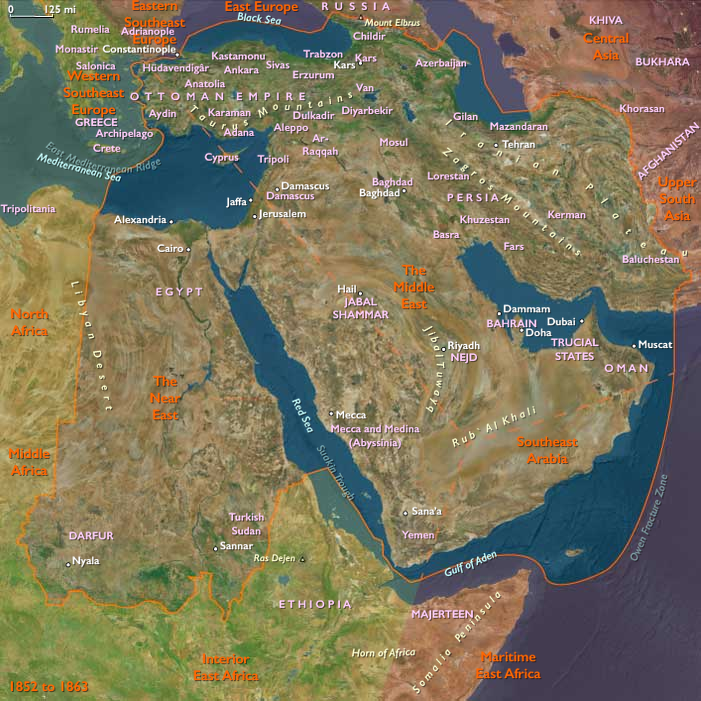
Under the determined leadership of Abdul Aziz ibn Muhammad ibn Saud, the Saudi-Wahhabi state continues its aggressive expansion throughout Arabia. By the early 1790s, Saudi forces solidify control over key strategic and economic centers, further entrenching their dominance and extending strict Wahhabi practices. This aggressive campaign culminates in the conquest of Ta'if in 1802 and the subsequent Wahhabi siege of the sacred city of Mecca in 1803. These successes not only boost their prestige but significantly enhance their economic and political leverage across the Arabian Peninsula.
Qajar Consolidation and Regional Influence
In Persia, the Qajar dynasty, under the firm rule of Agha Mohammad Khan Qajar and, following his assassination in 1797, his successor Fath-Ali Shah Qajar, continues to strengthen its political control. Agha Mohammad Khan decisively consolidates Persian territories, notably reclaiming Khorasan and establishing firm control over Georgia by reconquering Tbilisi in 1795. Following his death, Fath-Ali Shah maintains internal stability, secures the borders, and continues the centralization of administrative and military structures, laying the groundwork for Persia's future stability.
Continued Maritime Dominance of Oman
Under Sultan bin Ahmad al-Busaidi (1792–1804), Oman solidifies its maritime and commercial dominance. Sultan bin Ahmad expands naval capabilities and reinforces control over strategic coastal ports and islands along the Persian Gulf and the Indian Ocean. The bustling port of Muscat remains an essential hub for trade, linking Persia, India, and East Africa. Oman's ruling family divides in 1793 into two main lines, with Sultan bin Ahmad's lineage controlling the maritime state, and the Qais branch overseeing the Al Batinah and Ar Rustaq regions. This maritime prosperity supports internal political cohesion and ensures the continued wealth and prominence of the Al-Busaidi dynasty.
Tribal Dynamics and Economic Prosperity in the Persian Gulf
In Qatar, the economic boom in Az Zubarah persists, driven by thriving trade and pearl diving. Tribal rivalries, notably between the Al Khalifa and the Al Jalahima clans, intensify significantly. In 1795, these rivalries culminate in the Al Khalifa conquest of Bahrain, shifting their economic focus away from Az Zubarah, which subsequently declines. The Al Jalahmas, dissatisfied with the Al Khalifa's claims, relocate along the Qatari coast to establish Al Khuwayr, becoming feared maritime raiders, particularly under their leader, Rahman ibn Jabir Al Jalahma. Meanwhile, the Al Thani clan maintains its presence in Qatar, increasingly aligned with Wahhabi principles.
The Al bu Falah clan establishes their headquarters at the site of Abu Dhabi town in 1795, allying themselves strategically with the Sultanate of Muscat and Oman against their rivals, the Qawasim pirates of Ra's al-Khaimah and ash-Shariqah sheikhdoms.
Further Decline of Ottoman Influence and Growing Tribal Autonomy
Ottoman authority over its Arab territories continues to wane dramatically, as powerful tribal confederations such as the Muntafiq and the Kurdish Baban Dynasty maintain considerable autonomy in Iraq and Kurdistan, respectively. The weakening grip of the Ottomans results in frequent clashes and localized governance, underscoring the Empire's inability to effectively administer distant provinces. The declining Ottoman presence encourages the further rise of independent tribal and regional leaders, who increasingly negotiate their positions with minimal Ottoman interference.
Legacy of the Era
The era from 1792 to 1803 marks a critical period of territorial and political consolidation for the Saudi-Wahhabi state and the Qajar dynasty, as well as sustained maritime economic prosperity for Oman. The fragmentation of Ottoman authority, coupled with dynamic tribal rivalries and shifting economic fortunes in the Persian Gulf region, establishes enduring patterns of decentralized governance and localized autonomy, significantly shaping the geopolitical landscape of the Middle East for decades to follow.
The Al Jalahmas, angered by the Al Khalifah clan's claim to sovereignty over Bahrain and feeling deprived of their rightful share of the spoils, move a few kilometers up the Qatari coast to establish Al Khuwayr.
They use this as a staging point for maritime raids against the shipping of the Al Khalifa and the Iranians.
Most of the Al Khalifa migrate to the more desirable location of Bahrain and establish a shaykhdom.
That they leave only a token presence in Az Zubarah means initially that the Al Jalahma branch can achieve ascendancy in Qatar, with their leader, Rahman ibn Jabir Al Jalahma, earning a reputation as one of the most feared raiders on the surrounding waters.
The British regard Sheikh Jabir as a leading pirate of the so-called Pirate Coast.
Because the Al Khalifa shift their trade connections to Bahrain, however, their departure also means that with the economic decline of Az Zubarah, the peninsula will return to its former status as a relative backwater.
At the close of the 18th century, Qatar's population consists of nomadic and settled Arabs and a significant proportion of slaves brought originally from East Africa.
The Middle East: 1804–1815 CE
Expansion and Confrontation of the Saudi-Wahhabi State
Under the leadership of Saud ibn Abdul Aziz ibn Muhammad ibn Saud, the Saudi-Wahhabi state continues its territorial and ideological expansion. In 1805, Saudi forces successfully complete their conquest of the Hijaz, firmly controlling the holy cities of Mecca and Medina, significantly elevating their prestige across the Muslim world. The enforcement of strict Wahhabi practices provokes widespread resistance and hostility, especially among traditional Ottoman authorities. This tension ultimately escalates into a direct confrontation, with the Ottomans urging Muhammad Ali Pasha, the ambitious governor of Egypt, to launch a campaign aimed at reclaiming Hijaz from Wahhabi control.
Muhammad Ali's forces begin their decisive military campaign against the Saudis in 1811, marking the start of the Ottoman-Saudi War, which is intended to restore Ottoman prestige and authority across the Arabian Peninsula.
Qajar Dynasty: External Pressures and Internal Challenges
In Persia, Fath-Ali Shah Qajar (1797–1834) faces mounting pressures from both external rivals and internal dissent. Continuous conflict with Russia results in substantial territorial losses after the Treaty of Gulistan in 1813, where Persia cedes significant territories in the Caucasus, including Georgia, to Russian control. Georgia had been gradually annexed by Russia starting in 1801, with eastern regions incorporated in 1801 and western areas in 1804. These losses deeply affect Persian morale and economic strength. Domestically, Fath-Ali Shah strives to maintain central authority amid tribal dissent and regional uprisings, significantly challenging his governance and necessitating careful political maneuvering.
British Influence and Maritime Rivalries in Oman
Following Sultan bin Ahmad al-Busaidi's death in 1804, Oman experiences significant political fragmentation and family disputes over succession. His successor, Said bin Sultan al-Busaidi, initially co-rules with his brother Salim but becomes sole ruler after assassinating their usurper cousin, Badr, in 1806. Said bin Sultan consolidates his authority in Muscat, drawing intensified British interest in Oman's strategic maritime routes. This foreign involvement strengthens Oman's international trade but also brings increased tensions and maritime rivalries, particularly against the aggressive Qawasim pirates of Ra's al-Khaimah and ash-Shariqah, leading to multiple British punitive expeditions. In 1798, Oman had already entered a treaty with the British East India Company to counter threats from the Wahhabi-Saudi alliance.
Escalating Tribal Conflicts and Economic Shifts in the Persian Gulf
In Qatar and the broader Gulf region, tribal conflicts escalate, reshaping political alignments and local economies. The Al Khalifa solidify their control over Bahrain, significantly boosting their economic prospects at the expense of their former base in Az Zubarah, which continues its decline. Meanwhile, Rahman ibn Jabir Al Jalahma and the Al Jalahma tribe intensify maritime raids from Al Khuwayr, severely disrupting regional trade and earning Sheikh Jabir notoriety as a leading pirate.
The Al Thani clan consolidates its influence in Qatar, further adopting Wahhabi ideals to resist rival factions, especially the non-Wahhabi Al Khalifa. The Al Thani’s Wahhabi affiliations influence their political strategies and alliances.
The establishment of Abu Dhabi by the Al bu Falah continues to strengthen as a strategic center, aligning closely with Oman against mutual adversaries like the Qawasim pirates. Abu Dhabi grows in prominence as a commercial hub and a crucial center for regional maritime security.
Ottoman Decline and Rise of Muhammad Ali in Egypt
The weakening Ottoman Empire sees significant territorial and political erosion. The ambitious Albanian governor of Egypt, Muhammad Ali Pasha, becomes increasingly autonomous, responding assertively to the Ottoman call to curb Wahhabi expansion in the Arabian Peninsula. His assertive policies significantly reshape Egyptian autonomy and Ottoman relations.
Legacy of the Era
The period from 1804 to 1815 witnesses significant geopolitical shifts, marked by intensified Saudi-Ottoman confrontations, Persian territorial losses, and increased British maritime intervention. These developments solidify regional power dynamics, notably through the growing autonomy of Muhammad Ali in Egypt, the sustained influence of British maritime policies, and increased tribal fragmentation and rivalry in the Persian Gulf, setting enduring precedents for future regional interactions and conflicts.
The Middle East (1816–1827): Revival of the Al Saud and British Consolidation in the Gulf
Egyptian Intervention and the Fall of the First Saudi State
The modern history of the Arabian Peninsula is often divided into periods reflecting the fortunes of the Al Saud family. The first period began in 1744 with the alliance between Muhammad ibn Saud and the reformist religious leader Muhammad ibn Abd al-Wahhab, culminating in the establishment of the first Saudi-Wahhabi state. However, by 1818, Egyptian forces under Ibrahim Pasha, son of Egypt’s powerful ruler Muhammad Ali, dramatically altered the political landscape.
After capturing Ad Diriyah, the Saudi capital, Egyptian troops razed its walls, leveled buildings, and destroyed palm groves to ensure the city could no longer sustain life or resist reoccupation. Abdullah ibn Saud, the last ruler of the first Saudi state, was captured, sent to Istanbul, and publicly executed, signifying the apparent end of the Al Saud’s rule.
Revival of Al Saud Authority under Turki ibn Abdullah
Despite these catastrophic setbacks, the Al Saud lineage endured. Turki ibn Abdullah, a cousin and loyal commander who escaped the destruction of Ad Diriyah, became the pivotal figure in restoring Saudi authority. Having evaded capture by hiding among loyal tribesmen, he recaptured the ruins of Ad Diriyah in 1821, and then swiftly moved his base of operations to Riyadh, establishing it as the new center of power.
By 1824, Turki ibn Abdullah had reasserted Al Saud and Wahhabi rule over most of Najd, confirming the resilience and deep-rooted appeal of the Al Saud-Wahhabi alliance. This swift restoration of power underscored how firmly Wahhabi religious and political legitimacy had taken hold among the tribes of central Arabia.
Consolidation of Al Saud Influence in Central Arabia
From Riyadh, Turki ibn Abdullah extended his authority across a vast area of central Arabia. His rule combined direct control and strategic alliances, maintaining influence northward into Jabal Shammar through close ties with the influential Rashidi clan. Turki’s son, Faisal, later solidified this relationship through marriage, linking the two prominent families.
In eastern Arabia and along the Persian Gulf coast, Turki preferred to govern indirectly, appointing loyal local leaders who acknowledged Al Saud supremacy. Elsewhere, he secured agreements with tribes, extracting tribute and securing promises of neutrality or support, thus creating a complex but effective web of allegiance.
Religious Authority and Tribute Collection
Crucially, Turki’s reign was underpinned by Wahhabi religious authority. Al Saud leaders following the death of Muhammad ibn Abd al-Wahhab in 1792 had assumed the title of Imam, signifying combined religious and political leadership. This added dimension of legitimacy allowed them to mobilize tribes for military campaigns, often described as jihad. Tributes and taxes collected under their rule conformed to Islamic sharia principles, further embedding the regime’s religious legitimacy within its political structure.
British Intervention and the Emergence of the Trucial System in the Gulf
In the Persian Gulf region, escalating maritime conflict compelled Britain to intervene decisively. Persistent piracy by the Qawasim (Al Qasimi) tribes, particularly from strongholds in what is now the United Arab Emirates, posed a severe threat to British commercial and naval interests. By 1820, Britain responded forcefully, destroying key pirate bases such as Ras al-Khaimah, and compelling local rulers to sign treaties forbidding piracy and warfare at sea. These agreements initiated the “Trucial System,” which eventually evolved into the modern states of the UAE.
Omani Sultanate under Said ibn Sultan
Simultaneously, Oman under Said ibn Sultan Al Sa'id navigated complex challenges. Although Europeans often called Said “Imam,” he himself preferred the secular title of Sayyid, distancing himself from traditional Ibadi religious leadership. His reign saw ongoing tribal divisions, British pressure to halt the slave trade, and encroachments by Wahhabi forces from central Arabia. In response to British demands, Said signed a treaty in 1822, pledging not to sell slaves to subjects of Christian powers. Though Said’s power over Oman proper weakened after 1820, his maritime state expanded economically through trade in coffee, slaves, dates, and pearls, firmly embedding Oman within the global commercial network.
Legacy of the Era (1816–1827)
The period from 1816 to 1827 established several lasting legacies:
-
The resilient Al Saud, despite Egypt’s devastating military interventions, demonstrated their enduring power and legitimacy by reasserting Wahhabi rule from their new stronghold in Riyadh.
-
Britain’s decisive naval interventions along the Persian Gulf initiated a series of treaties, laying the foundations for the Trucial States and setting the stage for long-term British influence in the region.
-
Omani maritime trade, consolidated under Said ibn Sultan, connected the Gulf and East Africa more deeply into the global economy, albeit accompanied by European pressures to curtail the slave trade.
Thus, the era from 1816 to 1827 was marked by political revival, foreign intervention, and shifting alliances, setting patterns of governance and external influence that shaped the Middle Eastern geopolitical landscape into the modern era.
The Middle East: 1816–1827 CE
Defeat and Reorganization of the Saudi-Wahhabi State
The Ottoman-Saudi War, initiated by Muhammad Ali Pasha, governor of Egypt, achieves significant successes. By 1818, Muhammad Ali's forces, led by his son Ibrahim Pasha, decisively capture the Saudi capital of Ad Diriyah, effectively crushing the First Saudi State. Abdullah ibn Saud, the Saudi leader, is captured and later executed in Constantinople, marking a decisive Ottoman victory. Although the Saudi political structure collapses, Wahhabi religious doctrines persist throughout the Arabian Peninsula, maintaining influence among local tribes and providing the ideological foundation for future Saudi resurgence.
Following the fall of Ad Diriyah, Muhammad Ali restores the authority of the ashraf, traditional rulers in Mecca since the tenth century. To consolidate Egyptian authority, garrisons are placed strategically across the peninsula, including at the important port of Al Qatif on the Persian Gulf and along the Red Sea coast.
Despite these setbacks, Turki ibn Abd Allah, an uncle of former ruler Saud, escapes Egyptian capture and, after hiding among loyalists, recaptures Ad Diriyah in 1821. He subsequently establishes the new Al Saud base in Riyadh by 1824. The swift reestablishment of control demonstrates the lasting influence and appeal of Wahhabi doctrine. After the death of Muhammad ibn Abd al Wahhab in 1792, Al Saud leaders adopt the title of imam, granting them both political and religious authority, significantly strengthening their legitimacy and influence in central Arabia.
Qajar Dynasty: Continued Pressure and Territorial Losses
Under Fath-Ali Shah Qajar, Persia endures further setbacks following renewed conflict with Russia. The Russo-Persian War (1826–1828), initiated by Persia in an attempt to regain territories lost under the Treaty of Gulistan, ends disastrously for the Qajars. Despite initial victories, Persian forces are decisively defeated, culminating in the later Treaty of Turkmenchay (1828), which imposes severe territorial losses and heavy financial indemnities. This period exacerbates internal pressures on the Qajar Dynasty, highlighting its military and administrative weaknesses.
British Dominance and Maritime Stability in Oman
Said bin Sultan al-Busaidi continues to solidify his rule in Oman, enhancing economic stability through increased cooperation with British maritime power. His reign faces challenges from family and tribal disputes, growing Anglo-French rivalry in the Indian Ocean, the expansion of the Al Saud-Wahhabi movement, and persistent piracy from the Qawasim tribes, resulting in the area being labeled the “Pirate Coast.” To protect shipping, Great Britain initiates treaties with regional leaders starting in 1820, effectively outlawing sea battles and significantly reducing piracy.
By 1820, Oman loses control over parts of the southern Persian Gulf coast, effectively cutting off direct gulf access. Nonetheless, Said bin Sultan develops a modest military and naval fleet, supporting mercantile interests. Coastal Arabia becomes increasingly integrated into the global economy through the trade of coffee, slaves, pearls, and dates, along with pilgrimage routes to Mecca. Although pressured by Britain to suppress the slave trade, Said bin Sultan acknowledges the difficulty, signing an agreement in 1822 that forbids selling slaves to Christian subjects.
Tribal Dynamics and Power Shifts in the Persian Gulf
The departure of the Al Khalifa to Bahrain and the economic decline of Az Zubarah leave a power vacuum in Qatar, allowing the Al Thani clan to further consolidate their power and influence. The Al Jalahma remain significant players in maritime activities from their base at Al Khuwayr, although the severity of their piracy declines significantly following increased British naval patrols.
In Abu Dhabi, the Al bu Falah continue strengthening their position, bolstered by close ties with Oman and British authorities. This enhances Abu Dhabi's economic and political importance, particularly regarding maritime security and regional trade.
Muhammad Ali's Growing Autonomy and Regional Influence
Muhammad Ali Pasha further consolidates his political autonomy from the weakened Ottoman central authority. Following his successful campaign against the Saudi state, he embarks on extensive modernization programs in Egypt, strengthening military, agricultural, and industrial capabilities. This significantly elevates Egypt's regional status, laying the groundwork for future independent actions against Ottoman interests and expanding his political influence into neighboring territories.
Legacy of the Era
Between 1816 and 1827, major geopolitical shifts redefine the Middle East. The collapse of the Saudi-Wahhabi state temporarily stabilizes Ottoman authority in Arabia, although Wahhabi influence endures and quickly reasserts itself under new leadership in Riyadh. Persian territorial losses underscore the vulnerability of the Qajar Dynasty, while British maritime interventions decisively curb regional piracy and enhance trade stability. Muhammad Ali's increased autonomy signals a profound shift in Ottoman-Egyptian dynamics, setting the stage for significant transformations across the broader Middle East.