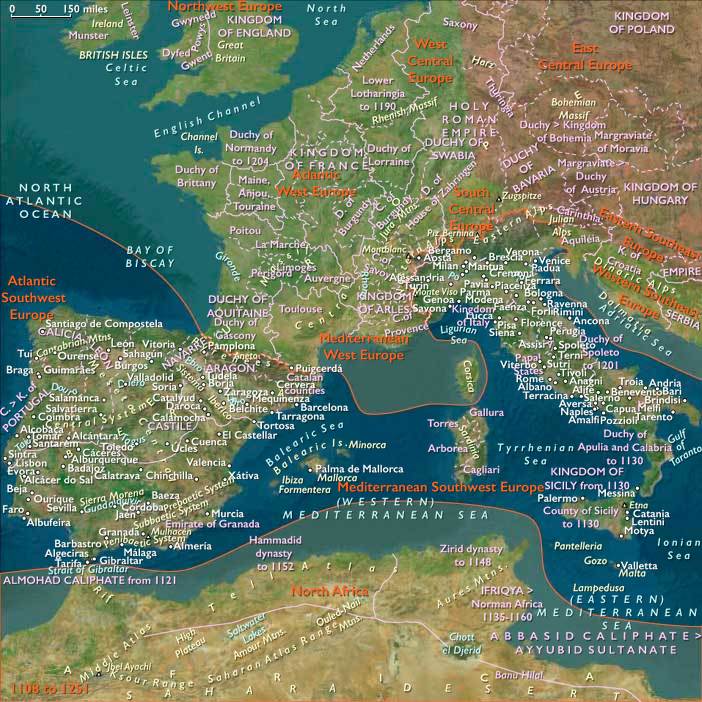
The crusaders’ next major target is Carcassonne, a town well-fortified but vulnerable and overpopulated with refugees.
The crusaders, led by a papal legate, Arnaud Amaury, Abbot of Cîteaux, arrive outside the town on August 1, 1209.
As vassal of King Peter II of Aragon, Raymond-Roger had hoped for protection, but Peter is powerless to oppose what is effectively a papal army and can act only as a mediator.
The siege does not last long.
By August 7, the crusaders have cut the town's access to water.
Raymond-Roger accepts a safe-conduct to negotiate terms of surrender in the Crusader camp.
At the conclusion of these negotiations he is taken prisoner while still under safe conduct, and imprisoned in his own dungeon, where he will die in November, possibly of dysentery, though there are suspicions of poisoning.
The town of Carcassonne had surrendered on August 15.
The inhabitants are not massacred but were forced to leave the town.
Simon de Montfort is granted control of the area encompassing Carcassonne, Albi, and Béziers.
When most of the crusaders depart after the 40-day term they had promised to serve, he is left with large territories still to conquer.
Jews are removed from office and their children are forcibly baptized.
Raymond-Roger's dispossessed son, Raymond II (1204-1263), will formally cede his rights to Louis IX of France in 1247, after several failed attempts to recover his patrimony.