
Roderic
Visigothic King of Hispania
688 CE to 712 CE
Ruderic (also spelled Roderic, Roderik, Roderich, or Roderick; Spanish and Portuguese: Rodrigo, died 711 or 712) is the Visigothic King of Hispania for a brief period between 710 and 712.
He is famous in legend as "the last king of the Goths".
In history he actually is an extremely obscure figure about whom little can be said with certainty but that he ruled part of Iberia with opponents ruling the rest and was defeated and killed by invading Muslims who soon conquered most of the peninsula.
His widow Egilona is believed to have married Abd al-Aziz ibn Musa, who was later assassinated.
The above circumstances have caused the name "Roderic" and its various variants to remain in use up to the present, unlike many other Germanic names of the time which had faded into obscurity.
World
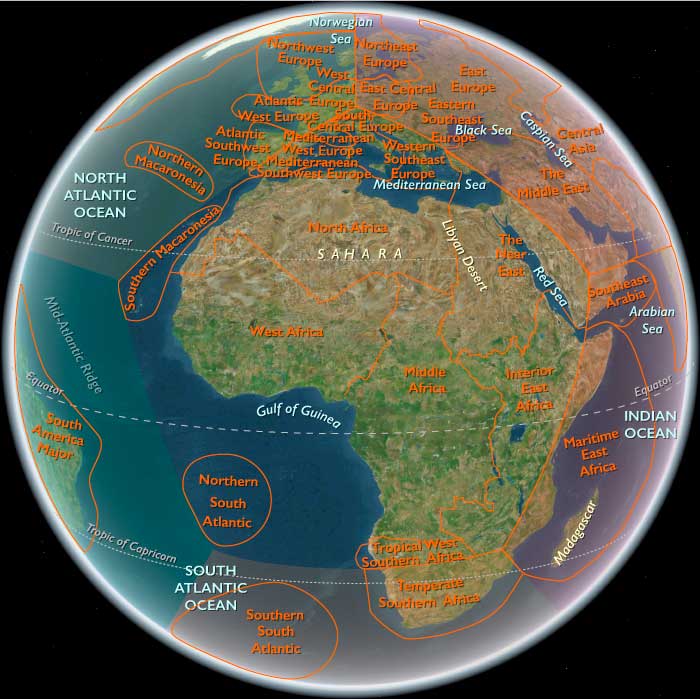
The Middle of The Earth
View →Related Events
Showing 10 events out of 13 total
The Muslim Conquest of Iberia (711–716 CE)
In 711 CE, a Muslim army led by Tariq ibn Ziyad invades the Iberian Peninsula, launching a campaign that rapidly dismantles Visigothic rule.
The Fall of the Visigothic Kingdom
The last Visigothic king, Rodrigo, attempts to resist the invasion but suffers a decisive defeat. The Muslims advance swiftly, capturing Córdoba before moving on to Toledo, the Visigothic capital.
The final Visigothic stronghold, Mérida, holds out for an extended siege but ultimately falls in June 713.
The Complete Conquest of Hispania
In the spring of 714, a Muslim force under Musa ibn Nusair marches through Saragossa, León, and Astorga, further consolidating control over northern and central Iberia. By 716, they capture key cities in present-day Portugal, including:
- Évora,
- Santarém, and
- Coimbra.
The Last Christian Stronghold: Asturias
Within just five years, Muslim forces conquer and occupy nearly the entire Iberian Peninsula. The only remaining Christian-controlled territory is a small, mountainous region in the extreme northwest, known as Asturias, where resistance will continue.
This marks the beginning of Muslim rule in Iberia, establishing Al-Andalus, which will endure for centuries.
Atlantic West Europe, 700–711: Late Merovingian Decline and Prelude to Islamic Expansion
Between 700 and 711, Atlantic West Europe experienced continued fragmentation under weak Merovingian rule, marked by the dominance of palace mayors, increasing political decentralization, and vulnerability to external threats. The period ended dramatically with the Umayyad invasion of the Iberian Peninsula in 711, fundamentally altering regional dynamics and posing new challenges for Frankish rulers.
Political and Military Developments
-
Merovingian Powerlessness
- Merovingian kings became figureheads, overshadowed by Mayors of the Palace, who wielded real political power.
- Factional conflicts intensified between Neustria, Austrasia, and Burgundy, further weakening central authority.
-
Ascendance of Pepin of Herstal (Pepin II)
- Pepin of Herstal, Mayor of the Palace of Austrasia, decisively defeated Neustrian and Burgundian forces at Tertry (687). By 700, he solidified his influence, ruling Austrasia, Neustria, and Burgundy effectively.
- Pepin's strong rule restored stability temporarily and laid the foundations for Carolingian dominance.
-
Umayyad Invasion of Iberia
- In 711, Umayyad Muslim forces, under Tariq ibn Ziyad, crossed into the Iberian Peninsula, decisively defeating the Visigothic King Roderic at the Battle of Guadalete.
- This marked the collapse of Visigothic rule in Spain, bringing the Islamic frontier directly to the Pyrenees and creating immediate implications for Atlantic West Europe’s future stability.
Economic and Social Developments
-
Localized Economies
- Increasing political fragmentation and repeated conflicts disrupted broader economic networks, fostering greater economic localization, particularly in rural areas.
- Towns experienced stagnation as long-distance trade and urban economies struggled under unstable conditions.
-
Emergence of Early Feudal Structures
- Landholding patterns began evolving toward proto-feudalism, characterized by personal allegiances and land grants from palace mayors to military followers, laying early groundwork for the feudal order.
Religious and Cultural Developments
-
Church Influence Amid Instability
- Monasteries remained vital centers of learning, spirituality, and preservation of classical knowledge.
- Bishops and abbots navigated complex relationships with powerful secular rulers, seeking protection while safeguarding ecclesiastical autonomy.
-
Missionary Activities and Early Reforms
- Missionary efforts continued beyond Frankish borders, anticipating later large-scale missions (such as those by Saint Boniface in subsequent eras).
Intellectual and Artistic Developments
- Cultural Preservation in Monasteries
- Monasteries continued their work of manuscript production and preservation of texts, though artistic innovation slowed in response to broader political instability.
- Scriptoria at Luxeuil and Corbie preserved literary and theological traditions, providing cultural continuity.
Long-Term Significance
The era from 700 to 711 concluded with events of profound historical significance for Atlantic West Europe. The decline of centralized Merovingian control created a power vacuum that facilitated the rise of palace mayors—particularly Pepin of Herstal—foreshadowing the Carolingian ascendancy. The Umayyad conquest of Iberia brought immediate geopolitical transformation, turning the Pyrenees into a new frontier that would shape Frankish politics, military strategy, and cultural identity in subsequent decades.
Visigothic king Wittiza, who had suffered the Jews to return to Spain, dies in 710, leaving two young sons, for whom Wittiza's widow and family try to secure the succession.
The turbulent Visigothic nobility instead elects Roderick and drives the Wittizans from Toledo.
Roderick, who seems to have been dux or military commander of one of the provinces, perhaps Baetica, faces a revolt of the Basques and is never recognized in the Northeast.
Meanwhile, Wittiza's family, determined to oust Roderick, has made contact with the Muslims in North Africa.
A Muslim army is invited into Ceuta by its governor, the possibly legendary Count Julian.
Roman Africa had been largely lost by the end of the seventh century to its Muslim conquerors, who in 711 seize the last outpost at Septem, where Julian, being an opponent of King Roderic of the Visigoths, encourages them to invade the Iberian peninsula.
According to the Egyptian historian Ibn Abd-el-Hakem, writing a century and a half after the events, Julian sent one of his daughters to Roderic's court at Toledo for education (and as a gauge of Julian's loyalty) and Roderic subsequently made her pregnant.
When Julian learned of the affair he removed his daughter from Roderic's court and, out of vengeance, betrayed Hispania to the Muslim invaders, thus making possible the Umayyad conquest of Hispania.
Later ballads and chronicles inflated this tale, Muslims making her out an innocent virgin who was ravished, Christians making her a seductress.
In Spanish she came to be known as la Cava Rumía, but this might well only be a legend.
Personal power politics were more likely at play, as better historical evidence points to a civil war among the Visigothic aristocracy.
Roderic had been appointed to the throne by the bishops of the Visigothic Catholic church—this appointment snubbing the sons of the previous king, Wittiza, who dies or is killed in 710; Wittiza's relatives and partisans had fled Iberia for Julian's protection at Ceuta (Septem), the Pillar of Hercules in North Africa on the northern shore of the Maghreb.
Here they have gathered with Arians and Jews fleeing forced conversions at the church's hands.
At this time, the surrounding area of the Maghreb had recently been conquered by Musa ibn Nusair, who has established his governor, Tariq ibn Ziyad, at Tangier with a Moorish army of seventeen hundred men.
Julian had therefore approached Musa to negotiate the latter's assistance in an effort to topple Roderic.
What is unclear is whether Julian hoped to place a son of Wittiza on the throne and gain power and preference thereby or whether he was intentionally opening up Iberia to foreign conquest.
The latter, though unlikely, isn't inconceivable, given that Julian may have long been on good terms with the Muslims of North Africa and found them to be more tolerant overlords than the Catholic Visigoths.
Moreover, if Julian was the Greek commander of the last imperial outpost in Africa, he would only have had an alliance with the Kingdom of the Visigoths rather than been part of it.
Perhaps, then, in exchange for lands in al-Andalus (the Arab name for the area the Visigoths still called by its Roman name, Hispania), or perhaps to topple a king and his religious allies, Julian provides military intelligence, troops, and ships.
Musa is initially unsure of Julian's project and so in July 710 directs Tarif ibn Malluk to lead a probe of the Iberian coast.
Legend says that Julian participated as a guide and emissary, arranging for Tarif to be hospitably received by supportive Christians—perhaps Julian's kinsmen, friends, and supporters—who agreed to become allies in the contemplated battle for the Visigothic throne.
Julian provides the ships to carry Muslim troops across to Europe in the summer of 711.
Julian also briefs Tariq, their general, who then leaves Julian behind among the merchants and crosses the Strait of Hercules with a force of some seventeen hundred men.
Musa bin Nusayr, governor of the Muslim Arab city of Ceuta in northwestern Africa, responds in 711 to the request by the Witizan family to help them overthrow Roderick.
Seventeen hundred Umayyad Moorish troops led by Tariq ibn Ziyad land at Gibraltar on April 30, and begin their invasion of the Iberian Peninsula (Al-Andalus) and conquest of the Visigothic Kingdom.
(The name of the Spanish promontory later called Gibraltar derives from its Moorish designation, Jebel Tariq, or Mount Tariq, in honor of this conqueror of Spain.)
Muslim Berber general Tariq ibn Ziyad, dispatched by Musa across the Straits of Gibraltar, defeats Roderic on July 19, 711 at Laguna de Janda, near the Guadalete River (Rio Barbate).
Roderic attempts escape, but is either killed or drowned.
According to the Mozarabic Chronicle, Mūsā crossed the Gaditanum fretum (strait of Cádiz) with a large force in 711 and remained in Hispania for fifteen months, but it is unclear from the sources if he came before or after the battle of Guadalete, which was fought by the forces of his subordinates.
During his time in the peninsula it is racked by civil war (intestino furore confligeratur, "internal frenzy", to the Mozarabic chronicler), cities are razed and many people slaughtered in the general destruction.
According to al-Maqqarī, Roderic was fighting the Basques when he was recalled to the south to deal with an invasion.
There is also the record of a attack on southern Iberia by Constantinople that was repulsed by Theudimer some years before the fall of the Visigothic kingdom.
This has led to theories that the Berber attacks may have been related to the East Roman, and perhaps the Arabs were originally useful allies in an imperial attempt to reconquer the lost province of Spania.
Tariq, following his decisive victory over Roderick's Visigoths, takes the Andalusian port cities of Algeciras, …
…Cartagena, …
…Málaga, and …