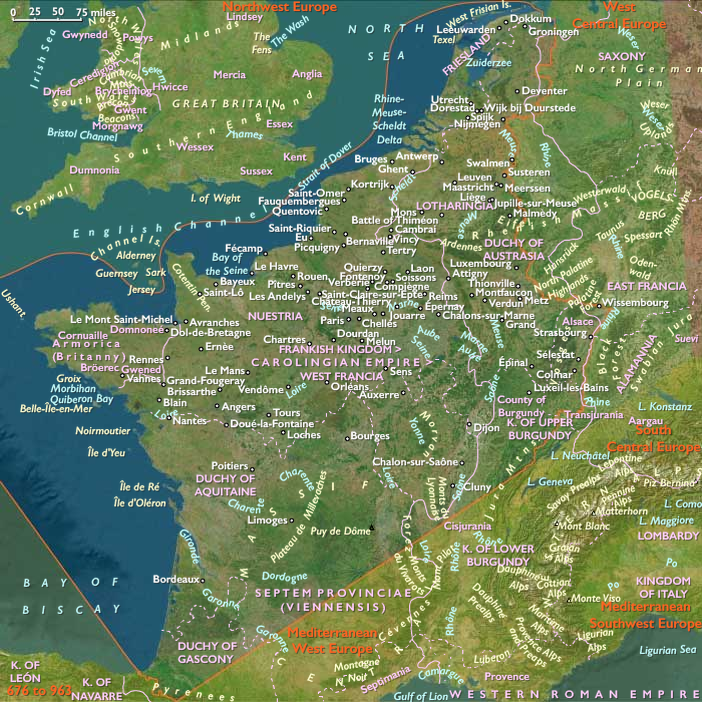
Atlantic West Europe, 700–711: Late Merovingian Decline…
700 CE to 711 CE
Atlantic West Europe, 700–711: Late Merovingian Decline and Prelude to Islamic Expansion
Between 700 and 711, Atlantic West Europe experienced continued fragmentation under weak Merovingian rule, marked by the dominance of palace mayors, increasing political decentralization, and vulnerability to external threats. The period ended dramatically with the Umayyad invasion of the Iberian Peninsula in 711, fundamentally altering regional dynamics and posing new challenges for Frankish rulers.
Political and Military Developments
-
Merovingian Powerlessness
- Merovingian kings became figureheads, overshadowed by Mayors of the Palace, who wielded real political power.
- Factional conflicts intensified between Neustria, Austrasia, and Burgundy, further weakening central authority.
-
Ascendance of Pepin of Herstal (Pepin II)
- Pepin of Herstal, Mayor of the Palace of Austrasia, decisively defeated Neustrian and Burgundian forces at Tertry (687). By 700, he solidified his influence, ruling Austrasia, Neustria, and Burgundy effectively.
- Pepin's strong rule restored stability temporarily and laid the foundations for Carolingian dominance.
-
Umayyad Invasion of Iberia
- In 711, Umayyad Muslim forces, under Tariq ibn Ziyad, crossed into the Iberian Peninsula, decisively defeating the Visigothic King Roderic at the Battle of Guadalete.
- This marked the collapse of Visigothic rule in Spain, bringing the Islamic frontier directly to the Pyrenees and creating immediate implications for Atlantic West Europe’s future stability.
Economic and Social Developments
-
Localized Economies
- Increasing political fragmentation and repeated conflicts disrupted broader economic networks, fostering greater economic localization, particularly in rural areas.
- Towns experienced stagnation as long-distance trade and urban economies struggled under unstable conditions.
-
Emergence of Early Feudal Structures
- Landholding patterns began evolving toward proto-feudalism, characterized by personal allegiances and land grants from palace mayors to military followers, laying early groundwork for the feudal order.
Religious and Cultural Developments
-
Church Influence Amid Instability
- Monasteries remained vital centers of learning, spirituality, and preservation of classical knowledge.
- Bishops and abbots navigated complex relationships with powerful secular rulers, seeking protection while safeguarding ecclesiastical autonomy.
-
Missionary Activities and Early Reforms
- Missionary efforts continued beyond Frankish borders, anticipating later large-scale missions (such as those by Saint Boniface in subsequent eras).
Intellectual and Artistic Developments
- Cultural Preservation in Monasteries
- Monasteries continued their work of manuscript production and preservation of texts, though artistic innovation slowed in response to broader political instability.
- Scriptoria at Luxeuil and Corbie preserved literary and theological traditions, providing cultural continuity.
Long-Term Significance
The era from 700 to 711 concluded with events of profound historical significance for Atlantic West Europe. The decline of centralized Merovingian control created a power vacuum that facilitated the rise of palace mayors—particularly Pepin of Herstal—foreshadowing the Carolingian ascendancy. The Umayyad conquest of Iberia brought immediate geopolitical transformation, turning the Pyrenees into a new frontier that would shape Frankish politics, military strategy, and cultural identity in subsequent decades.
Groups
Commodities
Regions
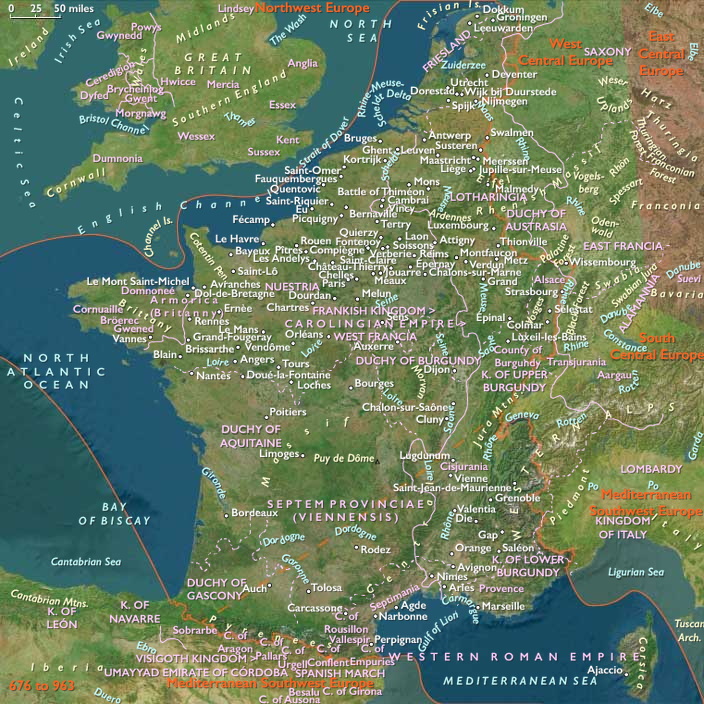
West Europe
View →Subregions