
Saṅghamittā
Buddhist nun and eldest daughter of Emperor Ashoka and his first wife, Devi
281 BCE to 202 BCE
Saṅghamittā is the eldest daughter of Emperor Ashoka and his first wife, Devi.
Together with Mahinda, her brother, she enteres an order of Buddhist monks.
The two siblings later go to Sri Lanka to spread the teachings of Buddha at the request of King Devanampiya Tissa (250 BCE– 210 BCE) who is a contemporary of Ashoka (304 BCE – 232 BCE).
At first she lands in 'Mathagal'.
The village Mathagal is situated sixteen kilometers away from Jaffna town, in the north of Sri Lanka, along the shores of the Indian Ocean.
Buddhist Emperor Samrat Ashoka sends her to Sri Lanka together with several other nuns to start the nun-lineage of Bhikkhunis (a fully ordained female Buddhist monastic) at the request of King Tissa to ordain queen Anulā and other women of Tissa's court at Anuradhapura who desire to be ordained as nuns after Mahindra converts them to Buddhism.
After Sanghamittā’s contribution to the propagation of Buddhism in Sri Lanka and her establishing the Bikhhunī Sangha or Meheini Sasna (Order of Nuns) there, her name becomes synonymous with "Buddhist Female Monastic Order of Theravāda Buddhism" that is established not only in Sri Lanka but also in Burma, China and Thailand, in particular.
The day the most revered tree, the Bodhi tree, a sapling of which is brought by her to Sri Lanka and planted in Anuradhapura, and which still survives, is also celebrated every year on the Full Moon day of December as "Uduvapa Poya" or "Uposatha Poya" and "Sanghamittā Day" by Theravāda Buddhists in Sri Lanka.
World
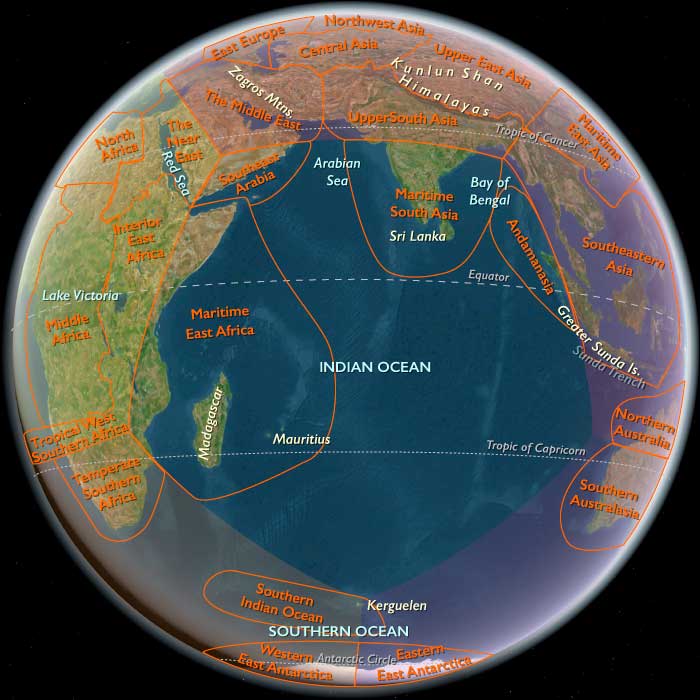
The Indian Ocean Lands
View →Related Events
Showing 2 events out of 2 total
Devanampiya Tissa is said to have received Buddha's right collarbone and his revered alms bowl from Asoka and to have built the Thuparama Dagoba, or stupa (Buddhist shrine), to honor these highly revered relics.
Another relic, Buddha's sacred tooth, will arrive in Sri Lanka in the fourth century CE.
The possession of the Tooth Relic will come to be regarded as essential for the legitimization of Sinhalese royalty and will remain so until its capture and probable destruction by the Portuguese in 1560
The sacred Tooth Relic (thought by many to be a substitute) that is venerated in the Temple of the Tooth in Kandy links legendary Sri Lanka with the modern era.
The annual procession of Perahera held in honor of the sacred Tooth Relic will serve as a powerful unifying force for the Sinhalese in the twentieth century.
Asoka's daughter, Sanghamitta, is recorded as having brought to the island a branch of the sacred bo tree under which the Buddha attained enlightenment.
According to legend, the tree that grew from this branch is near the ruins of the ancient city of Anuradhapura in the north of Sri Lanka.
The tree is said to be the oldest living thing in the world and is an object of great veneration.
The Asokan missionary approach, in contrast to the theological exclusivity of Hindu Brahmanism, features preaching and carries the principles of the Buddha directly to the common people.
This proselytizing has even greater success in Sri Lanka than it has in India and can be said to be the island's first experiment in mass education.
Buddhism also has a great effect on the literary development of the island.
The Indo-Aryan dialect spoken by the early Sinhalese is comprehensible to missionaries from India and facilitates early attempts at translating the scriptures.
The Sinhalese literati study Pali, the language of the Buddhist scriptures, thus influencing the development of Sinhala as a literary language.