Sebastian of Portugal
King of Portugal and the Algarves, of either side of the sea in Africa, Lord of Guinea and of Conquest, Navigation and Commerce of Ethiopia, Arabia, Persia and India, etc.
Years: 1554 - 1578
Sebastian "the Desired" (Sebastião I, born in Lisbon, 20 January 1554; presumed to have died at Alcácer-Quibir, 4 August 1578) is the 16th king of Portugal and the Algarves.
He is the son of Prince John of Portugal and his wife, Joan of Spain.
His paternal grandparents were John III of Portugal and Catherine of Habsburg; his maternal grandparents are the Holy Roman Emperor Charles V and Isabella of Portugal.



Related Events
Filter results
Showing 10 events out of 15 total
Kongo faces other challenges in the sixteenth century in addition to the slave trade.
After the death of Afonso in the 1540s, the kingdom endures a period of instability that culminates in an upheaval in 1568.
This rebellion will be long attributed by Portuguese sources and others to the invasion by a group of unknown origin called the Jaga.
Others, however, believed that the attack was probably launched by a Bakongo faction opposed to the king that may have been joined or aided by non-Bakongo seeking to gain control over the Kongo slave trade and other trading routes.
In any case, the assault on the capital (which had been renamed São Salvador) and its environs drives the king, Alvaro I, into exile.
The Portuguese governor of São Tome, responding to pleas from Alvaro I, fights the invaders from 1571 through 1573, finally ousting them and occupying the area until the mid-1570s.
A few years earlier, Sebastião, the Portuguese king, had granted the area south of the Bakongo as a proprietary colony to Paulo Dias de Novais, an associate of Portuguese Jesuits and an experienced explorer of the West African coast.
In 1576, in effective control of the countryside and facing no organized Kongo opposition, the Portuguese found the town of Luanda, in effect establishing the colony of Angola.
Other African leaders, however, continue to resist the Portuguese, and the Europeans only manage to establish insecure footholds along the coast.
Concerned that African attacks might impede the stream of slaves to Brazil and Portugal, in 1590 the crown assumes direct control of the colony.
Álvaro I and his successor, Álvaro II, bring stability to the Kongo Kingdom by expanding the domain of their royal authority while keeping at bay encroachment by the Portuguese, whose colony during the late years of the sixteenth century remains confined to the area south of Kongo, but after the death of Alvaro II in 1614, conflicts over access to cultivable land between Kongo and the Portuguese colony of Angola sour formerly amicable relations, and in 1622 the Portuguese governor of Angola launches an attack on Kongo.
Although not entirely successful from the Portuguese point of view, the war has a number of lasting effects. First, the colony captures a large number of slaves, which demonstrates how rewarding slave raiding can be.
Second, the Portuguese come out of the war convinced of the existence of silver and gold mines in Kongo, a belief that encourages a series of conflicts between the colonists and the Kongo Kingdom for the next half century.
The war also creates a xenophobia among the Bakongo of the interior, who drive away many Portuguese.
Because the trading system depends largely on the Bakongo, commerce is greatly disrupted, with effects on the Angolan colony as great as those on the Kongo Kingdom.
Adding to Kongo's troubles in the early 1600s is a general dissatisfaction among the Bakongo with their rulers, some of whom are greedy and corrupt.
Consequently, conflicts arise over succession to the throne, and more and more sections of the kingdom gain substantial degrees of autonomy and establish local control over the trade that had so enriched the monarchy in earlier years.
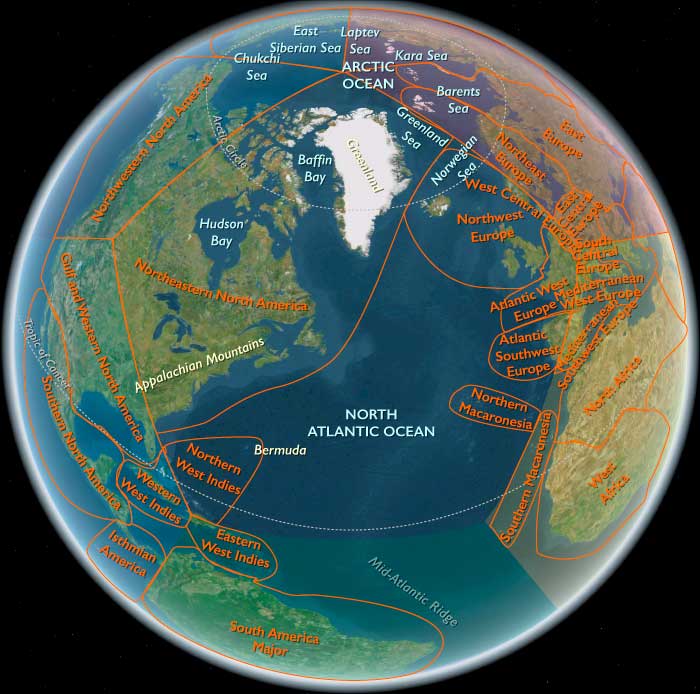
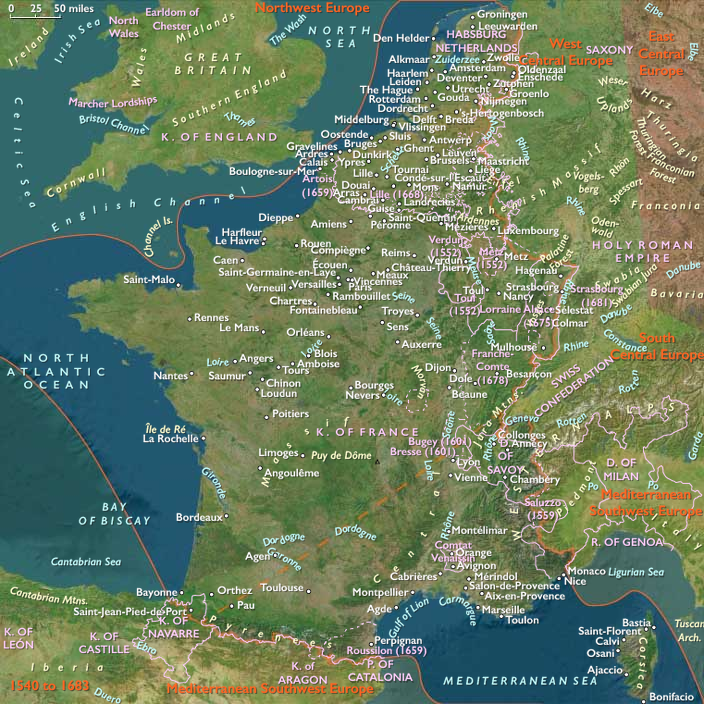
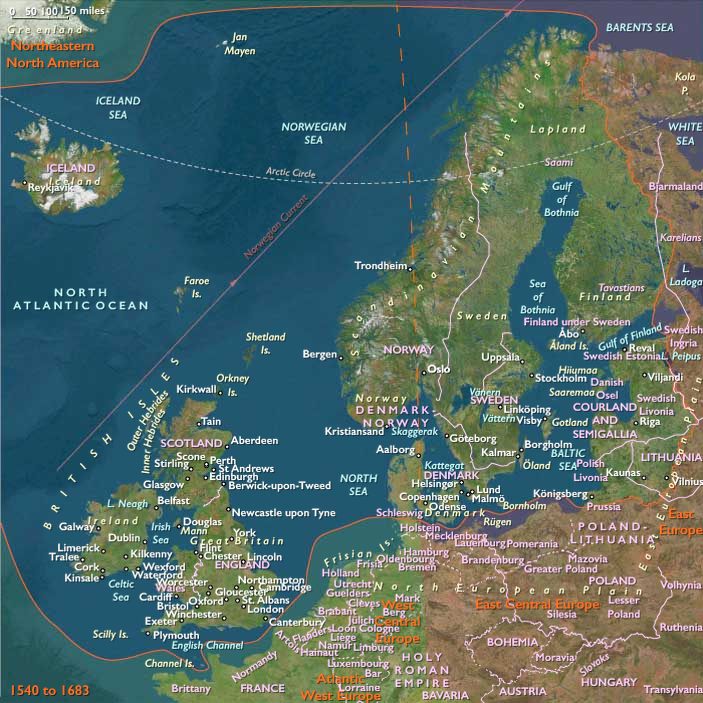
Atlantic Southwest Europe (1540–1683 CE): Political Transformation, Maritime Expansion, and Cultural Flourishing
Between 1540 and 1683, Atlantic Southwest Europe—including northern and central Portugal (Lisbon and Porto), Galicia, Asturias, Cantabria, northern León and Castile, northern Navarre, northern Rioja, and the Basque Country—underwent a transformative era marked by political upheaval, economic prosperity through maritime commerce, intense religious reform, and dynamic cultural expression. The region developed distinctive identities deeply influenced by the Renaissance and later the Baroque era, significantly shaping its trajectory toward modernity.
Political and Military Developments
The Iberian Union and Portuguese Restoration
In 1580, Portugal’s succession crisis resulted in the Iberian Union (1580–1640) under the Spanish Habsburg monarchy. This union initially strained the economies of northern Portuguese cities, notably Porto and Lisbon, which experienced intensified taxation and restrictions on trade. Dissatisfaction intensified, culminating in Portugal’s successful Restoration of Independence (1640) led by King João IV (House of Braganza). This pivotal moment restored political autonomy and stability, revitalizing regional governance structures and economic dynamism.
Autonomy and Fueros in Northern Spain
Throughout this period, regions such as the Basque Country and Navarre staunchly defended their traditional fueros, which guaranteed local autonomy, taxation privileges, and self-governance. These institutions effectively insulated the northern territories from the Spanish Crown's centralizing policies, sustaining political stability even as Spain faced broader imperial challenges.
In contrast, Galicia, Asturias, and Cantabria were more integrated within Castilian governance yet retained significant local autonomy. Their administrative flexibility enabled them to balance central demands and local interests effectively.
Military Pressures and Regional Stability
Atlantic Southwest Europe occasionally found itself at the forefront of broader military conflicts, notably during England’s maritime confrontations with Spain and Portugal. Despite such external pressures—including the disastrous defeat of the Spanish Armada (1588), which deeply impacted Basque and Cantabrian ports—the region largely maintained internal stability, enabling sustained economic recovery and growth in subsequent decades.
Economic Developments: Maritime and Commercial Expansion
Portuguese Maritime and Commercial Prosperity
Northern and central Portugal, especially cities like Lisbon, Porto, and Viana do Castelo, benefited enormously from maritime trade expansion. Porto, in particular, flourished as international demand surged for Port wine from the Douro Valley, becoming a key commercial hub for exports to England and the Low Countries. Shipbuilding along the northern Portuguese coast simultaneously expanded, driven by this booming maritime economy.
Northern Spain’s Industrial and Maritime Growth
The Basque provinces and Cantabria witnessed substantial economic prosperity driven by industrial growth, particularly shipbuilding, iron production, fisheries, and robust maritime commerce. The city of Bilbao became a major iron exporter, enhancing its economic importance within European trade networks. Santander similarly prospered through increased transatlantic and northern European maritime trade.
Galicia notably revitalized its maritime economy with strengthened fishing industries and expanded commercial ties through ports like Vigo and A Coruña, reinforcing regional economic resilience.
Religious Developments: Counter-Reformation and Local Identity
Counter-Reformation Orthodoxy
Following the Council of Trent (1545–1563), Atlantic Southwest Europe firmly embraced Counter-Reformation Catholicism, reinforced by inquisitorial tribunals and revitalized ecclesiastical institutions. Cities such as Valladolid, Braga, Coimbra, Santiago de Compostela, and Pamplona became prominent centers of religious orthodoxy, significantly shaping local educational, cultural, and spiritual life.
Pilgrimage routes, notably the Camino de Santiago, experienced renewed popularity, underscoring regional religious identity and promoting cultural cohesion, especially in Galicia.
Influence of the Jesuits
The establishment of Jesuit colleges significantly impacted regional intellectual life, fostering robust Catholic education in cities like Lisbon, Coimbra, Porto, and Valladolid. These institutions contributed significantly to the region’s intellectual vitality, while simultaneously ensuring adherence to Counter-Reformation doctrine.
Cultural and Artistic Flourishing
Transition from Renaissance to Baroque
Initially influenced by Renaissance humanism, cities like Braga, Santiago de Compostela, Burgos, Bilbao, and Lisbon sponsored art and architecture that reflected classical ideals and humanist values. By the late sixteenth century, the Baroque aesthetic profoundly reshaped the region, with elaborate cathedrals, palaces, and public buildings adorning urban landscapes, exemplified by iconic structures in Braga, Lisbon, and Santiago.
Literary and Linguistic Vibrancy
The period witnessed a notable literary flourishing across languages—Portuguese, Castilian, and Galician—strengthening regional identities and promoting linguistic diversity. Literature often subtly asserted local pride, reflecting broader political and cultural autonomy movements emerging across the region.
Social and Urban Developments
Urban Expansion and Merchant Ascendancy
Significant urban growth characterized this era, driven by maritime commerce, industrial expansion, and the increasing wealth of merchant classes. Cities like Porto, Lisbon, Bilbao, Santander, and Vitoria-Gasteiz expanded substantially, providing enhanced infrastructure, vibrant marketplaces, and burgeoning civic institutions.
The rising merchant and artisan classes became influential in urban governance, shifting social structures toward increased social mobility, prosperity, and localized political power.
Strengthened Regional Autonomy and Identity
Throughout Atlantic Southwest Europe, particularly in the Basque Country, Navarre, Galicia, and northern Portugal, traditional rights (fueros) were persistently reaffirmed. These protections solidified local identities, empowering regional governance against centralized imposition from Madrid, ensuring sustained political resilience and autonomy.
Notable Regional Groups and Settlements
-
Portuguese (Central and Northern): Experienced political restoration, maritime prosperity, and cultural renaissance in cities like Lisbon and Porto.
-
Galicians and Asturians: Balanced maritime economic prosperity with persistent rural challenges, fostering strong regional identities.
-
Basques, Navarrese, and Cantabrians: Leveraged local autonomy for economic growth, maintaining distinctive political and cultural identities despite imperial pressures.
-
Northern Castilians and Riojans: Maintained effective local governance, contributing to regional stability despite broader Spanish imperial decline.
Long-Term Significance and Legacy
From 1540 to 1683, Atlantic Southwest Europe:
-
Achieved critical political transformations, notably Portugal’s restoration of independence and northern Spain’s affirmation of regional autonomy.
-
Experienced significant maritime and economic prosperity, firmly integrating the region into European and global trade networks.
-
Fostered vibrant cultural expressions through Renaissance humanism and Baroque aesthetics, enriching regional identities and artistic legacies.
-
Strengthened local governance structures, particularly via the preservation of fueros, ensuring lasting political stability and regional resilience.
This formative period profoundly influenced Atlantic Southwest Europe's historical trajectory, embedding a legacy of economic vibrancy, cultural distinctiveness, and enduring regional autonomy that would persist well beyond the seventeenth century.
Philip II’s Rule Over Portugal and the Rise of Sebastianism (1580–1640)
When Philip II of Spain was declared King of Portugal in 1580, he sought to integrate Portugal into the Iberian Union while maintaining some degree of autonomy to placate the Portuguese elite. However, while the nobility largely accepted Spanish rule, a messianic movement known as Sebastianism (Sebastianismo) took hold in the countryside, reflecting Portuguese resistance to Castilian domination.
Philip II’s Policies Toward Portugal
To govern Portugal while maintaining its distinct identity, Philip II:
- Created a six-member Portuguese council to oversee administration.
- Ensured that the Portuguese Cortes (parliament) met only in Portugal.
- Preserved Portuguese institutions, keeping all civil, military, and ecclesiastical appointments Portuguese.
- Guaranteed autonomy in language, judicial system, coinage, and military.
Despite these assurances of autonomy, Portugal became increasingly subordinated to Spanish interests, particularly in foreign policy and colonial affairs.
Strengthening the Inquisition and Jesuit Influence
Philip II relied on the Jesuits and the Portuguese Inquisition to maintain control, as both institutions promoted Habsburg loyalty and religious orthodoxy.
- The Inquisition intensified persecution of New Christians (conversos, or Jews forcibly converted to Christianity), as Philip sought to align Portugal’s religious policies with Spain’s rigid Catholic orthodoxy.
- The Jesuits, who played a central role in Portuguese education and missionary efforts, were favored by Philip for their Iberian-wide influence and religious discipline.
This led to greater repression of religious minorities, exacerbating tensions within Portugal and its colonies.
Portuguese Cultural and Political Integration with Spain
- By the late 16th century, the Portuguese royal court had adopted Castilian language and etiquette.
- Many Portuguese intellectuals and writers produced works in Castilian Spanish, seeing themselves as part of a shared Iberian culture.
- While the Portuguese elite largely accepted Spanish rule, rural Portugal resisted assimilation, leading to the rise of Sebastianism.
Sebastianism: The Myth of the Hidden King and National Resistance
- Sebastianism (Sebastianismo) emerged from the belief that King Sebastião (who disappeared at the Battle of Alcácer Quibir in 1578) had not died but would return to free Portugal from Spanish rule.
- This messianic cult became deeply rooted in Portuguese society, particularly in the countryside and among the lower classes.
- Over the years, several impostors claiming to be King Sebastião appeared, leading to small-scale rebellions, but all were easily suppressed.
Long-Term Impact of Sebastianism
- Sebastianism became a lasting element of Portuguese identity, symbolizing:
- A nostalgic longing for lost national glory.
- Resistance to foreign rule.
- The hope for a miraculous national restoration.
- Even after Portugal regained independence in 1640, Sebastianism persisted as a cultural and psychological phenomenon, influencing Portuguese literature, folklore, and political thought.
Conclusion: A Fragile Union and Enduring National Identity
Philip II’s incorporation of Portugal into the Iberian Union (1580–1640) was met with noble acquiescence but popular resistance. While Portugal retained some degree of autonomy, the increasing influence of Spanish policies and institutions fueled resentment.
The rise of Sebastianism reflected Portugal’s deep desire for independence, a longing that would eventually culminate in the Portuguese Restoration War (1640), leading to the end of Spanish rule and the restoration of the House of Braganza. Even today, Sebastianism remains a powerful cultural symbol in Portugal, embodying a national longing for an unattainable past.
Sebastião's death causes the crown to fall to his uncle, Henrique, the last surviving son of Manuel I.
Henrique's crowning solves the succession crisis only temporarily because Henrique is an infirm and aged cardinal who is unable to obtain dispensation from the pope to marry.
There are several pretenders to the throne, one of whom is Philip II of Spain, nephew of Joao III.
When Henrique dies in 1580, a powerful Spanish army commanded by the duke of Alba invades Portugal and marches on Lisbon.
This force routs the army of rival contender, Antonio, prior of Crato and the illegitimate son of Joao Ill's son Luis.
Portugal is annexed by Spain, and Philip II is declared Filipe I of Portugal.
When Joao III dies in 1557, the only surviving heir to the throne is his three-year-old son, Sebastião, who takes over the government at the age of fourteen.
Sickly and poorly educated, Sebastião proves to be mentally unstable, and as he grows to young manhood he develops a fanatical obsession with launching a great crusade against the Muslims in North Africa, thus reviving the Moroccan policy of Afonso V.
In 1578, when he is twenty-four years old, Sebastião organizes an army of twenty-four thousand and assembles a large fleet that leaves Portugal on August 4 for Alcazarquivir.
Sebastião's army, poorly equipped and incompetently led, is defeated, and the king, presumed killed in battle, is never seen again.
A large number of the nobility are captured and held for ransom.
This defeat, the most disastrous in Portuguese military history, sweeps away the flower of the aristocratic leadership and drains the coffers of the treasury in order to pay ransoms.
Worse, it results in the death of a king who has no descendants, plunging Portugal into a period of confusion and intrigue over the succession.
Atlantic Southwest Europe (1552–1563 CE): Peak of Iberian Imperial Power, Heightened Counter-Reformation, and Cultural Transition
Between 1552 and 1563 CE, Atlantic Southwest Europe—including Galicia, northern and central Portugal, Asturias, Cantabria, and northern Spain south of the Franco-Spanish border (43.05548° N, 1.22924° W)—reached a pivotal stage marked by the apex of Iberian global dominance under Emperor Charles V and King Philip II, the expansion of Portugal’s maritime empire under João III and Sebastião, and intensifying religious and cultural transformations resulting from the Counter-Reformation. During this era, the region saw heightened ecclesiastical authority, intensified imperial rivalries, and shifts in cultural expression, decisively shaping regional identities, economic prosperity, and global influence.
Political and Military Developments
Imperial Transition from Charles V to Philip II
The era began with Emperor Charles V (1516–1556 CE) preparing his abdication, leading to the ascension of his son, Philip II of Spain (1556–1598 CE). Philip inherited an empire of unprecedented scale, including Iberia, vast American territories, European dominions, and territories in Italy and the Netherlands. Philip II decisively reinforced central governance, expanded bureaucratic administration, and intensified imperial control, especially in Atlantic Southwest Europe, shaping regional governance and identity for decades.
Portuguese Maritime Strength under João III and Regency
Under King João III (1521–1557 CE), Portugal decisively maintained global maritime dominance through expansive trade networks, fortified Asian and African outposts, and thriving Brazilian settlements. João’s death in 1557 led to a complex regency for his young grandson, Sebastião (1557–1578 CE). The regency managed ongoing imperial trade and colonial administration, preserving Portuguese maritime and economic power amid emerging internal political uncertainties.
Navarre and Basque Regional Autonomy
Southern Navarre continued its integration under Spanish Habsburg administration, though Basque communities decisively maintained distinctive regional identities, customs, and governance structures. Northern Navarre remained linked to France, preserving regional autonomy and reinforcing local cultural resilience amid growing geopolitical tensions between France and Spain.
Economic Developments
Sustained Agricultural Prosperity and Stability
Regional agricultural productivity decisively remained robust, supported by diverse crops—grains, vineyards, olives, citrus fruits, and almonds—and extensive livestock farming. Extraction of gold and silver, particularly in Galicia and Asturias, significantly supported economic stability, demographic resilience, and regional prosperity.
Portuguese Global Commerce and Economic Continuity
Portugal decisively continued its global commercial dominance under João III and subsequent regencies. Lisbon, Porto, Braga, and Coimbra thrived economically through lucrative trade networks in spices, textiles, precious metals, and luxury commodities from Africa, Asia, and America. Galician ports, notably A Coruña, benefited significantly from continued maritime commerce, reinforcing regional economic prosperity.
Spanish-American Trade and Imperial Wealth
Under Philip II, Spain decisively maintained intense economic engagement with American colonies, notably importing vast quantities of silver and gold. These resources significantly reshaped Iberian economic dynamics, financed imperial policies, and underpinned Spain’s geopolitical ambitions and military expenses, reinforcing the region’s global economic influence.
Cultural and Religious Developments
Heightened Counter-Reformation Influence and Ecclesiastical Authority
This era witnessed decisive intensification of the Counter-Reformation, profoundly reshaping religious life, intellectual freedom, and cultural expressions across Atlantic Southwest Europe. Ecclesiastical authority and the Spanish Inquisition intensified, reinforcing religious orthodoxy, suppressing perceived heresies, and shaping intellectual and cultural life significantly. The Council of Trent (concluded in 1563) decisively reinforced doctrinal orthodoxy and ecclesiastical reforms, profoundly influencing Iberian religious identity.
Portuguese Cultural Continuity and Humanist Scholarship
Portugal decisively maintained Renaissance humanist traditions, scholarly patronage, artistic innovation, and scientific inquiry under João III and subsequent regencies. Institutions like the University of Coimbra flourished intellectually, reinforcing Portugal’s cultural sophistication and European intellectual prominence amid increasingly orthodox religious pressures.
Spanish Renaissance Culture and Religious Orthodoxy
Under Philip II, Spain decisively balanced Renaissance cultural flourishing with intensified religious orthodoxy. Humanist scholarship, artistic creativity, and literary innovations persisted, enriched by European intellectual exchanges. However, cultural life increasingly reflected orthodox religious themes, evident in architectural and artistic expressions, signaling a cultural transition shaped by Counter-Reformation ideals.
Galician Cultural Resilience and Ecclesiastical Influence
Galicia decisively sustained cultural prominence, reinforced by Santiago de Compostela’s ecclesiastical authority and pilgrimage traditions. Scholarly activities, manuscript preservation, artistic patronage, and architectural projects continued, decisively reinforcing Galician cultural identity and international recognition despite increased religious orthodoxy.
Civic Identity and Governance
Portuguese Civic Unity amid Regency Challenges
Portugal decisively preserved national unity, civic identity, and governance continuity despite João III’s death and ensuing regency. Imperial ambitions, global commerce, and cultural sophistication significantly reinforced Portuguese identity, economic prosperity, and political coherence.
Spanish Civic Identity under Philip II’s Centralized Administration
Under Philip II, Spain decisively reinforced civic identity, centralized governance, and imperial administrative coherence. His meticulous bureaucratic reforms and religious orthodoxy significantly reshaped regional identity, political coherence, and cultural expression, decisively reinforcing Spanish national unity.
Basque Regional Autonomy and Identity
Navarre and broader Basque territories decisively maintained distinctive regional identities, traditions, and governance structures despite political integration, reinforcing northern Iberian cultural resilience, regional coherence, and local autonomy amid intensified imperial centralization.
Notable Regional Groups and Settlements
-
Portuguese: Sustained maritime dominance, global economic prosperity, and Renaissance cultural maturity under João III and subsequent regency, decisively influencing Portugal’s historical trajectory and global prominence.
-
Spaniards (Castilians and Aragonese): Reinforced imperial coherence, centralized governance, heightened religious orthodoxy, and cultural maturity under Philip II, decisively shaping Iberian political structures and Renaissance cultural development.
-
Galicians: Maintained vibrant economic resilience, cultural vitality, and ecclesiastical prominence, significantly reinforced by pilgrimage activity and maritime commerce.
-
Basques (Navarre): Preserved distinctive regional identities, cultural resilience, and local governance despite integration, decisively influencing northern Iberian regional coherence.
Long-Term Significance and Legacy
Between 1552 and 1563 CE, Atlantic Southwest Europe:
-
Achieved the peak of Iberian imperial dominance under Charles V and Philip II, decisively shaping global geopolitics, economic prosperity, and regional identity.
-
Experienced intensified Counter-Reformation currents and heightened ecclesiastical authority, significantly reshaping intellectual life, cultural expression, and religious practices.
-
Maintained Portuguese global commerce and imperial administration, reinforcing regional economic prosperity, civic unity, and cultural sophistication despite internal political challenges.
-
Reinforced regional resilience, agricultural stability, economic continuity, cultural innovation, and vibrant pilgrimage traditions, profoundly influencing historical trajectories and regional identities.
This transformative era decisively shaped regional governance, economic prosperity, cultural expression, and religious life, significantly influencing Atlantic Southwest Europe’s trajectory toward continued global prominence, heightened religious orthodoxy, and enduring historical significance.
The Death of John III and the Rise of Sebastian I: Portugal at a Crossroads (1557)
During the reign of King John III of Portugal (r. 1521–1557), Lisbon flourished as one of Europe’s largest, wealthiest, and most cosmopolitan cities. However, despite its economic prosperity, Portugal’s decline had already begun, marked by military failures, financial strain, and demographic decline.
Lisbon: A Global Capital Under John III
- By the mid-16th century, Lisbon was a key hub of global trade, enriched by spices, gold, and slaves from Africa, India, and Brazil.
- The city became a center of arts, literature, and luxury, with John III lavishing wealth on court life and extravagant projects.
- However, Portugal’s overextended empire was beginning to drain its economy.
The Decline of Portugal’s Power
-
Naval and Economic Decline
- Portugal struggled to maintain dominance over its vast overseas empire, facing challenges from rival European powers and local resistance in Asia and Africa.
- Trade revenues decreased, and Lisbon’s economic dominance weakened.
-
Expensive and Futile Wars in Morocco
- John III spent heavily on military campaigns in North Africa, but these costly ventures yielded little strategic gain.
- Portuguese garrisons in Morocco became increasingly difficult to defend, draining resources and manpower.
-
Religious Intolerance and the Inquisition
- A devout Catholic known as “the Pious”, John III established the Portuguese Inquisition (1536).
- The Jesuits were brought to Portugal, reinforcing Catholic orthodoxy but also stifling intellectual and economic progress.
- The persecution of New Christians (conversos) led to the flight of many skilled merchants and financiers, weakening the economy.
John III’s Death and the Accession of Sebastian I (1557)
- John III died on June 11, 1557, at age 55.
- His only surviving heir was his three-year-old grandson, Sebastian, who became King Sebastian I under a regency led by his grandmother, Catherine of Austria, and later by his great-uncle, Cardinal Henry.
- Sebastian’s ascension at such a young age marked the beginning of a period of instability, culminating in the disastrous Battle of Alcácer Quibir (1578) and Portugal’s eventual fall under Spanish rule (1580–1640).
Conclusion: The End of Portugal’s Golden Age?
John III’s reign marked both the peak and the beginning of Portugal’s decline. While Lisbon remained a wealthy and influential city, Portugal’s imperial overstretch, military failures, and economic decline foreshadowed the troubles of the late 16th century. His death left a vulnerable child-king, whose reign would lead Portugal further into crisis, setting the stage for one of the most dramatic turning points in Portuguese history.
Atlantic Southwest Europe (1564–1575 CE): Imperial Pressures, Maritime Prosperity, and Religious Consolidation
Between 1564 and 1575 CE, Atlantic Southwest Europe—including Galicia, northern and central Portugal, Asturias, Cantabria, northern León and Castile, northern Navarre, northern Rioja, and the Basque Country—faced increased imperial demands, deepened religious orthodoxy, thriving maritime commerce, and growing internal tensions. Under Philip II of Spain and the young King Sebastião of Portugal, the region’s integration into wider imperial frameworks intensified, profoundly shaping regional identities, economies, and cultural trajectories.
Political and Military Developments
Philip II’s Imperial Ambitions and Regional Burdens
Under Philip II (1556–1598 CE), centralized Habsburg authority intensified across northern Spain. The Basque Country, Cantabria, and northern Castile experienced heightened taxation and extensive recruitment to support imperial conflicts, especially military operations in the Netherlands and the preparation of the Spanish Armada. Regional nobility and urban merchant classes struggled with increasing fiscal and military demands, sparking tension between regional autonomy and centralized power.
Portugal’s Ambitious Expansion under King Sebastião
King Sebastião (1557–1578 CE) took personal rule in 1568, ending regency government. Driven by youthful idealism and religious zeal, Sebastião pursued aggressive military campaigns in North Africa, significantly involving northern Portuguese nobility and cities. These costly Moroccan ventures strained Portugal’s financial and human resources, foreshadowing vulnerabilities that would later undermine national stability.
Northern Navarre’s Delicate Stability
Northern Navarre successfully balanced dual allegiances between French and Spanish factions. This nuanced diplomacy preserved local autonomy, cultural resilience, and regional stability amid mounting geopolitical tensions between Spain and France.
Economic Developments
Maritime Prosperity and Portuguese Trade Networks
Portuguese maritime commerce thrived, particularly driven by lucrative sugar exports from Brazil. Coastal cities like Porto flourished economically, reinforcing urban wealth. However, escalating costs for naval defenses and fortifications to counter piracy and competition from English and French merchants began placing considerable strain on Portuguese state finances.
Expansion of Basque and Cantabrian Maritime Commerce
Basque ports, notably Bilbao and San Sebastián, prospered through expanded transatlantic trade, wool exports, and a booming shipbuilding industry crucial to Philip II’s naval ambitions, especially the ongoing preparations for the Spanish Armada. Cantabrian towns like Santander benefited similarly from increased mercantile activities, though the influx of silver from American colonies intensified inflation, negatively affecting local economies.
Agricultural Stability and Inland Stagnation
While coastal urban centers flourished, rural communities in Galicia, Asturias, and León remained largely dependent on traditional agriculture and pastoral economies, experiencing limited economic growth. Inflation driven by American silver imports exacerbated these regional disparities, deepening socioeconomic divisions between coastal and rural populations.
Cultural and Religious Developments
Heightened Counter-Reformation and Inquisitorial Authority
The Counter-Reformation profoundly intensified under Philip II’s rule, reinforcing Catholic orthodoxy through rigorous inquisitorial activities in Castilian cities such as Valladolid and Burgos, Basque towns like Bilbao and Vitoria, and northern Portuguese cities. Portugal’s Inquisition notably targeted conversos, merchants, and intellectual elites, curtailing earlier humanist freedoms and scholarly exchanges, reshaping regional intellectual and cultural landscapes significantly.
Artistic Patronage Aligned with Counter-Reformation Ideals
Northern Spanish cities, especially Burgos, Valladolid, and Salamanca, experienced significant artistic patronage aligned closely with Counter-Reformation orthodoxy. Religious architecture, devotional art, and literature flourished, reflecting deeper religious conformity and ecclesiastical authority. Portugal saw a similar cultural revival, especially at institutions like the University of Coimbra, where scholastic theology and classical humanism thrived within rigid doctrinal boundaries.
Galician Cultural Resilience and Pilgrimage Traditions
Galicia maintained strong cultural resilience, supported by Santiago de Compostela’s ecclesiastical prestige and pilgrimage traditions. Architectural projects, artistic patronage, and manuscript preservation continued, significantly reinforcing Galician identity and international prominence amidst intensified religious oversight.
Social and Urban Dynamics
Urban Expansion and Rising Merchant Influence
Maritime commerce significantly drove urban growth in coastal cities like Bilbao, Porto, Lisbon, and Santander, enhancing the prosperity and political influence of the merchant class. This urban prosperity, however, contrasted sharply with inland regions, exacerbating regional disparities and prompting internal migrations toward thriving coastal towns.
Imperial Demands and Regional Social Tensions
Philip II’s military campaigns and Portugal’s overseas ambitions intensified local demands for manpower, taxation, and strict religious conformity. These imperial pressures deepened social tensions across the region, sparking resentment among rural and urban communities struggling under the heavy burdens imposed by central authorities.
Basque Regional Autonomy Amid Centralization
Basque communities continued defending traditional local autonomy through the preservation of fueros, balancing loyalty to Philip II with efforts to maintain distinct regional identities and administrative freedoms. This delicate balancing act allowed significant regional self-governance amid growing centralizing pressures.
Notable Regional Groups and Settlements
-
Portuguese: Maintained maritime dominance and economic prosperity despite increasing vulnerabilities under Sebastião’s aggressive foreign policy, shaping Portugal’s global prominence and future challenges.
-
Spaniards (Castilians and Aragonese): Reinforced centralized Habsburg governance, heightened military and fiscal demands, and intensified religious orthodoxy under Philip II, decisively influencing regional political structures and cultural trajectories.
-
Galicians: Preserved vibrant economic resilience, cultural vitality, and ecclesiastical significance, supported by pilgrimage activities and maritime commerce, reinforcing regional prominence and resilience.
-
Basques (Navarre): Balanced centralized authority with regional autonomy, preserving distinctive cultural identities, local governance, and economic prosperity despite increasing imperial demands.
Long-Term Significance and Legacy
Between 1564 and 1575 CE, Atlantic Southwest Europe:
-
Experienced intensified imperial demands, financial pressures, and military obligations under Philip II and Sebastião, shaping regional identities and exposing economic vulnerabilities.
-
Witnessed heightened Counter-Reformation orthodoxy and inquisitorial rigor, reshaping intellectual life, cultural expressions, and religious practices profoundly.
-
Sustained robust maritime trade and urban expansion, reinforcing economic prosperity but also deepening regional socioeconomic divisions.
-
Maintained resilient local governance and distinctive regional identities despite increasing centralization pressures, laying foundations for future cultural and political developments.
This era decisively shaped regional governance, economic prosperity, cultural expression, and social cohesion, influencing Atlantic Southwest Europe’s trajectory toward continued global prominence, heightened religious orthodoxy, and enduring historical significance.
The 1569 Plague in Lisbon: A Devastating Epidemic
In 1569, Lisbon experienced one of the deadliest plague outbreaks in its history, reportedly killing 50,000 inhabitants. As Portugal’s imperial capital and a major European trade hub, Lisbon was highly vulnerable to epidemic diseases, which spread rapidly through dense urban areas, maritime trade routes, and poor sanitation conditions.
Causes and Spread of the Epidemic
While contemporary records do not always specify the exact disease, historians believe the 1569 outbreak was likely caused by:
-
Bubonic Plague
- Plague epidemics were common in the 16th century, particularly in port cities like Lisbon, where ships frequently carried infected rats and fleas from Africa, India, and the Mediterranean.
- Symptoms would have included swollen lymph nodes (buboes), fever, and high mortality rates.
-
Typhus or Other Infectious Diseases
- Typhus, spread through lice in crowded, unsanitary conditions, was another deadly epidemic disease of the period.
- Overcrowding and lack of hygiene in Lisbon made it an ideal breeding ground for such outbreaks.
-
Dysentery and Waterborne Illnesses
- Poor sanitation and contaminated water supplies contributed to waves of dysentery and other gastrointestinal diseases, which often followed plague outbreaks.
Impact on Lisbon
1. Massive Population Loss
- An estimated 50,000 deaths meant that a significant portion of Lisbon’s population perished, devastating the city’s social and economic stability.
- The sudden population decline created labor shortages in key industries, including shipping, trade, and urban services.
2. Economic and Maritime Consequences
- Lisbon was one of Europe’s busiest ports, connecting Portugal’s colonial empire to Africa, Asia, and the Americas.
- The epidemic disrupted trade and weakened Portugal’s ability to maintain its overseas empire, as ships and sailors fell victim to the disease.
3. Government and Religious Responses
- King Sebastian I took emergency measures to combat the crisis:
- Summoning physicians from Seville to help local doctors.
- Establishing two hospitals in Lisbon to care for plague victims.
- Founding shelters for widows and orphans, including the Recolhimento de Santa Marta and the Recolhimento dos Meninos.
- In 1570, Lisbon held the first Procession of Our Lady of Health, thanking the Virgin Mary for the end of the epidemic—a tradition that continued for centuries.
Conclusion: A Defining Plague in Lisbon’s History
The 1569 plague was one of the deadliest public health disasters in Lisbon’s history. With 50,000 deaths, the city suffered severe demographic, economic, and political consequences, illustrating the catastrophic impact of epidemic diseases on early modern European societies. Despite medical efforts and religious devotion, Lisbon’s vulnerability to future outbreaks remained a constant threat throughout the 16th and 17th centuries.
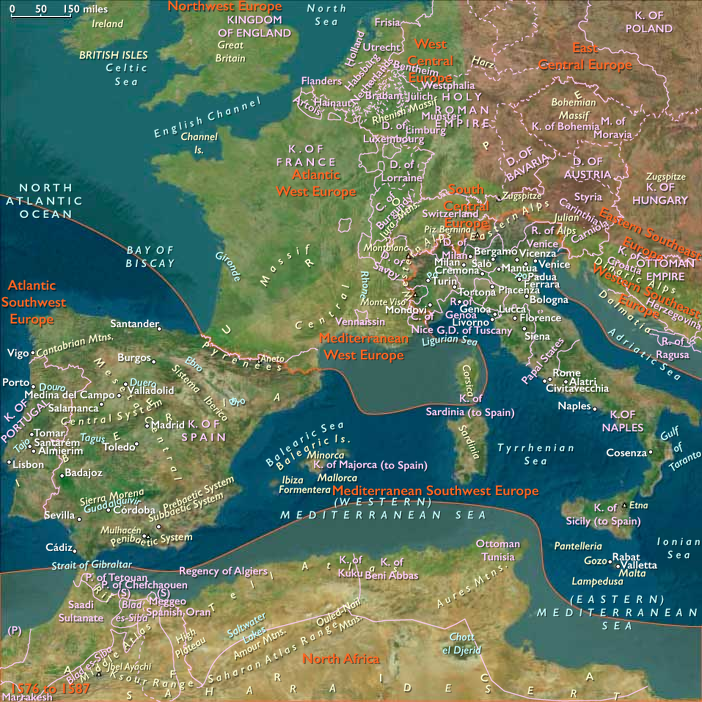
Atlantic Southwest Europe (1576–1587 CE): Crisis, Dynastic Union, and the Intensification of Iberian Integration
Between 1576 and 1587 CE, Atlantic Southwest Europe—including northern Portugal, Galicia, Asturias, Cantabria, northern León and Castile, northern Navarre, northern Rioja, and the Basque Country—experienced profound dynastic upheaval, intensified centralization under Habsburg rule, deepening Counter-Reformation influences, and substantial economic realignments. Marked by Portugal’s dynastic crisis culminating in the Iberian Union (1580), the region navigated significant military, economic, religious, and social pressures while striving to maintain traditional regional autonomy.
Political and Military Developments
Portuguese Dynastic Crisis and the Iberian Union
In 1578, King Sebastião of Portugal launched a catastrophic expedition against Morocco, which ended disastrously at the Battle of Alcácer Quibir, resulting in his disappearance and presumed death. This tragedy plunged Portugal into severe dynastic turmoil, exacerbated further by the death of the elderly King-Cardinal Henrique (1580), leaving no direct heir. Capitalizing on this vacuum, Philip II of Spain decisively secured his claim over Portugal after successfully defeating rival claimants, notably António, Prior of Crato. The Iberian Union thus brought Portugal under Habsburg rule, reshaping Iberian geopolitics profoundly, though Philip II carefully allowed limited Portuguese autonomy, particularly in the northern territories.
Philip II’s Centralization and Regional Autonomy
Throughout northern Spain, Philip II reinforced centralized Habsburg governance, enforcing heavier taxation, intensified military levies, and greater bureaucratic oversight, significantly affecting Basque Country, Cantabria, and northern Castile. Nevertheless, Philip prudently respected traditional local privileges (fueros), notably in Basque territories and northern Navarre. Basque and Navarrese nobility skillfully balanced submission to central authority with vigorous defense of local autonomy, maintaining distinctive administrative, legal, and cultural independence.
Northern Navarre’s Stability Amid Dual Allegiances
Northern Navarre, particularly Pamplona, continued navigating diplomatic complexities with pragmatic neutrality, carefully balancing its allegiances between Spanish and French interests. This nuanced policy sustained local stability, preserving its distinct legal system and regional autonomy amid escalating geopolitical tensions.
Economic Developments and Maritime Pressures
Impact of Iberian Union on Portuguese Maritime Interests
Initial anxiety in Portuguese northern ports—particularly Porto and Viana do Castelo—over economic marginalization eased somewhat as Philip II respected established Portuguese trade rights. Portuguese maritime commerce, notably in sugar, spices, and Asian goods, continued relatively uninterrupted. However, growing naval conflicts with England, France, and the Netherlands placed increasing pressure on maritime security and profitability, necessitating costly defensive fortifications and expanded naval forces along Portugal’s northern Atlantic coast.
Expansion and Pressures on Basque and Cantabrian Maritime Economies
Basque maritime centers such as Bilbao and San Sebastián flourished economically, driven by transatlantic trade, wool exports, and intensive shipbuilding activities linked directly to Philip II’s naval preparations for the forthcoming Spanish Armada. Cantabrian ports, notably Santander, similarly prospered through naval provisioning and mercantile trade. Nonetheless, the sustained influx of silver from American colonies drove inflation, significantly eroding local purchasing power and contributing to mounting regional economic pressures.
Rural and Urban Economic Disparities
While coastal urban centers thrived, inland rural communities in Galicia, Asturias, and northern Castile experienced economic stagnation, deepening demographic and socioeconomic disparities. Rural communities faced increased impoverishment and demographic pressures, accentuating regional inequalities.
Cultural and Religious Transformations
Intensified Counter-Reformation and Inquisitorial Activities
Under Philip II’s centralized religious policies, the Counter-Reformation decisively intensified across the region. The Portuguese and Spanish inquisitions coordinated closely, rigorously pursuing heretics, Protestant sympathizers, and conversos. Major northern cities—including Porto, Valladolid, Burgos, Bilbao, Vitoria, and Pamplona—became focal points of inquisitorial scrutiny, significantly affecting merchant classes, intellectual elites, and everyday social interactions. Religious uniformity strengthened, curtailing previously flourishing humanist and scholarly exchanges.
Cultural Patronage Aligned with Counter-Reformation Ideals
Northern Spanish cities such as Burgos, Valladolid, Salamanca, and Pamplona continued receiving significant artistic patronage closely aligned with Counter-Reformation values. Religious architecture, paintings, sculptures, and literature flourished, reflecting intensified religious orthodoxy and Tridentine aesthetics. In Portugal, despite increasing inquisitorial constraints, Coimbra University and northern monasteries maintained vibrant scholarly traditions, preserving classical learning and religious literature within strictly regulated frameworks.
Galician Cultural Resilience and Pilgrimage Traditions
Galicia maintained robust cultural vitality, supported significantly by the ecclesiastical prominence of Santiago de Compostela. Continued artistic patronage, architectural investment, manuscript preservation, and pilgrimage activities reinforced Galician cultural resilience, regional identity, and international prominence.
Social and Urban Dynamics
Social Unrest and Local Resistance
Escalating fiscal demands, military conscription, and centralized imperial policies provoked significant regional discontent and social tensions. Urban riots and localized rural unrest periodically erupted, notably in response to taxation and recruitment burdens, expressing regional resistance to increased centralization and imperial pressures.
Urban Prosperity and Merchant Class Influence
Northern maritime cities, particularly Bilbao, Santander, Porto, and Lisbon, continued to experience substantial urban expansion and commercial prosperity. The rising merchant classes consolidated economic influence, increasingly shaping civic politics and urban governance. The stark contrast with stagnating rural hinterlands further deepened regional socioeconomic divisions.
Basque and Navarrese Autonomy
Basque territories and northern Navarre successfully maintained considerable local autonomy through the vigorous defense of their fueros, preserving traditional administrative, legal, and economic systems despite Philip II’s intensified centralization. This balance of regional autonomy with centralized rule significantly shaped Basque identity, resilience, and governance.
Notable Regional Groups and Settlements
-
Portuguese: Experienced profound dynastic upheaval resulting in the Iberian Union, yet maintained maritime commercial strength and regional autonomy despite growing imperial pressures.
-
Spaniards (Castilians, Cantabrians, and Riojans): Endured heightened centralization, increased military obligations, and intensified religious orthodoxy, decisively shaping regional political dynamics and cultural life.
-
Galicians: Maintained robust economic resilience, cultural vitality, and ecclesiastical prominence, significantly supported by pilgrimage activities and maritime commerce.
-
Basques (Navarre): Preserved distinctive regional autonomy, cultural identity, and administrative independence despite intensifying central authority, significantly influencing regional stability.
Long-Term Significance and Legacy
Between 1576 and 1587 CE, Atlantic Southwest Europe:
-
Underwent profound political realignment through the Iberian Union, reshaping governance structures, regional autonomy, and imperial integration.
-
Experienced intensified Counter-Reformation influences and inquisitorial oversight, decisively reshaping regional religious identity, intellectual life, and cultural expression.
-
Maintained maritime economic prosperity amid growing international pressures and internal vulnerabilities, highlighting future economic tensions and challenges.
-
Preserved significant regional autonomy, especially in Basque and Navarrese territories, laying enduring foundations for future resistance movements and regional identity politics.
This transformative era critically shaped regional identities, governance structures, economic dynamics, and cultural trajectories, decisively influencing Atlantic Southwest Europe’s historical trajectory toward sustained global influence, increased centralization, heightened religious orthodoxy, and enduring regional autonomy.