
Seewoosagur Ramgoolam
Mauritian physician, politician, and statesman
1900 CE to 1985 CE
Sir Seewoosagur Ramgoolam GCMG LRCP MRCS (18 September 1900 – 15 December 1985), often referred to as Chacha "Uncle" Ramgoolam or SSR, was a Mauritian physician, politician, and statesman. He served as the island's only chief minister, first prime minister, and fifth governor-general.
He is widely recognized as the nation's founding father. After Guy Rozemont's death in 1956, Ramgoolam served as the leader of the Labour Party of Mauritius until his death in 1985 and led the country to independence in 1968.
His son, Navinchandra Ramgoolam, has served as prime minister of Mauritius in the past and currently occupies the office
World
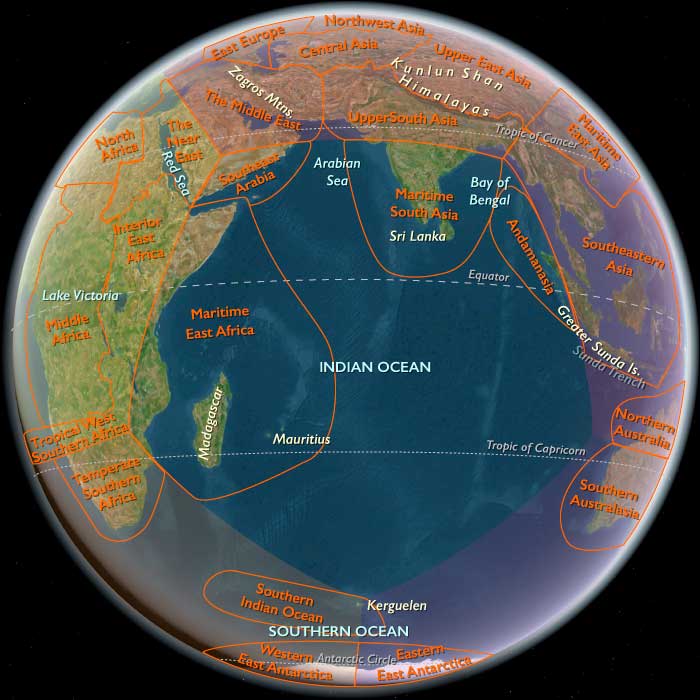
The Indian Ocean Lands
View →Related Events
Showing 3 events out of 3 total
East Africa (1828–1971 CE)
Caravans, Kingdoms, Empires, and Independence
Geography & Environmental Context
East Africa comprises two fixed subregions:
-
Maritime East Africa — Somalia, eastern Ethiopia, eastern Kenya, eastern Tanzania (including Zanzibar and Pemba), northern Mozambique, southern Malawi, and the island nations of Comoros, Madagascar, Mauritius, and Seychelles.
-
Interior East Africa — Eritrea, Djibouti, Ethiopia, South Sudan, Uganda, Rwanda, Burundi, Zambia’s northwestern margin, northern Zimbabwe, northern Malawi, northwestern Mozambique, inland Tanzania, and inland Kenya.
Anchors include the Great Rift Valley, Lake Victoria, Lake Tanganyika, and Lake Malawi, the Ethiopian Highlands, the Swahili coast, and the Indian Ocean islands. The region stretches from coral coasts and monsoon ports to volcanic highlands and plateau kingdoms.
Climate & Environmental Shifts
Monsoon winds sustained coastal trade, while alternating wet and dry seasons structured inland life. The late 19th century saw famine and rinderpest (1890s) devastate livestock and populations. The 20th century brought ecological engineering—railways, irrigation, and conservation parks—alongside deforestation and soil erosion. Drought cycles recurred in the Horn and interior; locusts and tsetse flies remained persistent threats. Climatic contrasts between humid coasts and arid hinterlands shaped political geography, as highland states and lowland caravan routes competed for control of trade and people.
Subsistence & Settlement
-
Maritime East Africa: Coastal communities combined fishing, coral gardening, and small-scale farming of coconuts, cloves, and grains. On Zanzibar and Pemba, the clove plantations established under Sultan Seyyid Said thrived on enslaved labor. In Madagascar, the Merina Kingdom unified the central highlands and expanded wet-rice farming.
-
Interior East Africa: Highland polities such as Buganda, Bunyoro, and Ethiopia’s Shewa expanded through trade and conquest. Maize and banana cultivation sustained dense populations. After 1890, British, German, and Belgian colonial powers imposed hut taxes and cash-crop systems (cotton, coffee, sisal). Settler estates in Kenya and Tanganyika displaced African farmers; pastoralists adapted by engaging in labor markets or moving into reserves.
Technology & Material Culture
Caravan trade used oxen, donkeys, and later porters to carry ivory and slaves inland to coastal markets. The Uganda Railway (1896–1901) and the Tanga and Central Lines in German East Africa opened the interior to global commerce. Mission presses introduced literacy; railways and telegraphs expanded administration. In the 20th century, imported bicycles, radios, and sewing machines joined local crafts—basketry, textiles, wood carving, and ironwork—forming hybrid material cultures. Coastal stone architecture and carved doors persisted beside new cement towns.
Movement & Interaction Corridors
-
Indian Ocean monsoon routes connected Zanzibar, Mombasa, Lamu, Sofala, Aden, and Bombay; dhows carried people, ivory, slaves, and spices.
-
Caravan routes—notably those of Tippu Tip and Hamed bin Muhammad—linked the interior lakes to the coast.
-
Pilgrimage and diaspora: Muslim scholars traveled to Mecca; Indian, Arab, and Comorian traders settled in coastal cities.
-
Mission and education networks: CMS, White Fathers, and Jesuits spread Christianity, schools, and medical missions inland.
-
War and liberation corridors: WWII troop movements (Abyssinia Campaign, 1940–41), Mau Mau resistance in Kenya (1952–60), and Tanzania’s and Zambia’s postwar support for southern African liberation linked East Africa to wider continental struggles.
Cultural & Symbolic Expressions
The Swahili language and Islamic culture unified coastal societies, while inland oral traditions preserved lineage, cattle, and warrior ideals. Christianity expanded literacy and hymnody; Islam deepened scholarly and mercantile ties. Literature, from Hamitic chronicles to Swahili poetry, blended Arabic script and local forms. In the 20th century, anticolonial writers such as Ngũgĩ wa Thiong’o, Okot p’Bitek, and Julius Nyerere’s political essays articulated new visions of identity. Coastal music (taarab) and inland dances symbolized cultural fusion.
Environmental Adaptation & Resilience
Rotational cultivation and fallowing preserved soil fertility; pastoralists tracked rainfall patterns and rebuilt herds after rinderpest. Irrigation terraces in Ethiopia, banana groves in Buganda, and shifting cultivation in Madagascar reflected ecological diversity. In the 20th century, national parks (e.g., Serengeti, 1951; Tsavo, 1948) institutionalized conservation but often displaced local communities. Rural cooperatives, ujamaa villages, and community irrigation projects (1960s–70s) reflected adaptation to postcolonial development goals.
Political & Military Shocks
-
Colonial conquest: The Scramble for Africa (1880s–90s) divided the region among Britain, Germany, Belgium, France, and Portugal.
-
Ethiopia’s resilience: The Battle of Adwa (1896) preserved Ethiopian independence under Menelik II; Italian invasion (1935–41) under Mussolini was defeated in WWII with Allied support.
-
Resistance and uprisings: The Maji Maji Rebellion (1905–07) in German East Africa, the Hehe resistance, and the Somali Dervish movement (1899–1920) testified to enduring autonomy.
-
World Wars: East Africa was a key front in both conflicts; labor and resources were conscripted for imperial armies.
-
Decolonization:
-
Tanzania (1961), Uganda (1962), Kenya (1963), Malawi (1964), Zambia (1964), and Madagascar (1960) achieved independence.
-
Somalia unified its British and Italian territories (1960); Comoros and Mauritius followed later in the 1970s.
-
Eritrea was federated with Ethiopia (1952) and annexed (1962), sowing seeds of later conflict.
-
Regional federations such as the East African Community (1967) sought economic unity.
-
Transition
Between 1828 and 1971, East Africa transformed from a network of coastal sultanates and caravan kingdoms into a mosaic of colonial states and independent nations. The Swahili coast, once dominated by monsoon commerce and slavery, gave way to global trade in cash crops and labor migration. Inland, Christianity, Islam, and anticolonial nationalism remade political identity. Railways and cash crops reoriented the economy; liberation movements redrew its moral geography. By 1971, East Africa had become a region of independent states—from Ethiopia’s highlands to Madagascar’s forests—poised between the legacies of empire and the aspirations of Pan-African renewal.
Maritime East Africa (1828–1971 CE): Clove Empires, Colonial Partition, and Island Independence
Geographic & Environmental Context
The subregion of Maritime East Africa includes Somalia, eastern Ethiopia, eastern Kenya, eastern Tanzania and its islands, northern Mozambique, the Comoros, Madagascar, Mauritius, and Seychelles. Anchors included the Swahili ports of Zanzibar, Mombasa, and Mogadishu; the clove plantations of Zanzibar and Pemba; the rice terraces of the Merina highlands in Madagascar; and the sugar estates of Mauritius and Seychelles. From coral rag coasts and mangrove estuaries to highland terraces and volcanic islands, this littoral zone became both a hub of global commerce and a theater of European colonization.
Climate & Environmental Shifts
The retreat of the Little Ice Age brought warming trends, though coastal and island regions continued to experience cyclones and drought cycles. Zanzibar endured periodic clove crop failures from pests and storms. Madagascar’s south suffered recurrent drought, while highland rice fields stabilized production. Mauritius and Seychelles faced hurricanes that devastated sugar and coconut crops. Coastal fisheries remained resilient but faced pressure from expanding populations and trade.
Subsistence & Settlement
-
Zanzibar and Pemba: Became global centers of clove cultivation under Omani sultans, relying on enslaved Africans from the mainland. Rice, cassava, and coconuts sustained islanders; fishing and trade supplemented diets.
-
Swahili coast (Kenya–Tanzania–Mozambique): Farmers grew millet, cassava, and maize in coastal hinterlands; fishing and mangrove harvesting persisted. Towns expanded around ports linked to Indian Ocean trade.
-
Somalia and eastern Ethiopia: Pastoralists herded camels, sheep, and goats, supplementing with sorghum and date cultivation in oases.
-
Madagascar: The Merina kingdom centralized power under Radama I and successors, expanding rice terraces and cattle herding; coastal groups (Sakalava, Betsimisaraka) farmed, fished, and engaged in maritime trade.
-
Comoros: Mixed subsistence of rice, cassava, coconuts, and fishing; cloves planted in the 19th century tied islands into world markets.
-
Mauritius and Seychelles: Sugar estates dominated, worked by enslaved laborers until emancipation (1830s–1840s) and later Indian indentured migrants; coconuts and spices diversified production.
Technology & Material Culture
Omani rulers built stone palaces, forts, and clove-processing houses in Zanzibar. Dhows remained central for Indian Ocean trade, carrying cloves, ivory, and slaves. Imported firearms armed coastal elites. In Madagascar, Merina kings constructed fortified hill capitals and expanded irrigation systems. French colonists introduced European-style architecture and mills in Madagascar, Comoros, Mauritius, and Seychelles. Textiles, pottery, and coral-stone mosques continued Swahili traditions; in the Mascarenes, creole architecture and music blended African, European, and Indian influences.
Movement & Interaction Corridors
-
Slave and ivory trade: In the early 19th century, dhows carried enslaved Africans from mainland ports (Bagamoyo, Kilwa, Mozambique Island) to Zanzibar and beyond; ivory caravans reached deep into the interior.
-
Abolition: Britain pressured Zanzibar into anti-slavery treaties (1822, 1873), though clandestine trade persisted into the late 19th century.
-
Colonial partition: Britain took Kenya, Zanzibar (protectorate, 1890), and Somaliland; Germany claimed Tanganyika; France colonized Madagascar (1896) and the Comoros; Portugal retained Mozambique. Mauritius and Seychelles passed to Britain (1810).
-
Labor migrations: Indian indentured workers moved to Mauritius, Seychelles, and coastal East Africa. African porters staffed ivory and rubber caravans inland.
-
20th-century transport: Railways (Uganda Railway to Mombasa, Tanga line) tied coast to interior; steamships and later air links bound islands to global routes.
Cultural & Symbolic Expressions
Swahili Islamic culture thrived in mosques, Qur’anic schools, and poetry; Omani rule reinforced Arabic scholarship. The Zanzibar court became a symbol of coastal Islamic power. In Madagascar, Merina rulers blended traditional rituals with European-style monarchy until French conquest. Catholic and Protestant missions spread across the coast, Madagascar, and the islands, establishing schools and churches. Creole cultures flourished in Mauritius and Seychelles, expressed in séga music, cuisine, and festivals. Oral traditions, ancestor veneration, and ritual feasts persisted across the subregion.
Environmental Adaptation & Resilience
Farmers incorporated cassava, maize, and cloves to buffer crop failures. Pastoralists shifted herds seasonally in Somali and Ethiopian lowlands. Merina highlanders expanded rice terraces, securing resilience against famine. After emancipation, plantation societies adapted through indentured labor systems. Coastal and islanders rebuilt after cyclones, diversifying crops and relying on fishing. Conservation initiatives began mid-20th century, especially in Madagascar’s forests and island ecosystems.
Technology & Power Shifts (Conflict Dynamics)
-
Omani Zanzibar: Under Said bin Sultan, Zanzibar became a clove empire and slave entrepôt; later sultans governed under British oversight.
-
Colonial conquest: France subdued Madagascar (1896); Germany ruled Tanganyika until World War I, when Britain assumed control. Somalia was partitioned between Britain, Italy, and France. Portugal tightened rule in Mozambique.
-
Resistance: Local revolts resisted colonial demands—e.g., Maji Maji Rebellion (1905–1907) in German East Africa. Malagasy uprisings (1947) challenged French rule.
-
Independence movements: Mauritius (1968), Somalia (1960), Madagascar (1960), Comoros (1975, just beyond this span), and Seychelles (1976, also just beyond) emerged from decolonization. Zanzibar’s revolution (1964) overthrew the sultanate, uniting with Tanganyika to form Tanzania.
Transition
By 1971 CE, Maritime East Africa had been transformed from a Swahili–Omani corridor into a mosaic of colonial and postcolonial states. Zanzibar’s clove plantations, Madagascar’s rice highlands, and Mauritius’s sugar estates tied the region to global markets, even as nationalist movements reshaped politics. Swahili culture, Islamic learning, and Malagasy ritual traditions persisted alongside new Christian and creole identities. Maritime East Africa entered the modern era as both a crossroads of global trade and a crucible of independence struggles.
Maritime East Africa (1960–1971 CE): Independence Achieved, National Consolidation, and Regional Realignments
From 1960 to 1971 CE, Maritime East Africa—including the Swahili Coast, Comoros, Madagascar, Mauritius, Seychelles, and Somali coastal territories—experiences transformative developments marked by widespread independence, national consolidation, and significant regional and international realignments.
Achievement of Independence and Nation-Building
This era witnesses the dramatic realization of independence for most of Maritime East Africa. Somalia leads the way, achieving independence in 1960 through the unification of British Somaliland and Italian Somaliland, forming the Somali Republic. The new government emphasizes Somali nationalism and embarks on ambitious programs to unify Somali-speaking territories, laying groundwork for regional tensions.
In Tanganyika, independence from Britain is secured in 1961 under the leadership of Julius Nyerere and TANU. Tanganyika subsequently unites with Zanzibar, following the Zanzibar Revolution of 1964, to form the United Republic of Tanzania. Nyerere introduces "Ujamaa," a socialist-inspired policy aimed at rural development, self-reliance, and collective ownership, fundamentally shaping Tanzania’s national identity.
Kenya attains independence from British colonial rule in 1963, with Jomo Kenyatta as its first Prime Minister and later President. The country faces immediate challenges of unifying diverse ethnic groups, addressing land redistribution, and navigating Cold War dynamics while solidifying its national identity and governance structures.
Political Evolution and Challenges in Madagascar and Comoros
In Madagascar, full independence from France occurs in 1960 under the presidency of Philibert Tsiranana. The early post-independence period is marked by moderate policies closely aligned with France. However, rising nationalist sentiments and economic frustrations fuel political tension, setting the stage for later political upheaval and ideological realignment.
The Comoros Islands see heightened political mobilization during this period, characterized by active demands for autonomy and eventual independence from French colonial rule. Internal political developments increasingly move toward complete independence, although formal independence will not be achieved until later.
Malawi and Mozambique
Malawi achieves independence from Britain in 1964, with Hastings Kamuzu Banda becoming its first president. Blantyre emerges as an economic and political focal point for the newly independent nation, emphasizing development and regional trade.
Mozambique, still under Portuguese control, faces a protracted liberation war initiated by FRELIMO (Front for the Liberation of Mozambique), particularly affecting central and northern areas, reshaping regional political dynamics.
Mauritius and Seychelles: Paths Toward Sovereignty
In Mauritius, independence from Britain is achieved in 1968, with Seewoosagur Ramgoolam becoming the first Prime Minister. The new nation faces the immediate challenge of economic diversification, moving beyond reliance on sugar production to develop industries such as tourism, textiles, and manufacturing.
The Seychelles intensifies demands for self-governance and economic development, though it remains a British colony through this period. Growing political awareness and activism lay critical groundwork for full independence in the following decade.
Regional Dynamics and Cold War Influences
The geopolitical landscape of Maritime East Africa is significantly influenced by the broader Cold War context. Newly independent states navigate competing interests from Western nations, the Soviet Union, and China. Somalia’s strategic location near critical maritime routes increases international interest, leading to shifting alliances and regional tensions, particularly with Ethiopia and Kenya.
The formation of the East African Community in 1967, comprising Kenya, Uganda, and Tanzania, exemplifies regional cooperation efforts, promoting economic integration and collaborative infrastructure projects, though internal political differences pose ongoing challenges.
Legacy of the Era
The era from 1960 to 1971 CE fundamentally reshapes Maritime East Africa, marked by the historic realization of independence, ambitious national consolidation efforts, and significant regional realignments within the Cold War framework. This foundational period lays essential groundwork for the diverse political, economic, and social trajectories that Maritime East African nations will follow in subsequent decades.