Sigismund of Burgundy
king of the Burgundians
Years: 475 - 524
Sigismund (died 524) is king of the Burgundians from 516 to his death.
He is the son of king Gundobad, whom he succeeds in 516.
Sigismund and his brother Godomar are defeated in battle by Clovis' sons and Godomar flees.
Sigismund is taken by Chlodomer, King of Orléans, where he is kept as a prisoner.
He is drowned in the village of St Pervay la Colombe, near Orléans.
Godomar then rallies the Burgundian army and wins back his kingdom.
Meanwhile, Chlodomer orders the death of Sigismund and marches with his brother Theuderic I, King of Metz, on Burgundy in 524.
Related Events
Filter results
Showing 9 events out of 9 total
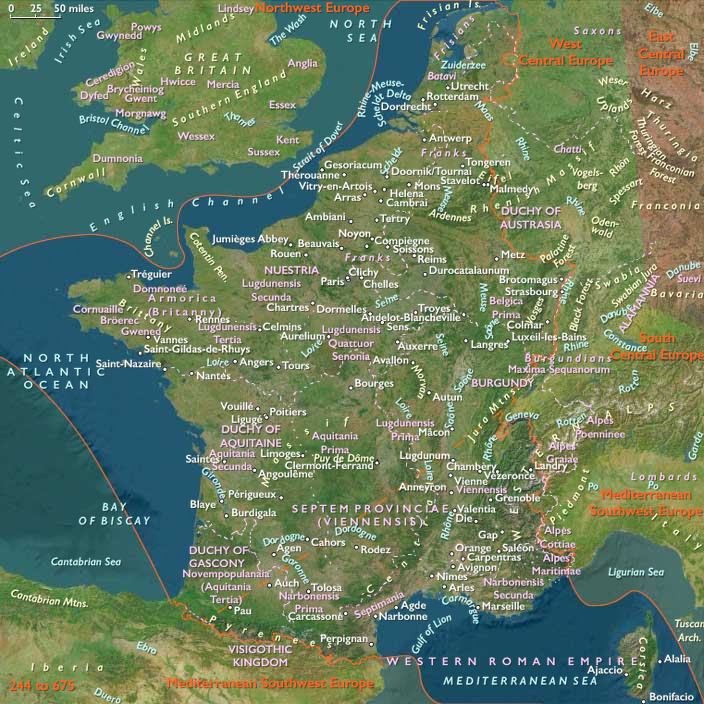
Atlantic West Europe (508–519): Frankish Consolidation, Burgundian Stability, and Ecclesiastical Strengthening
Between 508 and 519, Atlantic West Europe saw the Merovingian Franks consolidate territorial and political gains following the decisive Battle of Vouillé (507). The Frankish Kingdom under Clovis I stabilized its dominance over Gaul, integrating Gallo-Roman traditions, legal structures, and ecclesiastical institutions. Meanwhile, the Burgundian kingdom preserved a degree of autonomy under careful diplomacy, and the Visigothic presence receded definitively into Iberia.
Political and Military Developments
-
Frankish Kingdom: Consolidation under Clovis I
-
Following the conquest of Visigothic territories in Gaul, Clovis I secured his gains by establishing stable governance across Aquitaine and southwestern Gaul, aligning closely with regional bishops and Gallo-Roman aristocrats.
-
He actively fostered administrative continuity by adopting Roman law traditions, notably issuing the Lex Salica (Salic Law) in revised form around 511, blending Roman and Germanic customs.
-
-
Division of the Frankish Kingdom (511):
-
Clovis’s death in 511 led to the division of the Frankish kingdom among his four sons: Theuderic, Chlodomer, Childebert, and Chlothar.
-
Each son governed a portion of the realm from their regional capitals: Metz (Theuderic), Orléans (Chlodomer), Paris (Childebert), and Soissons (Chlothar). This partition initiated a complex phase of dynastic rivalries, although unity was maintained against external threats.
-
-
Burgundian Stability under Gundobad and Sigismund:
-
King Gundobad (d. 516) maintained careful diplomatic relations with the Frankish rulers, preserving Burgundian territorial integrity.
-
His successor, Sigismund (r. 516–524), continued this balancing act, though Frankish pressures intensified. The kingdom remained autonomous, emphasizing internal governance and legal reforms.
-
-
Visigothic Kingdom Retreat and Reorientation:
-
Visigothic territories north of the Pyrenees had been largely lost by 508. The remaining Visigothic kingdom reorganized south of the Pyrenees under King Theodoric the Great of the Ostrogoths, who intervened as regent following internal Visigothic strife.
-
Visigothic focus shifted definitively toward Iberia, leading to a long-term reorientation of Visigothic culture and governance toward Hispania.
-
Economic and Social Developments
-
Integration of Roman and Frankish Economic Structures:
-
The Frankish kingdom's economic foundation became increasingly tied to extensive agricultural estates managed by bishops and aristocrats, who served as intermediaries between royal authority and local populations.
-
Economic integration between northern and southern Gaul expanded, driven by regional trade networks that benefited from the Frankish peace and internal stability.
-
-
Growing Role of Aristocracy and Church:
-
Frankish and Burgundian aristocrats strengthened their roles in managing land and resources, often controlling local governance in cooperation with bishops.
-
Episcopal estates grew, becoming significant centers of economic and social power, further linking secular and religious authority.
-
Religious and Cultural Developments
-
Strengthening of Catholic Orthodoxy:
-
Clovis’s embrace of Catholic Christianity continued to reshape religious identity. The Catholic Church gained unprecedented influence, with episcopal leaders such as Remigius of Reims playing crucial political roles.
-
Ecclesiastical synods (e.g., Council of Orléans in 511) helped standardize religious practices, clarify episcopal authority, and support Merovingian royal legitimacy.
-
-
Continued Decline of Arianism:
-
Arian Christianity, previously dominant among Visigothic elites, rapidly diminished north of the Pyrenees under Frankish Catholic rule.
-
Catholicism’s dominance set the stage for religious uniformity and reduced sectarian tensions within the Frankish realms.
-
Legacy and Significance
By 519, Atlantic West Europe had undergone significant political and cultural reorientation:
-
The Frankish kingdom consolidated its hold on Gaul, successfully blending Roman traditions with Frankish governance, and laying foundations for future medieval monarchies.
-
Burgundy retained stability through skillful diplomacy and internal reform but increasingly operated in Frankish orbit.
-
The Catholic Church emerged stronger than ever, closely intertwined with secular governance, significantly shaping Western Europe's religious, social, and cultural trajectories.
This era thus established enduring political structures and religious patterns that profoundly influenced the development of early medieval Europe.
St. Maurice's Abbey is built on the ruins of a Roman shrine of the first century BCE to the god Mercury in the Roman staging-post of Agaunum, and first came to prominence as a result of a now disputed account by Saint Eucherius, Bishop of Lyon, who lived from about 380 to about 449).
Eucherius had experienced a revelation that convinced him of the martyrdom of a Roman legion, known as the "Theban Legion", under the leadership of Saint Maurice, around CE 285, in the area where the abbey is located.
The basilica of St. Maurice of Agaunum becomes the church of a monastery in 515 under the patronage of King Sigismund of Burgundy, the first ruler in his dynasty to convert from Arian Christianity to Trinitarian Christianity.
Sigismund had been a student of Avitus of Vienne, the Catholic bishop of Vienne who had converted Sigismund from the Arian faith of his Burgundian forebears.
Sigismund sets up five groups of monks to whom he entrusts the liturgy of the praise of God.
King Gundobad revives trial by combat as a solution to justice, establishing, in 501, judicial duel or trial by battle, the earliest form of the duel as a formal method of settling an argument or point of honor.
Gundobad is the likely promulgator of the Lex Burgundionum, a tribal code of the Burgundians, concerning marriage and inheritance as well as regulating weregild and other penalties (approximate date).
Interaction between Burgundians is treated separately from interaction between Burgundians and Gallo-Romans.
The oldest of the fourteen surviving manuscripts of the text dates to the ninth century, but the code's institution is ascribed to Gundobad , with a possible revision by his successor Sigismund.
King Sigismund of Burgundy is opposed by his son Sigeric, who also insults his new wife, and has him strangled.
Overcome with remorse, he retreats to the monastery that he founded, St. Maurice's Abbey.
The Frankish-Burgundian Wars and the Fall of Sigismund (523–524 CE)
Following the death of Gundobad, king of Burgundy, in 516 CE, the throne passes to his son, Sigismund, a convert to Catholic Christianity. His reign is marked by religious tensions and political conflicts, particularly with the Franks and the Ostrogoths.
Sigismund’s Anti-Arian Policies and Political Missteps
- Sigismund abandons Arianism, the traditional faith of the Burgundian aristocracy, and adopts Catholicism, creating tensions within his kingdom.
- His harsh suppression of Arianism culminates in the execution of his own son, Sigeric, in 522 CE.
- Sigeric was the grandson of Theoderic the Great, the powerful Ostrogothic king of Italy.
- This act alienates Theoderic, depriving Sigismund of potential Ostrogothic support.
- Sigismund also antagonizes the Franks, nearly provoking an invasion, but temporarily averts war by marrying his daughter to Theuderic I, king of Metz.
First Frankish Invasion (523 CE): Sigismund’s Downfall
- Queen Clotilde, the widow of Clovis and a Burgundian princess, urges her sons Chlothar, Childebert, and Chlodomer to wage war against Sigismund to avenge their grandfather, Chilperic II of Burgundy, whom Gundobad had executed decades earlier.
- The Frankish kings invade Burgundy in 523, crushing Sigismund’s forces.
- Sigismund is captured and executed, while his brother Godomar flees.
Burgundian Resistance and the Battle of Vézeronce (524 CE)
- With the support of the Burgundian aristocracy, Godomar returns and retakes the throne.
- The Franks launch a second invasion in 524, this time including Theuderic I alongside Chlothar, Childebert, and Chlodomer.
- They advance deep into the Isère Valley, but on June 25, 524, at the Battle of Vézeronce, the Frankish army suffers a severe defeat.
- Chlodomer is killed in battle, dealing a major blow to the Frankish campaign.
Aftermath and Consequences
- Following their defeat, the Franks retreat, allowing Godomar to reclaim the Burgundian throne.
- The conflict remains unresolved, as Burgundy resists full Frankish domination for the time being.
- The Franks eventually conquer Burgundy in 534 CE, incorporating it into the Frankish realm permanently.
This war marks one of the early major conflicts between the Franks and the Burgundians, setting the stage for Frankish expansion and the eventual absorption of Burgundy into the growing Merovingian empire.
Atlantic West Europe (520–531): Frankish Expansion, Burgundian Integration, and Ecclesiastical Consolidation
Between 520 and 531, Atlantic West Europe experienced the continued rise of the Merovingian Franks as the dominant political force, marked notably by their absorption of the Burgundian kingdom. Dynastic politics intensified among Clovis's successors, ecclesiastical influence expanded, and a distinctive blend of Roman and Frankish traditions solidified, shaping the foundations of early medieval European culture.
Political and Military Developments
-
Frankish Kingdom: Rivalries and Territorial Expansion
-
Clovis’s sons—Theuderic I, Chlodomer, Childebert I, and Chlothar I—continued the Frankish kingdom's dynastic rivalries, with alliances frequently shifting among brothers.
-
Chlodomer of Orléans initiated war against Burgundy (523), aiming to conquer and integrate its territory. He achieved initial successes but was killed at the Battle of Vézeronce (524), complicating Frankish politics.
-
-
Absorption of the Burgundian Kingdom (523–534):
-
Following Chlodomer’s death, his brothers Childebert and Chlothar resumed the Burgundian campaign, leading ultimately (by 534) to Burgundy’s incorporation into the Frankish dominions.
-
King Sigismund of Burgundy, defeated and captured by Chlodomer in 524, was executed, leading to the ascension of his brother Godomar, who briefly resisted before Burgundy’s final annexation.
-
-
Visigothic Consolidation in Iberia:
-
North of the Pyrenees, former Visigothic territories remained under firm Frankish control. Southward, the Visigoths consolidated power in Iberia, increasingly isolated from Atlantic West European affairs.
-
Economic and Social Developments
-
Integration of Burgundian and Frankish Economies:
-
The absorption of Burgundy expanded Frankish control over crucial trade routes and productive agricultural territories, strengthening economic ties across the region.
-
The growing prominence of ecclesiastical estates continued, reinforcing the church’s central economic and social roles in Gaul.
-
-
Urban Decline and Ruralization:
-
Urban centers in the former Roman Gaul experienced steady decline, with populations dispersing to rural estates controlled by local nobility or church authorities.
-
This shift further entrenched feudal relationships and reduced the administrative significance of Roman cities.
-
Religious and Cultural Developments
-
Increased Ecclesiastical Influence:
-
Regional synods, including the influential Council of Clermont (535) shortly after this era, reinforced episcopal authority and standardized church practices, underlining the church's integration into Frankish governance.
-
Bishops played decisive roles in local administration, further consolidating Catholic influence across Frankish territories.
-
-
Decline of Arian Christianity:
-
The integration of Burgundy, largely Catholic, into the Frankish kingdom further marginalized Arianism north of the Pyrenees, reinforcing Catholic dominance and shaping future religious homogeneity in Western Europe.
-
Legacy and Significance
By 531, Atlantic West Europe saw profound consolidation and reshaping:
-
Frankish power was significantly strengthened, incorporating Burgundy and reshaping political boundaries within Gaul.
-
Dynastic rivalries among Clovis’s successors set a precedent for future Merovingian conflicts, influencing the kingdom’s subsequent political instability.
-
Ecclesiastical authority became firmly embedded in governance structures, shaping cultural and social development.
These transformations laid enduring foundations, defining the political, cultural, and religious character of early medieval Europe for centuries to come.
…Sigismund dons a monk's habit and hides in a cell near his abbey.
He is captured by Chlodomer, king of Aurelianum (modern Orléans), and taken prisoner to Aurelianum.
Godomar now rallies the Burgundian army and calls for aid from his ally, the Ostrogothic king Theodoric the Great.
Godomar regains his territory.
However, the garrison the Franks had left behind are massacred.
Chlodomer takes the offensive again but is killed at the Battle of Vézeronce on June 25, 524, reportedly at the hands of Godomar.
In vengeance, Frankish soldiers behead Sigismund and throw his body in a well at Coulmiers.
Sigismund's two sons Gisald and Gondebaud are also put to death.
Sigismund is succeeded on the throne by his brother Godomar.
The definitive defeat of the Burgundians reverses their fortunes permanently and assures eventual annexation of their kingdom to that of the Merovingians.
The chief legacy of the battle within Francia is the division of Chlodomer's kingdom among his brothers and the dispossession (and murder) of his young heirs.