he Middle East: 1792–1803 CE
Expansion and Assertiveness of the Saudi-Wahhabi State
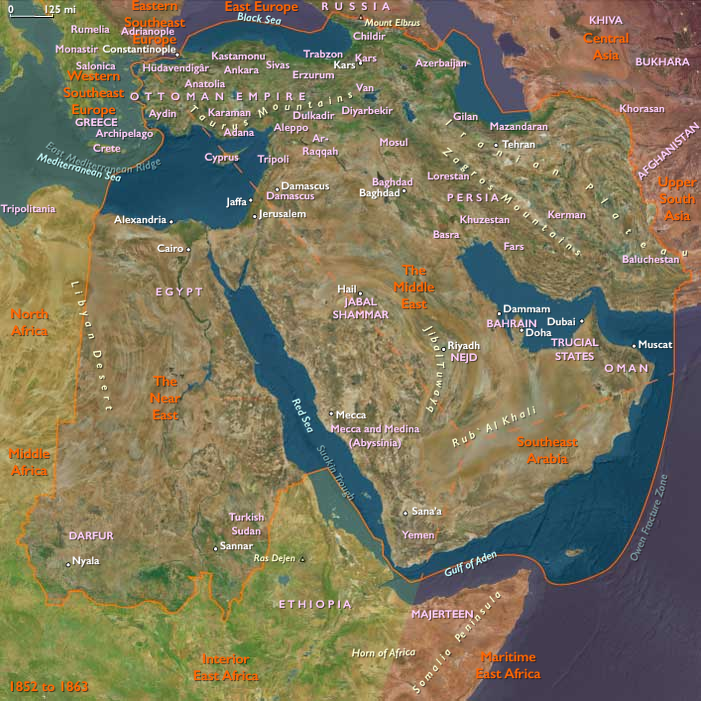
Under the determined leadership of Abdul Aziz ibn Muhammad ibn Saud, the Saudi-Wahhabi state continues its aggressive expansion throughout Arabia. By the early 1790s, Saudi forces solidify control over key strategic and economic centers, further entrenching their dominance and extending strict Wahhabi practices. This aggressive campaign culminates in the conquest of Ta'if in 1802 and the subsequent Wahhabi siege of the sacred city of Mecca in 1803. These successes not only boost their prestige but significantly enhance their economic and political leverage across the Arabian Peninsula.
Qajar Consolidation and Regional Influence
In Persia, the Qajar dynasty, under the firm rule of Agha Mohammad Khan Qajar and, following his assassination in 1797, his successor Fath-Ali Shah Qajar, continues to strengthen its political control. Agha Mohammad Khan decisively consolidates Persian territories, notably reclaiming Khorasan and establishing firm control over Georgia by reconquering Tbilisi in 1795. Following his death, Fath-Ali Shah maintains internal stability, secures the borders, and continues the centralization of administrative and military structures, laying the groundwork for Persia's future stability.
Continued Maritime Dominance of Oman
Under Sultan bin Ahmad al-Busaidi (1792–1804), Oman solidifies its maritime and commercial dominance. Sultan bin Ahmad expands naval capabilities and reinforces control over strategic coastal ports and islands along the Persian Gulf and the Indian Ocean. The bustling port of Muscat remains an essential hub for trade, linking Persia, India, and East Africa. Oman's ruling family divides in 1793 into two main lines, with Sultan bin Ahmad's lineage controlling the maritime state, and the Qais branch overseeing the Al Batinah and Ar Rustaq regions. This maritime prosperity supports internal political cohesion and ensures the continued wealth and prominence of the Al-Busaidi dynasty.
Tribal Dynamics and Economic Prosperity in the Persian Gulf
In Qatar, the economic boom in Az Zubarah persists, driven by thriving trade and pearl diving. Tribal rivalries, notably between the Al Khalifa and the Al Jalahima clans, intensify significantly. In 1795, these rivalries culminate in the Al Khalifa conquest of Bahrain, shifting their economic focus away from Az Zubarah, which subsequently declines. The Al Jalahmas, dissatisfied with the Al Khalifa's claims, relocate along the Qatari coast to establish Al Khuwayr, becoming feared maritime raiders, particularly under their leader, Rahman ibn Jabir Al Jalahma. Meanwhile, the Al Thani clan maintains its presence in Qatar, increasingly aligned with Wahhabi principles.
The Al bu Falah clan establishes their headquarters at the site of Abu Dhabi town in 1795, allying themselves strategically with the Sultanate of Muscat and Oman against their rivals, the Qawasim pirates of Ra's al-Khaimah and ash-Shariqah sheikhdoms.
Further Decline of Ottoman Influence and Growing Tribal Autonomy
Ottoman authority over its Arab territories continues to wane dramatically, as powerful tribal confederations such as the Muntafiq and the Kurdish Baban Dynasty maintain considerable autonomy in Iraq and Kurdistan, respectively. The weakening grip of the Ottomans results in frequent clashes and localized governance, underscoring the Empire's inability to effectively administer distant provinces. The declining Ottoman presence encourages the further rise of independent tribal and regional leaders, who increasingly negotiate their positions with minimal Ottoman interference.
Legacy of the Era
The era from 1792 to 1803 marks a critical period of territorial and political consolidation for the Saudi-Wahhabi state and the Qajar dynasty, as well as sustained maritime economic prosperity for Oman. The fragmentation of Ottoman authority, coupled with dynamic tribal rivalries and shifting economic fortunes in the Persian Gulf region, establishes enduring patterns of decentralized governance and localized autonomy, significantly shaping the geopolitical landscape of the Middle East for decades to follow.