Susenyos I
Emperor of Ethiopia
Years: 1572 - 1632
Susenyos (throne name Malak Sagad III, "to whom the angel bows"; 1572 - 7 September 1632) is nəgusä nägäst (1606–1632) of Ethiopia.
His father was Abeto (Prince) Fasilides, a grandson of Dawit II; as a result, while some authorities list him as a member of the Solomonic dynasty, others consider him, instead of his son, as the founder of the Gondar line of the dynasty (ultimately a subset, however, of the Solomonic dynasty).
Manuel de Almeida, a Portuguese Jesuit who lived in Ethiopia during Susenyos' reign, described him as "tall, with the features of a man of quality, large handsome eyes, pointed nose and an ample and well groomed beard.
He was wearing a tunic of crimson velvet down to the knee, breeches of the Moorish style, a sash or girdle of many large pieces of fine gold, and an outer coat of damask of the same colour, like a capelhar.”

Related Events
Filter results
Showing 10 events out of 18 total
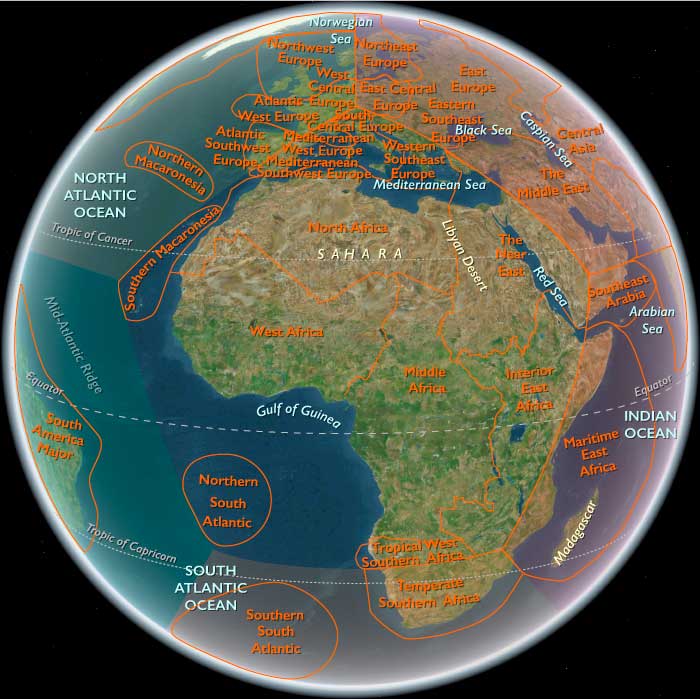
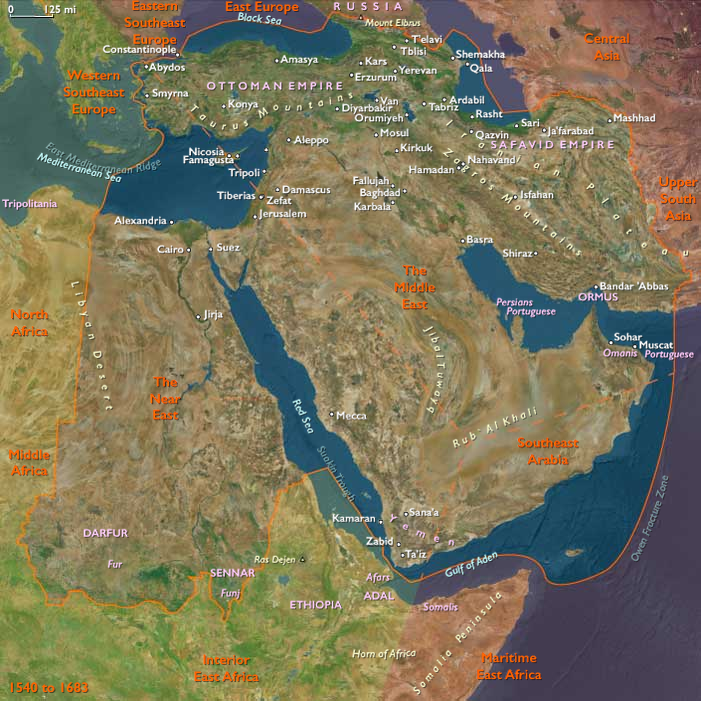
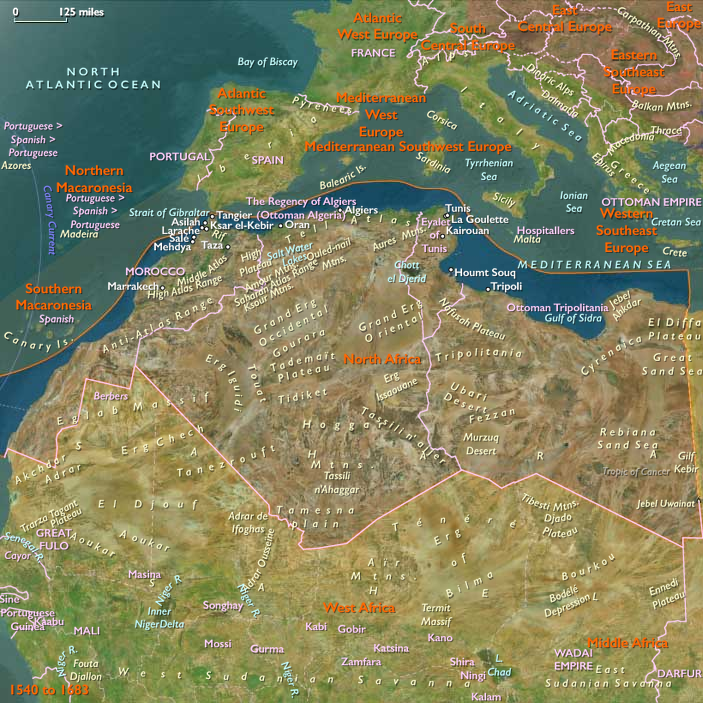
Interior East Africa (1540–1683 CE): Gunpowder Frontiers, Oromo Migrations, and Great Lakes Statecraft
Geographic & Environmental Context
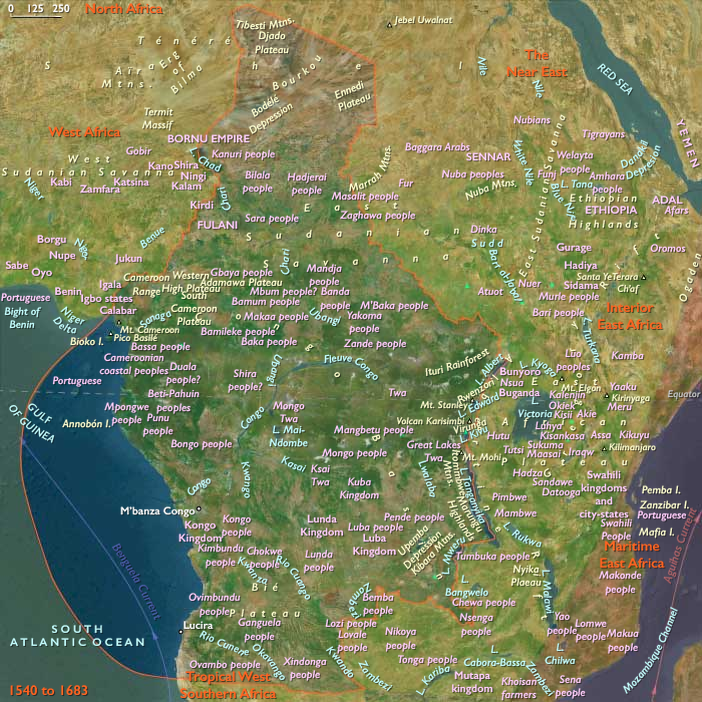
The subregion of Interior East Africa includes Eritrea, Djibouti, Ethiopia, South Sudan, Uganda, Rwanda, Burundi, Zambia, northern Zimbabwe, northern Malawi, northwestern Mozambique, inland Tanzania, and inland Kenya. Anchors include the Ethiopian and Eritrean highlands, the Rift Valley lakes and corridors (Tana, Turkana, Victoria, Kivu, Tanganyika, Mweru), the interlacustrine plateaus (Rwanda–Burundi–Uganda), the savanna woodlands of inland Tanzania and Zambia, and the Lake Chad–Nile fringe toward South Sudan. Highlands, plateaus, and rift basins remained the interior’s great funnels, carrying people, herds, ideas, and goods between the Nile and the Indian Ocean.
Climate & Environmental Shifts
The later Little Ice Age intensified interannual variability. Highland Ethiopia experienced frost episodes and drought pulses that stressed terrace fields and church granaries. Equatorial plateaus saw uneven long and short rains, with years of bumper banana and millet harvests followed by shortfalls. Major rift lakes fluctuated, shifting fisheries and floodplain soils; farther south, miombo belts alternated between fire-opened woodland and denser canopies as rainfall wavered.
Subsistence & Settlement
-
Highlands (Ethiopia/Eritrea): Mixed plow agriculture—teff, barley, wheat, pulses—on terraced slopes; ox traction; beekeeping; coffee gardens in humid pockets. Sheep, goats, and cattle grazed uplands; church forests protected springs and pollinators.
-
Interlacustrine plateau (Uganda–Rwanda–Burundi): Intensive banana/plantain (matoke) complexes with beans, yams, and finger millet; cattle and small stock structured rank, tribute, and marriage payments.
-
Savannas and rift margins (inland Tanzania–Zambia–n. Malawi/n. Mozambique): Sorghum, pearl millet, later maize (gaining ground mid-period); groundnuts and cucurbits; riverine and lacustrine fisheries on Victoria, Tanganyika, Mweru.
-
Pastoral–agro-pastoral belts (Turkana, Karamoja, South Sudan): Seasonal transhumance of cattle, sheep, goats; grain via exchange with cultivators; dry-season wells and pasture reserves managed by lineage councils.
Technology & Material Culture
Highland terraces, stone bunds, and hillside canals stabilized soils; wooden scratch plows with iron shares anchored grain regimes. Ironworking furnished hoes, knives, and prestige blades; salt bars from Danakil and rift natron moved as media of exchange. Courtly ateliers in the Great Lakes produced drums, inlaid stools, and regalia; barkcloth and banana-fiber cordage provisioned dense settlements. In churches and monasteries, parchment manuscripts, bindings, and processional crosses embodied elite devotion. Matchlocks and powder arrived to the northern highlands via the Red Sea; inland, smiths refitted imported barrels and forged spearheads and mail.
Movement & Interaction Corridors
Ridge-top roads and river fords tied Solomonic capitals to granary provinces and Massawa; caravan paths crossed Afar to salt pans. Southward, drum-roads and canoe chains linked Bunyoro, Buganda, Rwanda, Burundi, and Karagwe to fisheries, iron districts, and interior–coast exchanges (cloth, beads, copper, later slaves and ivory) that fed Swahili entrepôts indirectly from inland markets. To the west and south, copper and salt moved between plateau polities and the central African savannas; to the Nile, cattle, captives, and gum filtered through the Sudd margins.
Cultural & Symbolic Expressions
-
Highlands: The Solomonic monarchy maintained Christian sacral kingship; saints’ feasts, fasting calendars, and monastic networks bound rural parishes to the throne. Hymns, hagiographies, and chronicles legitimated rule and recorded calamities and victories.
-
Great Lakes kingdoms: Royal drums and regnal names staged sovereignty; origin epics and shrine cults ordered land, cattle, and rain. Clientship idioms (ubugabire, ubuhake) tied patrons and clients; clan shrines mediated justice.
-
Pastoral belts: Age sets, cattle rituals, oath-taking over spears and gourds, and ngoma song cycles governed drought, pasture, and war.
Environmental Adaptation & Resilience
Highlanders intercropped cereals and pulses, rotated terraces, and relied on church granaries; when fields failed, bee-keeping and forest coffee buffered diets. Plateau households stabilized soils through perennial banana groves, mulch, and shade; smoked fish bridged hungry seasons. Pastoralists staggered herds by age/sex across grazing zones, kept drought boreholes in reserve, and traded milk/meat for grain. Salt, iron, and cloth circulated as crisis goods; shrine networks coordinated labor for canal repair and terrace rebuilding after deluges.
Technology & Power Shifts (Conflict Dynamics)
Northern politics pivoted on gunpowder frontiers and migration:
-
The Adal–highland wars crested when Ahmad ibn Ibrahim “Gragn” drove matchlock-armed campaigns deep into the Christian kingdom (1529–1543). With Portuguese musketeers and cannon, highland forces reversed Adal’s advances; by the 1540s the immediate threat subsided.
-
The Oromo expansions (mid-16th–17th centuries) surged into the highlands via gadaa-organized age-sets, transforming demography, landholding, and tribute in Shewa, Bale, and beyond; armed horsemen and lancers reshaped frontier ecologies and politics.
-
Jesuit missions followed victory—Susenyos briefly embraced Catholicism (1620s), provoking revolt; Fasilidesexpelled Jesuits (1632) and inaugurated the Gondar era (from c. 1636), rebuilding churches and courts while keeping firearms at arm’s length.
Across the interlacustrine, statecraft thickened: Bunyoro defended iron and fish corridors; Buganda expanded eastward along Lake Victoria’s shores; Rwanda’s Nyiginya court centralized hills through cattle-clientship; Burundiconsolidated regnal drums and hill polities. Earthwork forts, stockades, and long-drum signals coordinated musters; raiding and captives entered inland–coast circuits more visibly late in the period.
Transition
By 1683 CE, Interior East Africa had been remapped by war, migration, and statecraft. The highland throne survived the gunpowder shock, turned inward to Gondar, and faced a transformed Oromo frontier; the Great Lakes courts consolidated along lakes, gardens, and drum-roads; pastoral corridors adapted to climate flicker with deeper transhumance calendars. Inland caravan and canoe markets bound producers to distant Indian Ocean demand without ceding autonomy. The next age would tighten those links: ivory, captives, and cloth flows, new firearms, and missionary diplomacy—extending interior polities’ reach even as external pressures grew.
Nevertheless, joining the forces of the Christian kingdom, the Portuguese succeed eventually in helping to defeat and kill Gragn.
Portuguese Roman Catholic missionaries arrived in 1554.
Efforts to induce the Ethiopians to reject their Monophysite beliefs and accept Rome's supremacy continue for nearly a century and engender bitterness as pro- and anti-Catholic parties maneuver for control of the state.
At least two emperors in this period allegedly convert to Roman Catholicism.
The second of these, Susenyos (reigned 1607-32), after a particularly fierce battle between adherents of the two faiths, abdicates in 1632 in favor of his son, Fasilides (reigned 1632-67), to spare the country further bloodshed.
The expulsion of the Jesuits and all Roman Catholic missionaries follows.
This religious controversy leaves a legacy of deep hostility toward foreign Christians and Europeans that will continue into the twentieth century.
It also contributes to the isolation that follow for the next two hundred years.
Sarsa Dengel campaigns twice in Ennarea, in southwest Ethiopia, the first time in 1586, and the second time in 1597.
On the final campaign against the Oromo, his Chronicle records, a group of monks tried to dissuade him from this expedition; failing that, they warned him not to eat fish from a certain river he would pass.
Despite their warning, when he passed by the river the monks warned him about, he ate fish taken from this river and grew sick and died.
Sarsa Dengel had intended to make his nephew Za Dengel his successor, but under the influence of his wife Maryam Sena and a number of his sons-in-law, he instead chose his son Yaqob, who is seven when he comes to the throne, with Ras Antenatewos of Begemder as his regent.
Za Dengel and the other rival for the throne—Susenyos, the son of Abeto Fasilides—are exiled, but Za Dengel escapes to the mountains around Lake Tana, while Susenyos finds refuge in the south among the Oromo.
Interior East Africa (1600–1611 CE): Challenges of Succession, Religious Tensions, and Growing Foreign Influence in Ethiopia
The Brief Reign of Emperor Yaqob and Dynastic Instability
The early seventeenth century in Interior East Africa began with uncertainty and internal instability, centered around Ethiopia’s imperial throne. Emperor Yaqob (Malak Sagad II) (reigned 1597–1603), successor of the strong and centralizing Sarsa Dengel, faced mounting opposition from powerful regional nobles who had chafed under his father’s firm administrative policies. Yaqob's rule quickly became characterized by court intrigues and rebellion, notably from ambitious provincial governors seeking to reassert their traditional autonomy.
Despite his efforts to maintain central control, Emperor Yaqob was eventually overthrown in a coup in 1603, plunging the empire into a short but chaotic struggle for power.
Ascension and Early Rule of Emperor Za Dengel
Following Yaqob’s deposition, Ethiopia witnessed a swift succession by his cousin, Emperor Za Dengel (reigned 1603–1604). Za Dengel initially demonstrated promise, moving decisively to suppress revolts and restore central authority. He, too, was drawn into religious controversies as Portuguese Jesuits increased pressure to convert the Ethiopian Orthodox Church to Roman Catholicism, promising military and diplomatic support from Portugal in exchange.
In a notable diplomatic and religious shift, Za Dengel briefly aligned himself with the Jesuit missionaries, declaring openness to conversion to Catholicism—largely a political maneuver aimed at gaining external support to stabilize his precarious rule. This decision, however, severely alienated influential segments of Ethiopian society, especially the powerful Orthodox clergy and traditionally-minded nobility, triggering a significant backlash.
The Restoration and Firm Rule of Emperor Susenyos I
The religious and political crises under Za Dengel's brief reign paved the way for the emergence of a more durable ruler, Emperor Susenyos I (reigned 1607–1632), who ascended the throne following several years of turmoil and contested successions. Initially hailed as a stabilizing figure capable of reunifying the empire, Susenyos swiftly acted to suppress revolts and reassert imperial authority in Ethiopia’s central and peripheral provinces.
Recognizing the damage wrought by his predecessor's Catholic overtures, Susenyos initially appeared cautious in his approach to the Jesuits. However, his increasing interactions with Portuguese missionaries and their persuasive arguments regarding Catholic support in military and economic affairs led him gradually toward their influence.
Foreign Influences: Portuguese Jesuits and Early European Intervention
By 1610, the presence and influence of Portuguese Jesuit missionaries had grown substantially, increasingly intertwined with Ethiopia’s political dynamics. Jesuit leaders such as Pedro Páez arrived in Ethiopia, gaining access to Susenyos’s court and establishing a permanent mission presence. Páez, in particular, gained the emperor’s confidence, slowly laying the groundwork for greater Catholic influence.
The presence of these missionaries provoked tension within Ethiopian society. While the Jesuits offered expertise in architecture, engineering, and diplomacy, benefiting the imperial court materially, they simultaneously challenged the Orthodox Church's established religious traditions and authority.
Regional Stability and External Relations
Despite internal tensions, the early years of Susenyos's reign saw Ethiopia regain a measure of stability and regional authority. External threats from Muslim sultanates such as Adal had diminished considerably, though smaller skirmishes continued along border areas. The imperial administration reasserted control over vital trade routes, facilitating an economic recovery from previous decades of conflict.
Ethiopia also continued its complex diplomatic relationship with Ottoman representatives on the Red Sea, balancing cooperation with resistance to direct Ottoman domination. The emperor sought Portuguese naval support to counterbalance Ottoman maritime influence, making strategic alliances even more critical for Ethiopia’s security and prosperity.
Key Historical Developments
-
Turbulent reign of Emperor Yaqob ending in deposition (1603), followed by brief and controversial reign of Za Dengel.
-
Ascension and early stabilization under Emperor Susenyos I (1607), with renewed emphasis on central authority.
-
Increased Portuguese Jesuit missionary influence at the imperial court, notably through Pedro Páez.
-
Continued religious tensions arising from Jesuit efforts to convert the Ethiopian Orthodox Church to Roman Catholicism.
-
Strategic management of relationships with regional Muslim powers and Ottoman representatives, aiming at securing economic and military stability.
Long-Term Consequences and Historical Significance
This era in Interior East Africa marked a critical juncture in Ethiopian history. It exposed vulnerabilities in the centralized monarchy, highlighting the persistent tension between imperial authority and regional autonomy. Moreover, the increasing influence of European missionaries, especially Portuguese Jesuits, set the stage for severe internal religious conflicts that would significantly impact Ethiopia’s political and cultural landscape. Emperor Susenyos’s complex relationship with the Jesuits, characterized by both cooperation and caution, presaged a later, more dramatic embrace of Catholicism, which would lead to greater internal strife. The delicate diplomatic balancing act practiced in this era also provided important precedents for Ethiopia’s interactions with external powers in the coming centuries.
Za Dengel’s religious conversion leads to Za Sellase not only withdrawing his support, but actively working against him and stirring up a revolt in Gojjam.
Za Dengel marches to the plain of Bartcho to put down this revolt, but despite the help of two hundred Portuguese musketeers ,Za Dengel perishes in battle on October 24.
According to James Bruce, Za Dengel's corpse lay unclaimed on the battlefield for three days, until some peasants buried it "in a little building, like a chapel (which I have seen), not above six feet high, under the shade of a very fine tree, in Abyssinia called sassa."
The body will be reinterred ten years later in Daga Estifanos monastery on Daga Island in Lake Tana.
When Susyenos was a boy, a group of marauding Oromo had captured him and his father, Abeto (Prince) Fasilides, a grandson of Dawit II; holding them captive for over a year until they were rescued by the Dejazmach Assebo.
Upon his rescue, he had gone to live with Queen Admas Mogasa, the widow of Emperor Mena and mother of Sarsa Dengel, nəgusä nägäst from 1563 to 1597.
Susenyos in the 1590s had been perceived as a potential successor to the throne, as Emperor Sarsa Dengel's sons were very young.
Empress Maryam Sena, in order to eliminate Susenyos from the competition, had had him exiled, but Susenyos had managed to escape and find refuge among his former captors, the Oromo.
At the death of his one-time ally, Emperor Za Dengel, Susenyos is proclaimed his successor and returns to the realm, although the fight against Emperor Yaqob continues.
Not long after Za Dengel is defeated and killed in battle, Susenyos marches north at the head of an army raised among the Oromo, and sends a message to Ras Antenatewos proclaiming himself as king and demanding support from Antenatewos; unable to communicate with Za Sellase, the Ras sends his troops to support Susenyos.
A similar message to Za Sellase only serves to steel Za Sellase into action: he marches on Susenyos, who, sick from fever, retreats into the mountains of Amhara.
This lack of resolve persuades Ras Antenatewos to waver in his support, and as the rainy season passes Za Sellase begins to negotiate his submission to Susenyos.
At this moment Yaqob reveals himself in Dembiya and both Ras Antenatewos and Za Sellase flock to his side.
Susenyos manages to first surprise and decimate the forces of Za Sellase at Manta Dafar in Begemder; when Za Sellase escapes to Yaqob's camp, the Emperor's derision causes Za Sellase to defect to Susenyos.
For several days, the armies of the two rival emperors maneuver in the mountains of Gojjam, to at last meet in the Battle of Gol on March 10, 1606, where Yaqob and Abuna Petros II are killed in battle, and his troops slaughtered.
Susenyos becomes Emperor following the defeat of first Za Sellase, then Yaqob at the Battle of Gol in 1606, which is in southern Gojjam.
Pedro Páez’s caution benefits his cause: Susenyos invites him to his court, where the two become friends.
Susenyos' reign is perhaps best known as the brief period in Ethiopian history when Roman Catholic Christianity became the official religion.
The Emperor became interested in Catholicism, in part due to Páez' persuasion, but also hoping for military help from Portugal and Spain.
Susenyos hopes to receive a new contingent of well-armed European soldiers, this time against the Oromo, who are ravaging his kingdom, and to help with the constant rebellions.
Two letters of this diplomatic effort survive, which he entrusts to Páez to send to Europe: the one to the King of Portugal is dated December 10, 1607, while the other is to the Pope and dated October 14 of the same year; neither mention his conversion, but both ask for soldiers.
He shows the Jesuit missionaries his favor by a number of land grants, most importantly those at Gorgora, located on a peninsula on the northern shore of Lake Tana.
A rebel appears near Debre Bizen in 1608.
Because the body of Yaqob had never been found after the Battle of Gol, there has been some doubt that the previous Emperor is truly dead, and the pretender announces that he is the dead Emperor Yaqob.
The pretender manages to disguise the fact he does not resemble Yaqob by keeping part of his face covered, claiming that he had suffered grievous wounds to his teeth and face from the battle.
The governor of Tigray, Sela Krestos, eventually hears of the revolt, and not trusting the loyalty of a general levy of troops, strikes against the rebel with his own household and the descendants of the Portuguese soldiers who had followed Cristóvão da Gama into Ethiopia.
Despite defeating the rebels three different times, the pretender has managed to escape each battle to hide in the mountains of Hamasien.
Meanwhile, Emperor Susenyos is preoccupied with raiding parties of the Oromo.
An initial encounter with the Marawa Oromo near the upper course of the Reb River ends in a defeat for the Ethiopians; Susenyos rallies his men and makes a second attack which scatter the Oromo.
The Marawa ally with other Oromo, and the united force enters Begemder to avenge their defeat.
Upon hearing of this, the Emperor responds by summoning his son-in-law Qegnazmach Julius and Kifla Krestos to join him with their troops, and defeats the raiders at Ebenat on January 17, 1608.
According to James Bruce, the Royal Chronicle of Susenyos reports 12,000 Oromo were killed while only 400 on the Emperor's side were lost.
With the Oromo threat dealt with, Susenyos now can turn his attention to Yaqob the pretender; he marches to Axum by way of the Lamalmo and Waldebba, where he is formally crowned Emperor on March 18, 1608, in a ceremony described by João Gabriel, the captain of the Portuguese in Ethiopia.
Despite this act legitimizing his rule, Susenyos has no luck capturing the pretender, and is forced to leave the task to his servant Amsala Krestos.
Amsala Krestos induces two brothers who had joined the rebellion to assassinate Yaqob the pretender, who then send the dead man's head to Susenyos.
Without a scarf obscuring his features, writes Bruce, "it now appeared, that he had neither scars in his face, broken jaw, nor loss of teeth; but the covering was intending only to conceal the little resemblance he bore to king Jacob, slain, as we said before, at the battle of Lebart."
According to his Royal Chronicle, Susenyos makes his power felt along his western frontier from Fazogli north to Suakin.