
Thomas Henry Huxley
English biologist (anatomist)
1825 CE to 1895 CE
Thomas Henry Huxley PC FRS (4 May 1825 – 29 June 1895) is an English biologist (anatomist), known as "Darwin's Bulldog" for his advocacy of Charles Darwin's theory of evolution.
Huxley's famous 1860 debate with Samuel Wilberforce is a key moment in the wider acceptance of evolution, and in his own career.
Huxley had been planning to leave Oxford on the previous day, but, after an encounter with Robert Chambers, the author of Vestiges, he had changed his mind and decided to join the debate.
Wilberforce is coached by Richard Owen, against whom Huxley also debates whether humans are closely related to apes.
Huxley is slow to accept some of Darwin's ideas, such as gradualism, and is undecided about natural selection, but despite this he is wholehearted in his public support of Darwin.
He is instrumental in developing scientific education in Britain, and fights against the more extreme versions of religious tradition.
In 1869, Huxley coins the term 'agnostic' to describe his own views on theology, a term whose use has continued to the present day.
Huxley has little formal schooling and teaches himself almost everything he knows.
He becomes perhaps the finest comparative anatomist of the latter 19th century.
He works on invertebrates, clarifying relationships between groups previously little understood.
Later, he works on vertebrates, especially on the relationship between apes and humans.
After comparing Archaeopteryx with Compsognathus, he concludes that birds have evolved from small carnivorous dinosaurs, a theory widely accepted today.
The tendency has been for this fine anatomical work to be overshadowed by his energetic and controversial activity in favor of evolution, and by his extensive public work on scientific education, both of which have significant effects on society in Britain and elsewhere.
World
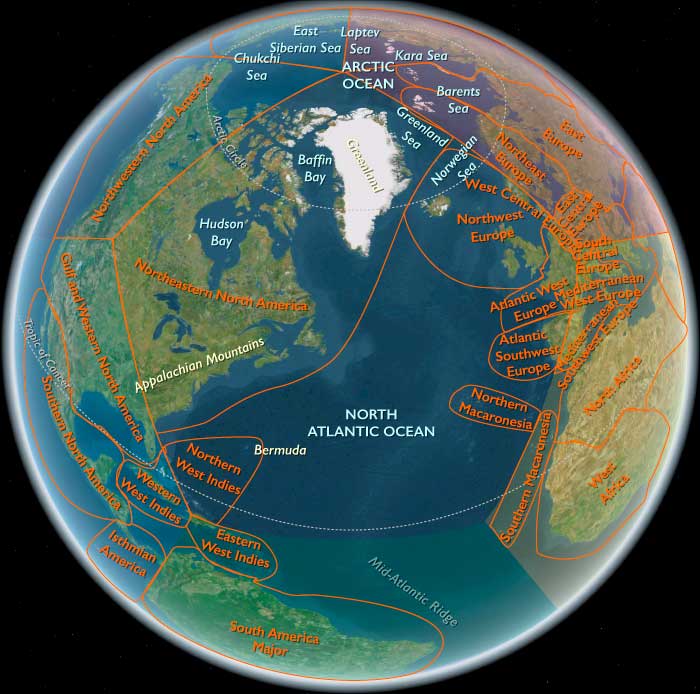
The Atlantic Lands
View →Related Events
Showing 2 events out of 2 total
The response to the Morant Bay rebellion had generated fierce debate after the news broke in Britain, with public figures of different political affiliations lining up to support or oppose Governor Eyre's actions.
When Eyre returned to Britain in August 1866, his supporters had held a banquet in his honor, while opponents at a protest meeting the same evening had condemned him as a murderer.
Opponents had gone on to establish the Jamaica Committee, which calls for Eyre to be tried for his excesses in suppressing the "insurrection."
More radical members of the Committee want him tried for the murder of British subjects under the rule of law.
The Committee includes English liberals, such as John Bright, Charles Darwin, John Stuart Mill, Thomas Huxley, Thomas Hughes and Herbert Spencer.
An opposing committee, which includes such Tories and Tory socialists as Thomas Carlyle, Charles Dickens, and John Ruskin, springs up in Eyre's defense.
Twice Eyre is charged with murder, but the cases will never proceed.
From 1866 to 1867, Haeckel has made an extended journey to the Canary Islands with Hermann Fol and during this period, had met with Charles Darwin, in 1866 at Down House in Kent, Thomas Huxley and Charles Lyell.
Ernst Haeckel was born on February 16, 1834, in Potsdam (then part of Prussia).
In 1852, Haeckel had completed studies at Cathedral High School (Domgymnasium) of Merseburg, then studied medicine in Berlin and Würzburg, particularly with Albert von Kölliker, Franz Leydig, Rudolf Virchow (with whom he would later work briefly as assistant), and with anatomist-physiologist Johannes Peter Müller (1801–1858).
Together with Hermann Steudner, he had attended botany lectures in Würzburg.
In 1857, Haeckel had attained a doctorate in medicine (M.D.), and afterwards had received a license to practice medicine.
The occupation of physician appeared less worthwhile to Haeckel, after contact with suffering patients.
Haeckel had studied under Karl Gegenbaur at the University of Jena for three years, earning a doctorate in zoology, before becoming a professor of comparative anatomy at the University of Jena, where he will remain for forty-seven years, from 1862 to 1909.
Between 1859 and 1866, Haeckel has worked on many invertebrate groups, including radiolarians, poriferans (sponges) and annelids (segmented worms).
During a trip to the Mediterranean, Haeckel had named nearly one hundred and fifty new species of radiolarians; he will name thousands of new species of various genera from 1859 to 1887.