Tycho Brahe
Danish astronomer
Years: 1546 - 1601
Tycho Brahe (14 December 1546 – 24 October 1601), born Tyge Ottesen Brahe (de Knudstrup), is a Danish nobleman known for his accurate and comprehensive astronomical and planetary observations.
Coming from Scania, at this time part of Denmark, today part of modern-day Sweden, Tycho is well known in his lifetime as an astronomer and alchemist.
His Danish name "Tyge Ottesen Brahe" is pronounced in Modern Standard Danish as [ˈtˢyːə ˈʌd̥əsn̩ ˈb̥ʁɑː].
He adoptsthe Latinized name "Tycho Brahe" (usually pronounced /ˈtaɪkoʊ ˈbrɑː/ or /ˈbrɑːhiː/ in English) from Tycho (sometimes written Tÿcho) at around age fifteen, and he is now generally referred to as "Tycho", as is common in Scandinavia in his time, rather than by his surname "Brahe".
(The incorrect form of his name, Tycho de Brahe, appeared only much later.)
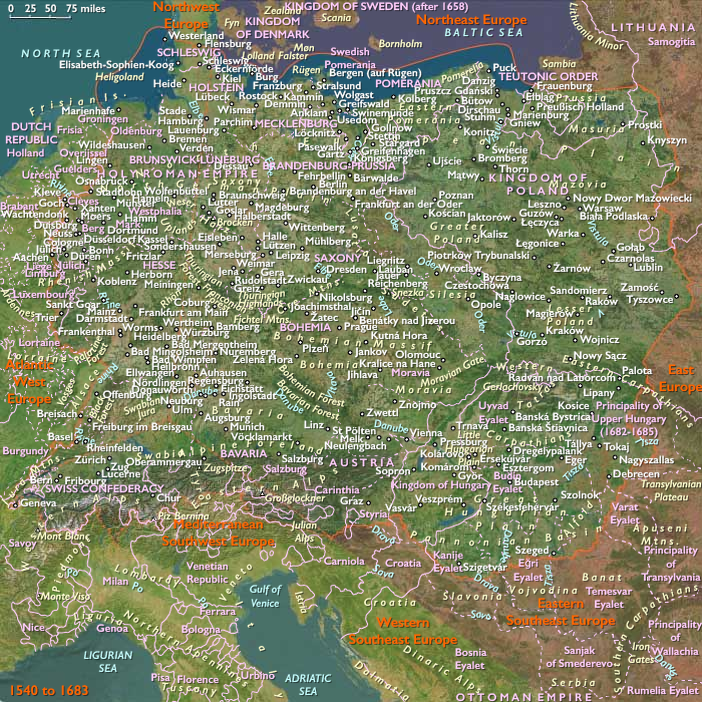
Tycho Brahe is granted an estate on the island of Hven and the funding to build the Uraniborg, an early research institute, where he builds large astronomical instruments and takes many careful measurements.
After disagreements with the new king in 1597, he is invited by the Bohemian king and Holy Roman emperor Rudolph II to Prague, where he becomes the official imperial astronomer.
He builds the new observatory at Benátky nad Jizerou.
Here, from 1600 until his death in 1601, he is assisted by Johannes Kepler.
Kepler will later use Tycho's astronomical information to develop his own theories of astronomy.
As an astronomer, Tycho worked to combine what he saw as the geometrical benefits of the Copernican system with the philosophical benefits of the Ptolemaic system into his own model of the universe, the Tychonic system.
Tycho is credited with the most accurate astronomical observations of his time, and the data is used by his assistant Kepler to derive the laws of planetary motion.
No one before Tycho had attempted to make so many planetary observations.

Related Events
Filter results
Showing 10 events out of 29 total
Tycho Brahe, born at Knudstrup in Scania, Denmark, has been raised by his uncle, Jorgen Brahe, who had sent the thirteen-year-old in 1559 to Copenhagen to study law.
The observation of a solar eclipse in 1560 had turned Tycho’s interest to observational astronomy and, contrary to his uncle's intentions, he has studied the subject independently, using Ptolemy's Almagest.
Tycho Brahe is sixteen years old in 1563 when he observes the conjunction of Jupiter and Saturn, an event that clearly demonstrates to him the inaccuracy of the existing records of planetary positions.
Northeast Europe (1564–1575 CE): Escalation of the Livonian War, Strategic Rivalries, and Regional Reconfigurations
Between 1564 and 1575 CE, Northeast Europe experienced heightened geopolitical turmoil primarily driven by the ongoing Livonian War. This era was marked by aggressive territorial expansion by the Grand Duchy of Muscovy, growing intervention by Sweden, Denmark–Norway, and the Polish–Lithuanian Commonwealth, and significant religious, economic, and demographic transformations across the region.
Intensified Conflict in the Livonian War
The prolonged Livonian War (1558–1583) intensified significantly during this period. Ivan IV (the Terrible) of Muscovy escalated his military campaigns in Livonia, aiming for strategic Baltic access and regional dominance. Muscovite forces devastated much of Livonia, severely destabilizing the already weakened Livonian Confederation.
Polish–Lithuanian Commonwealth's Expansion
In response, the Polish–Lithuanian Commonwealth under Sigismund II Augustus became increasingly assertive. The Union of Lublin in 1569 formally unified Poland and Lithuania into a single Commonwealth, enhancing their geopolitical strength. Poland–Lithuania intervened decisively in Livonian affairs, securing key southern territories and actively contesting Muscovite aggression, thereby reinforcing its regional dominance.
Swedish Territorial Gains and Colonization Efforts
Sweden, under Eric XIV (until 1568) and subsequently John III, expanded territorial control in Estonia and northern Livonia. Sweden fortified critical Baltic cities, notably Reval (Tallinn) and Narva, enhancing defensive capabilities and securing crucial commercial routes. Concurrently, Swedish colonization policies promoted settlements of Forest Finns, traditional practitioners of slash-and-burn agriculture, into sparsely populated provinces of Eastern Finland and subsequently into Swedish territories such as Gästrikland, Ångermanland, and Hälsingland. This colonization aimed to secure frontier lands against eastern threats and alleviate population pressures within Finland.
Denmark–Norway’s Baltic Ambitions
Under King Frederick II, Denmark–Norway pursued strategic territorial and economic interests in the contested Baltic region. Engaging in diplomatic and military interventions, Frederick sought to secure maritime trade routes and bolster Danish influence in Courland and Livonian territories. Denmark's active participation intensified rivalries, especially with Sweden.
Duchy of Prussia’s Stability
The secularized Duchy of Prussia, now under Duke Albert Frederick (from 1568), navigated regional instability by maintaining cautious diplomatic neutrality and strong internal governance. Economically vibrant urban centers like Königsberg ensured regional stability and economic prosperity despite the broader geopolitical turmoil.
Economic Resilience in Urban Centers
Despite military conflicts, major urban centers such as Reval (Tallinn), Riga, Königsberg, and Visby on Gotland maintained economic resilience through continued maritime trade, commercial networks, and stable urban governance. This economic strength significantly mitigated disruptions from ongoing warfare.
Religious and Cultural Transformations
Protestantism, particularly Lutheranism, further reshaped the religious and cultural landscape, fostering educational innovation and vernacular literacy. Nonetheless, religious tensions between Protestant and Catholic communities increased, complicating regional alliances and political dynamics.
Scientific Advancements and Astronomical Observations
This period also saw significant scientific advancements, notably by the Danish astronomer Tycho Brahe. Brahe’s meticulous astronomical observations, the most accurate prior to the invention of the telescope, provided a comprehensive study of the solar system and precise measurements of more than seven hundred seventy-seven fixed stars, paving the way for future discoveries and scientific progress in Northeast Europe.
Strategic Diplomatic Maneuvers
Diplomatic activities intensified significantly as regional powers navigated complex alliances, territorial disputes, and religious divisions driven by the ongoing Livonian crisis. Temporary truces, shifting alliances, and strategic negotiations characterized diplomatic efforts to stabilize and manage escalating conflict.
Legacy of the Era
The era from 1564 to 1575 CE significantly reshaped Northeast Europe's geopolitical and cultural landscapes. Intensified warfare, territorial realignments, demographic shifts from colonization efforts, and scientific advancements established lasting regional alignments, territorial boundaries, and cultural identities, fundamentally influencing Northeast Europe's subsequent historical trajectory.
Nineteen-year-old Dane Tycho Brahe had decided, upon the death of his guardian uncle in 1565, to travel throughout Europe, and has embarked on the study of science at several universities.
He returns in 1572 to Denmark and installs a chemical laboratory in the castle of a relative at Heridsvad Abbey, where he observes a "new star" (a supernova) in the constellation of Cassiopeia.
Brahe's detailed observations of the appearance of the supernova call into question the notion of immutability of the heavens.
In his first work, De Nova Stella, published in 1573, Brahe establishes that the nova he observed in Cassiopeia is a star beyond the Moon's orbit.
Northeast Europe (1576–1587 CE): Climactic Phases of the Livonian War and Geopolitical Realignments
Between 1576 and 1587 CE, Northeast Europe experienced the climactic phases of the Livonian War, marked by complex geopolitical rivalries, continued territorial reconfigurations, and strategic diplomatic realignments. This era significantly impacted the region’s political structures, economic vitality, and cultural transformations, laying foundations for future stability.
Climax of the Livonian War
The Livonian War (1558–1583) reached its decisive stages during this period, with continuing military engagements among Muscovy, Sweden, Denmark–Norway, and the Polish–Lithuanian Commonwealth. Persistent warfare devastated Livonian territories, causing profound demographic and economic disruptions. The prolonged conflict ultimately exhausted regional resources, prompting major powers to seek strategic resolutions.
Polish–Lithuanian Commonwealth’s Ascendance
Under King Stefan Batory (r. 1576–1586), the Polish–Lithuanian Commonwealth strengthened its position in Livonia through decisive military victories against Muscovy, including the successful siege of Polotsk (1579) and the strategic campaigns of 1580–1581. These successes significantly enhanced Polish–Lithuanian dominance in Livonia, consolidating southern territories and establishing stronger administrative control, thus shaping regional geopolitics.
Swedish Consolidation and Expansion
Sweden, under King John III, consolidated territorial control over northern Livonia and Estonia, reinforcing strategic fortifications in critical cities like Reval (Tallinn) and Narva. Swedish administrative reforms and fortified defenses safeguarded economic interests and provided stability, allowing continued colonization and settlement efforts, notably involving Forest Finns, thus strengthening Sweden's geopolitical influence along the eastern Baltic.
Danish–Norwegian Influence and Maritime Interests
Under Frederick II, Denmark–Norway remained deeply engaged in Baltic geopolitics, securing strategic maritime routes and contesting Swedish and Polish–Lithuanian ambitions. Danish influence in Courland and Baltic islands strengthened through active diplomacy and naval deployments, further intensifying regional rivalries.
Muscovite Setbacks and Territorial Adjustments
Muscovy, under Ivan IV (the Terrible), faced significant setbacks during this era. Repeated military defeats and internal administrative challenges weakened Muscovite positions in Livonia. Muscovy’s territorial ambitions suffered crucial limitations, prompting diplomatic negotiations and shifts in strategy to mitigate losses.
Stability and Economic Growth in the Duchy of Prussia
The secularized Duchy of Prussia, under Duke Albert Frederick, continued maintaining cautious neutrality, promoting internal stability and economic growth, particularly in urban centers like Königsberg. Its strategic location enabled sustained economic prosperity despite broader regional instability, positioning Prussia favorably within the shifting geopolitical landscape.
Economic Resilience in Major Urban Centers
Key cities such as Reval (Tallinn), Riga, Königsberg, and Visby on Gotland maintained economic resilience through sustained maritime commerce and robust merchant networks. These urban economies provided crucial regional stability, mitigating adverse impacts from ongoing military conflicts and geopolitical uncertainty.
Religious and Cultural Developments
Protestantism, especially Lutheranism, solidified further across Northeast Europe, significantly reshaping educational practices, cultural identities, and social institutions. Meanwhile, Catholic–Protestant tensions remained prevalent, influencing political alliances, internal governance, and regional diplomacy.
Scientific and Intellectual Advancements
Advancements continued through intellectual figures such as Danish astronomer Tycho Brahe, whose astronomical research during this period furthered understanding of celestial mechanics, solidifying Northeast Europe’s role as an emerging center of scientific and intellectual development.
Diplomatic Realignments and Peace Negotiations
Diplomatic negotiations intensified significantly as regional powers sought to end protracted conflicts. Complex diplomatic maneuvers culminated in preliminary peace negotiations, setting the stage for eventual resolutions and redefined territorial boundaries. These efforts marked significant strategic shifts among regional powers, reflecting emerging geopolitical realignments.
Legacy of the Era
The era from 1576 to 1587 CE profoundly shaped Northeast Europe's historical trajectory, characterized by decisive military outcomes, strategic territorial adjustments, and sustained economic and intellectual developments. These dynamics laid crucial foundations for future political stability, territorial configurations, and cultural identities, influencing the region significantly into the seventeenth century.
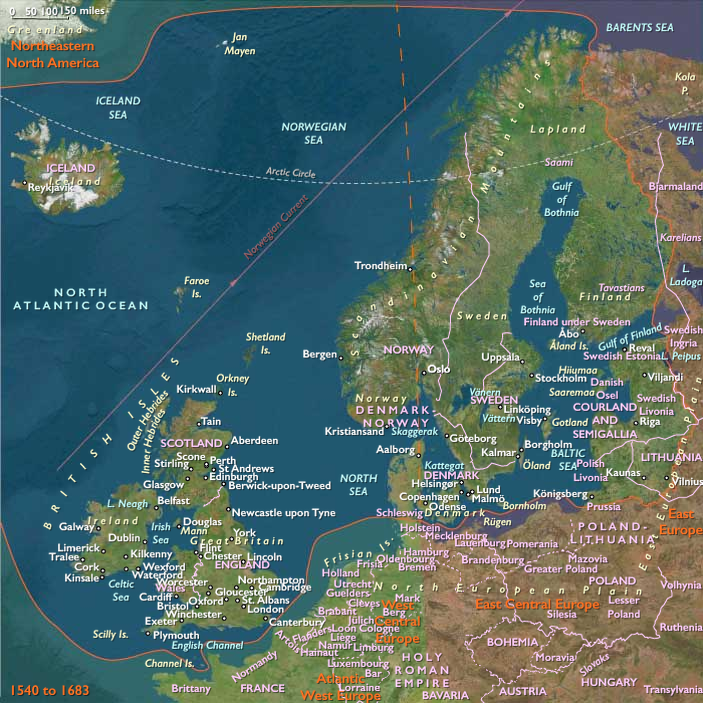
Frederick II of Denmark grants the island of Hven (off the coast of southern Sweden, under Danish hegemony) in fief to Danish astronomer Tycho Brahe in 1576.
A palatial three-story building is constructed in which student astronomers and staff are quartered and royalty is sometimes entertained.
Instruments include quadrants, parallactic rulers, and armillary spheres, built to Tycho's demanding standards of accuracy.
Uraniborg is the last of the primitive observatories in that it antedates by thirty years the invention of the telescope; and it is the first of the modern observatories in that it is completely supported by the state and produces the first organized, extensive array of dependable data in astronomical history, including a catalog of more than one thousand stars.
Tycho compares the lack of diurnal parallax of the comet of 1577 with the well-known parallax of the Moon (the diurnal parallax is the apparent change of position in the sky relative to the distant stars due to the rotation of the Earth).
Tycho deduces that the comet is at least four times farther away than the Moon, establishing for the first time critical proof that comets are heavenly bodies.
Tycho, putting forward his scheme for the structure of the solar system in 1583, retains from the ancient Ptolemaic system the idea of Earth as a fixed center of the universe around which the Sun and Moon revolve, but he holds that, as in the newer system of Copernicus, all other planets revolve around the Sun.
In both the Tychonic and the Ptolemaic systems, an outer sphere containing the fixed stars is considered to revolve every day around the Earth.
The Tychonic theory explains the observed variations of phase of Venus, for which the Ptolemaic system had no explanation.
A system somewhat similar to Tycho's had been proposed in the 4th century BC by the Greek philosopher Heracleides Ponticus, who thought that at least Mercury and Venus (it is uncertain if Heracleides included other planets) went around the Sun.
William IV, Landgrave (or count) of Hesse-Kassel from 1567, is called “the Wise” because of his accomplishments in political economy and the natural sciences.
The partition of the Hessian lands at that time had left William with little basis for a forceful foreign policy.
Domestically, he has sought a compromise between Lutherans and Calvinists.
He is an outstanding organizer and a skilled economist.
The Ökonomische Staat (1585), a territorial survey compiled for him, is a model of administrative statistics.
William also pursues scientific studies and perhaps owes his lasting fame to his research in astronomy.
On friendly terms with the great Danish astronomer Tycho Brahe, he constructs numerous astronomical instruments and calculates many stellar positions.
Northeast Europe (1588–1599 CE): Post-War Stabilization, Continued Rivalries, and Cultural Flourishing
Between 1588 and 1599 CE, Northeast Europe transitioned from prolonged warfare to relative stabilization following the conclusion of the Livonian War. This period saw cautious diplomatic realignments, internal political consolidations, continued economic resilience, and significant cultural and intellectual developments, even as regional rivalries persisted.
Aftermath and Stabilization Following the Livonian War
The Treaty of Plussa (1583) and the Truce of Yam-Zapolsky (1582) ended hostilities, allowing Northeast Europe a brief respite from decades of warfare. Territories previously ravaged by conflict, especially in Livonia, began recovery processes through reconstruction and economic revitalization, although geopolitical tensions remained high among former combatants.
Swedish Consolidation and Governance in Estonia and Livonia
Under John III (r. until 1592) and subsequently his son Sigismund III Vasa, Sweden solidified its control over northern Livonia and Estonia. Sweden improved administrative governance, reinforced defensive fortifications in key cities such as Reval (Tallinn) and Narva, and encouraged continued settlement by communities like the Forest Finns, enhancing Sweden’s territorial stability and economic strength.
Polish–Lithuanian Commonwealth’s Internal Strength and Regional Influence
The Polish–Lithuanian Commonwealth under Sigismund III Vasa (r. from 1587) sought internal stability and consolidation of its extensive Livonian territories. The Commonwealth maintained effective administrative control, promoted economic recovery, and strengthened diplomatic relationships, solidifying its role as a central power influencing Northeast Europe’s geopolitical landscape.
Denmark–Norway’s Maritime and Diplomatic Ambitions
Under Christian IV (r. from 1588), Denmark–Norway actively strengthened its Baltic maritime interests. The kingdom invested in naval expansion, enhanced fortifications, and diplomatic initiatives aimed at balancing Swedish and Polish–Lithuanian influence, further complicating regional dynamics.
Muscovy’s Internal Challenges and Territorial Adjustments
Following the death of Ivan IV (the Terrible) in 1584 and the subsequent ascension of Feodor I, Muscovy grappled with significant internal governance challenges. Despite diplomatic truces, Muscovy continued strategic preparations aimed at future territorial revisions, maintaining regional tension.
Economic Stability and Growth in the Duchy of Prussia
Under Duke Albert Frederick, the secularized Duchy of Prussia sustained political neutrality, robust internal governance, and continued economic prosperity, particularly through thriving urban centers like Königsberg. Prussia’s strategic diplomatic neutrality and economic strength provided regional stability amidst surrounding geopolitical shifts.
Continued Economic Vitality of Urban Centers
Major urban centers such as Reval (Tallinn), Riga, Königsberg, and Visby on Gotland furthered their economic resilience. Stable maritime commerce, active merchant networks, and effective urban governance fostered regional prosperity and helped recover from the war’s disruptions.
Cultural, Educational, and Religious Flourishing
Protestantism, especially Lutheranism, deepened its influence, driving further educational reforms and cultural developments. Schools and universities flourished, promoting literacy, intellectual advancements, and cultural production across Northeast Europe. However, religious tensions, particularly between Protestant and Catholic communities, continued to influence internal and external politics significantly.
Intellectual and Scientific Contributions
The region continued to benefit from intellectual advancements, exemplified by the continuing impact of Danish astronomer Tycho Brahe, whose meticulous astronomical observations remained influential, setting the stage for future scientific developments and consolidating Northeast Europe as a significant center of scholarly activity.
Diplomatic Realignments and Strategic Maneuvering
Diplomatic interactions remained intricate as regional powers navigated post-war realities. Negotiations and alliances sought to balance territorial interests, mitigate ongoing rivalries, and secure lasting stability, reflecting continued geopolitical caution among major powers.
Legacy of the Era
The era from 1588 to 1599 CE significantly shaped Northeast Europe's trajectory through post-war stabilization, cultural advancements, and continued diplomatic complexity. These developments laid critical foundations for subsequent regional stability, territorial delineations, and cultural identities, guiding Northeast Europe into the seventeenth century.
The work of Tycho Brahe, a temperamental, red-haired Dane, in developing astronomical instruments and in measuring and fixing the positions of stars paves the way for future discoveries.
Among his observations—the most accurate possible before the invention of the telescope in 1608—are a comprehensive study of the solar system and accurate positions of more than seven hundred and seventy-seven fixed stars.