Uthman ibn Affan
3rd caliph of the Muslim Empire
Years: 577 - 656
Uthman ibn Affan (577 – 20 June 656) is one of the companions of Islamic prophet, Muhammad.
He plays a major role in early Islamic history as the third of the Sunni Rashidun or Rightly Guided Caliphs.
Uthman was born into the Umayyad clan of Mecca, a powerful family of the Quraish tribe.
He is a companion of Muhammad who assumes the role of leader (caliph) of the Muslim Empire at the age of 65 following Umar ibn al-Khattab.
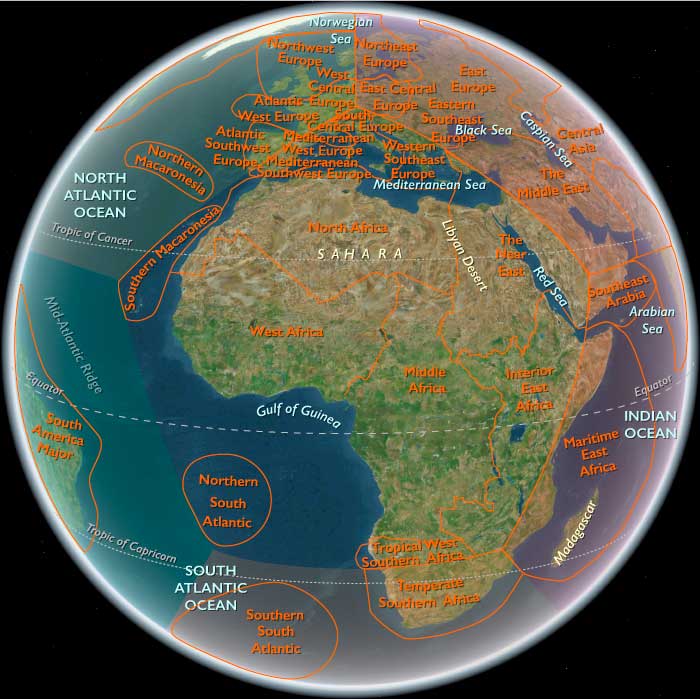
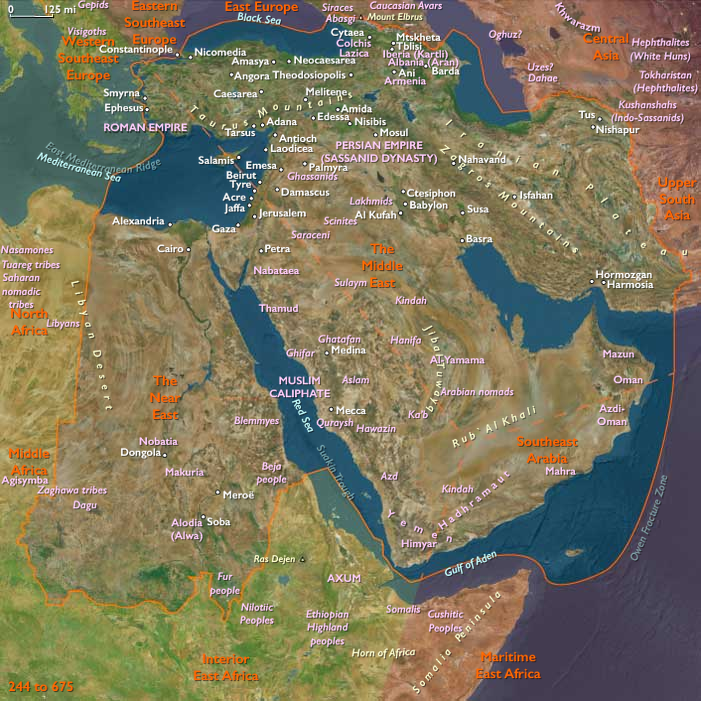
Under his leadership, the empire expands into Fars in 650 (present-day Iran) and some areas of Khorasan (present-day Afghanistan) in 651 and the conquest of Armenia is begun in the 640s.
Some of Uthman's notable achievements are the economic reforms he introduces, and the compilation of the Qur'an into the unified, authoritative text that is known today.

Related Events
Filter results
Showing 10 events out of 105 total
Muhammad had made Medina his first capital, and it was there that he dies.
Leadership of the faithful falls to Abu Bakr (632-34), Muhammad's father-in-law and the first of the four orthodox caliphs, or temporal leaders of the Muslims.
Umar follows him (634-44) and organizes the government of captured provinces.
The third caliph is Uthman (644-56), under whose administration the compilation of the Quran is accomplished.
Among the aspirants to the caliphate is Ali, Muhammad's cousin and son-in-law, whose supporters feel he should be the Prophet's successor.
Upon the murder of Uthman, Ali becomes caliph (656-61).
After a civil war with other aspirants to the caliphate, Ali moves his capital to Mesopotamia and is later assassinated at Al Kufah.
Ali's early followers establish the first of Islam's dissident sects, the Shias (from Shiat Ali, party of Ali).
Those who had accepted the successions before and after Ali remain the orthodox of Islam; they are called Sunnis—from the word sunna, meaning orthodox.
After Ali's murder in 661, Muawiyah—the governor of Syria during the early Arab conquests, a kinsman of Uthman, and a member of the Quraysh tribe of the Prophet—proclaims himself caliph and establishes the Umayyad caliphate with its capital at Damascus.
From here he conquers Muslim enemies to the east, south, and west and fights the imperial forces to the north.
At this time, some persons favor Ali ibn Abu Talib, Muhammad's cousin and the husband of his daughter, Fatima, but Ali and his supporters (the Shiat Ali, or Party of Ali) eventually recognize the community's choice.
The next two caliphs (successors)—Umar, who succeeds in 634, and Uthman, who takes power in 644—enjoy the recognition of the entire community.
When Ali finally succeeds to the caliphate in 656, Muawiyah, governor of Syria, rebels in the name of his murdered kinsman, Uthman.
After the ensuing civil war, Ali moves his capital to Iraq, where he is murdered shortly thereafter.
Ali's death ends the last of the so-called four orthodox caliphs and the period in which the entire community of Islam recognizes a single leader.
Muawiyah proclaims himself caliph from Damascus.
The Shiat Ali refuses to recognize him or his line, the Umayyad caliphs, and withdraws in the great schism of Islam to establish the dissident sect, known as the Shia, who support the claims of Ali's line to the caliphate based on descent from the Prophet.
The larger faction, the Sunnis, adhere to the position that the caliph must be elected, and over the centuries they will represented themselves as the orthodox branch.
The most critical problem that faces the young Islamic community revolves around the rightful successor to the office of caliph.
Uthman, the third caliph, had encountered opposition during and after his election to the caliphate.
Ali ibn Abu Talib, the Prophet Muhammad's cousin and son-in-law (by virtue of his marrying the Prophet's only surviving child, Fatimah), had been the other contender.
Ali's pietism is disquieting to certain vested-interest groups, who perceive the more conservative Uthman as more likely to continue the policies of the previous caliph, Umar.
Discontent increases, as does Ali's formal opposition to Uthman based on religious grounds.
Ali claims that innovations have been introduced that are not consonant with Quranic directives.
Economics is the key factor for most of the members of the opposition, but this, too, acquires religious overtones.
As a result of the rapid military expansion of the Islamic movement, financial troubles beset Uthman.
Many Bedouin have offered themselves for military service in Iraq and in Egypt.
Their abstemious and hard life contrasts with the leisured life of Arabs in the Hejaz (the western part of the Arabian Peninsula), who are enjoying the benefits of conquest.
When these volunteer soldiers question the allocation of lands and the distribution of revenues and pensions, they find a ready spokesman in Ali.
Groups of malcontents eventually leave Iraq and Egypt to seek redress at Medina in the Hijaz.
Uthman promises reforms, but on their return journey the rebels intercept a message to the gover- nor of Egypt commanding that they be punished.
In response, the rebels besiege Uthman in his home in Medina, eventually slaying him.
Uthman's slayer is a Muslim and a son of the first caliph, Abu Bakr.
The Muslim world is shaken.
Ali, who had not taken part in the siege, is chosen caliph.
Ali's decision, however, comes too late for the more extreme of his followers.
Citing the Quranic injunction to fight rebels until they obey, these followers insist that Ali is morally wrong to submit to arbitration.
In doing so, they claim, he bows to the judgment of men—as opposed to the judgment of God that would have been revealed by the outcome of the battle.
These dissenters, known as Kharajites (from the verb kharaja—to go out), withdraw from battle, an action that is to have far-reaching political effects on the Islamic community in the centuries ahead.
Muawiyah, a kinsman of Uthman and the governor of Syria, now refuses to recognize Ali, and he demands the right to avenge his relative's death.
In what is perhaps the most important battle fought between Muslims, Ali's forces meet Muawiyah's at the Plain of Siffin near the largest bend of the Euphrates River.
Muawiyah's forces, seeing that they are losing, propose arbitration.
Accordingly, two arbitrators are chosen to decide whether Uthman's death had been deserved.
Such a decision would give his slayer status as an executioner rather than as a murderer and would remove the claims of Uthman's relatives.
When the arbitrators decide against Ali, he protests that the verdict is not in accordance with sharia (Islamic law) and declares his intention to resume the battle.
Two opponents of Ali enlist Aisha, a widow of the Prophet Muhammad, to join them in accusing Ali and demanding retribution for Uthman's death.
When the three go to Iraq to seek support for their cause, Ali's forces engage theirs near Basra.
Aisha's two companions are killed, and Ali is clearly victorious.
Some persons in Yathrib, who had satirized Muhammad in verse, speaking of his cruelties, are assassinated, possibly with his connivance, following the Muslim victory over the Meccans at Badr.
Asma Bint Merwan, a married woman with five children, and reputedly Median's most popular poetess, is stabbed to death by a group of Muslims who break into her house at night as she lies in her bedroom breast-feeding her newborn child, who is then hacked to pieces.
Soon afterward, Abu Afek, an elderly poet respected for his sense of fairness, meets a similar fate.
Another, a renowned Arab poet named Kaab Ibn Ashraf of the Tribe of Tai, who resides with the Jewish clan Banu Nadir, had composed a lament for the Quraysh leaders of who had been massacred in the battle of Badr.
Four Muslims drag ibn Ashraf from his bed and stab him to death in full view of his family.
Muhammad also uses a minor disturbance as a pretext for expelling the Jewish clan that operates the market.
This weakens his most serious opponent there, the “hypocrite” (munafiq), or nominal Muslim, 'Abd Allah ibn Ubayy, who is allied with the local Jews.
As the remaining fence sitters among the Arabs of Yathrib probably become Muslims about this time, the victory of Badr greatly strengthens Muhammad.
Concurrently, he employs marriage relationships to bring greater cohesion to the emigrants.
His daughter Fatimah is married to Abu Talib's son Ali (later fourth caliph), and Umm Kulthum to Uthman (third caliph).
Muhammad himself marries the newly widowed Hafsah, daughter of 'Umar (later second caliph), whose previous husband was one of the Muslims killed at Badr.
He continues, with some success, to lead larger Muslim forces on razzias against hostile nomadic tribes.
Abu Sufyan, meanwhile, has energetically mobilized vengeful Meccan forces, who declare their intention to make the Muslims pay several times over for Badr.
On March 11, 625, with Abu Sufyan at the helm, the Meccans—anxious to avenge their defeat at Badr—raise another force numbering three thousand and set out for the Muslim base in Medina.
Rather than attacking Medina itself, which is populated by numerous strongholds that would require long sieges to overcome, they camp on the pastures north of the city, hoping that the Muslims will come out to meet them.
According to the early Muslim historian Ibn Ishaq, a number of Meccan women are said to have accompanied Abu Sufyan's army to provide vocal support, including Hind bint Utbah, his wife.
A scout alerts Muhammad of the Meccan army's presence and numbers late on Thursday March 21.
The next morning, a Muslim conference of war convenes, and there is dispute over how best to repel the Meccans.
Muhammad and many of the senior figures suggest that it would be safer to fight within Medina and take advantage of its heavily fortified strongholds.
Younger Muslims argue that the Meccans are destroying their crops, and that huddling in the strongholds will destroy Muslim prestige.
Muhammad eventually concedes to the wishes of the latter, and readies the Muslim force for battle.
The Muslim force, now numbering around seven hundred, is stationed on the slopes of Uhud, facing Medina with the rear being protected by the towering mount itself.
Before the battle, Muhammad had assigned fifty archers on a nearby rocky hill at the West side of the Muslim camp.
This was a strategic decision in order to shield the vulnerable flanks of the outnumbered Muslim army; the archers on the hill are to protect the left flank, while the right flank is to be protected by the Mount of Uhud situated on the east side of the Muslim camp.
Protecting the flanks of the Muslim army means that the Meccan army will not be able to turn around the Muslim camp, and thus the Muslim army won't be surrounded or encircled by the Meccan cavalry, keeping in mind that the Meccan cavalry outnumbers the Muslim cavalry with a 50:1 ratio.
Muhammad orders the Muslim archers to never, under any circumstances, leave their positions on the hill unless ordered to do so by him only.
The Meccan army positions itself facing the Muslim lines, with the main body led by Abu Sufyan, and the left and right flanks commanded by Ikrimah ibn Abi-Jahl and Khalid ibn al-Walid respectively.
'Amr ibn al-'As is named the commander of cavalry and his task is to coordinate attack between the cavalry wings.
The Meccans attack with their initial charge led by the Medinan exile Abu ‘Amir.
Thwarted by a shower of stones from the Muslims, Abu ‘Amir and his men are forced to retire and tend to the camps behind the Meccan lines.
The Meccan standard-bearer, Talhah ibn Abi Talhah al-‘Abdari, advances and challenges the enemy to a duel.
Ali (Ali ibn Abi Talib), the young cousin of Muhammad, rushes forth and strikes Talhah down in a single blow.
Talhah's brother, `Uthman, runs forward to pick up the fallen banner—the Meccan women willing him on with songs and the loud beating of timbrels.
Hamza ibn ‘Abd al-Muttalib emerges from the Muslim ranks, bringing him to a similar fate as Talhah.
It is their family that is responsible for the Meccan army's standard-bearing, and thus one by one, Talhah's brothers and sons go to retrieve the Meccan banner and fight unsuccessfully, until they all eventually perish.
Following the duels, general engagement between the two armies commences.
Meccan confidence quickly begins to dissolve as the Muslims sweep through their ranks.
The Meccan army is pushed back, and repeated attempts by its cavalry to overrun the left Muslim flank are negated by the Muslim archers.
Enjoying the best of these early encounters, the Muslims pierce the Meccan lines, with victory appearing certain.
However, it is the detachment of the Muslim archers, disobeying Muhammad's strict orders to remain stationary, that shifts the outcome of the battle, as they run downhill to join in the advance and despoil the Meccan camp, leaving the flank vulnerable.
At this critical juncture, the Meccan cavalry led by Khalid ibn al-Walid exploits this move and attacks the remaining minority of Muslim archers who had refused to disobey Muhammad's orders and are still positioned on the hill.
From there, the Meccans are then able to target and overrun the Muslim flank and rear.
Confusion ensues, and numerous Muslims are killed.
Most notable among the casualties is Hamza, who had been thrown down in a surprise attack by the javelin of the Ethiopian slave of Hind, Wahshi ibn Harb.
While the Meccan riposte strengthens, rumors circulate that Muhammad too had perished.
It emerges, however, that Muhammad had only been wounded—due to missiles of stone which resulted in a gash on his forehead and lip.
It is recorded that Ali ibn Abi Talib alone remained, fending off the assaults of Khaleed's cavalrymen.
After fierce hand-to-hand combat, most of the Muslims manage to withdraw and regroup higher up on the slopes of Uhud.
A small faction is cut off and tries to make its way back to Medina, though many of these are killed.
The Meccans' chief offensive arm, its cavalry, is unable to ascend the slopes of Uhud in pursuit of the Muslims, and so the fighting ceases.
Hind and her companions are said to have mutilated the Muslim corpses, cutting off their ears and noses and making the relics into anklets.
Hind is reported to have cut open the corpse of Hamza, taking out his liver which she then attempted to eat.
Abu Sufyan, after some brief verbal exchanges with Muhammad's companion, Umar (Umar ibn al-Khattab), decides to return to Mecca without pressing his advantage.
Muhammad and the Muslims bury the dead on the battlefield, returning home that evening.
The battle is generally believed by scholars to be a defeat for the Muslims, as they had incurred greater losses than the Meccans.
The battle is also noted for the emergence of the military leadership and tactical military genius of Khalid ibn al-Walid, who will later become the most famous of all Arab generals during the Islamic expansion era, in conquering the Sassanid Empire and Constantinople-held Syria.
The Meccans retire for the evening at a place called Hamra al-Asad, a few miles away from Medina.
The next morning, Muhammad sends out a small force to hurry the Meccan army on their way home.