Wenceslaus I
Duke of Bohemia
Years: 907 - 935
Wenceslaus I (c. 907 – September 28, 935), or Wenceslas I, is the duke (kníže) of Bohemia from 921 until his assassination in 935, purportedly in a plot by his own brother, Boleslav the Cruel.
His martyrdom, and the popularity of several biographies, quickly gives rise to a reputation for heroic goodness, resulting in his being elevated to Sainthood, posthumously declared king, and seen as the patron saint of the Czech state.
He is the subject of Good King Wenceslas, a Saint Stephen's Day carol written over 900 years later, in 1853, that remains popular to this day.




Related Events
Filter results
Showing 9 events out of 9 total
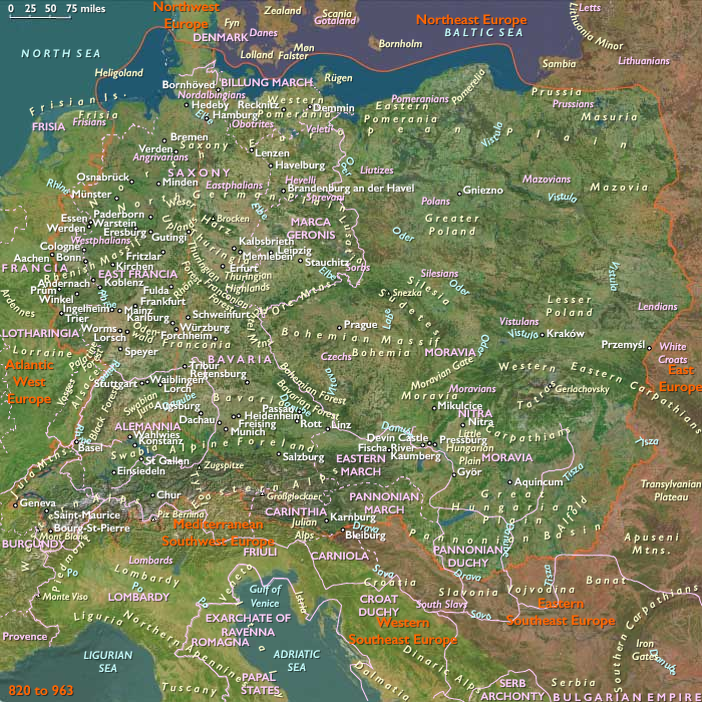
Central Europe (820 – 963 CE): Carolingian Frontiers, River Kingdoms, and the Alpine Arteries
Geographic and Environmental Context
Central Europe spanned the Baltic lowlands of Poland and Germany, the Bohemian Massif and Carpathian arc, and the Danube–Morava corridor down into the Pannonian Plain, while the Rhine–Moselle–Main system and the Alpine passes tied the region to Burgundy and Italy.
-
Northern arteries: Elbe, Oder, Vistula.
-
Southern spine: Danube–Morava–Pannonian corridor.
-
Alpine hinges: Brenner, Reschen, Septimer, Julier, Splügen, Great St. Bernard.
A cool–temperate regime prevailed; by mid-10th century, onset of the Medieval Warm Period modestly lengthened growing seasons on loess uplands and improved Carpathian pastures. Flood pulses on the Elbe, Oder, Danube structured transport, milling, and settlement.
Societies and Political Developments
East Central Europe: Carolingian Legacy, Great Moravia, and the Magyar Ingress
-
East Francia → Ottonian Germany (Germany/Austria): After Carolingian partitions, East Francia stabilized as the Kingdom of Germany (Saxony, Franconia, Bavaria, Swabia). Henry I (919–936) and Otto I (936–973)consolidated power, pushing marches eastward against Polabian Slavs and laying the basis for the Holy Roman Empire.
-
Great Moravia (833–c. 906): At its height under Svatopluk I (870–894), it spanned Moravia, western Slovakia, and parts of Bohemia and Pannonia. Cyril and Methodius (863) introduced Slavonic liturgy and Glagolitic, rooting Christianity in local tongues. Collapse followed Magyar raids and Frankish pressure after 894.
-
Magyars (Carpathian Basin): Entered c. 895–907 under Árpád, occupied the Pannonian Plain, and crushed East Frankish–Bavarian armies at Pressburg (907). Through the 10th century, cavalry raids reached Bavaria, Saxony, Italy, and France until later checked at Lechfeld (955).
-
Bohemia: The Přemyslids in Prague balanced Moravian precedent and German suzerainty. Wenceslas (r. c. 921–935) advanced Christianization and tribute ties to Saxony; Boleslaus I expanded Bohemian power after Wenceslas’s murder.
-
Poland: Fortified grody anchored Polans, Vistulans, Pomeranians. By c. 960, Mieszko I began unifying the Polans and neighboring tribes—prelude to baptism (966, next age).
South Central Europe: Alpine Marches and Episcopal Road-Keeping
-
Post-Verdun (843), the zone split between East Francia (Tyrol, Carinthia, Swabian/Bavarian forelands, Swiss Plateau) and Upper Burgundy (Geneva–Valais).
-
The Inn and Carinthian marches guarded the Brenner approach; bishops of Trento and Brixen administered tolls and estates along the Tyrolean routes.
-
Monasteries—St. Gall, Disentis, Einsiedeln (934)—managed alpine estates, kept passes open, and provisioned travelers.
-
Otto I’s consolidation and victory at Lechfeld (955) ended Magyar pressure on Bavaria/Carinthia and secured the Alpine corridors.
West Central Europe: Lotharingian Marches and the Rhineland Core
-
Verdun (843) fractured the Carolingian world; Lotharingia oscillated between East and West, with Aachen, Cologne, Mainz mediating border defense and royal claims (Meerssen 870, Ribbemont 880).
-
Under the Ottonians (919–963), episcopal princes—Mainz, Trier, Cologne—and great abbeys stabilized governance as comital lordship proliferated.
-
Lechfeld (955) secured hinterlands; Otto’s imperial coronation (962/963) reaffirmed the Rhineland’s role in ceremony, law, and church politics. Aachen remained symbolic capital; Worms, Speyer rose as royal centers; Basel guarded the Upper Rhine/Jura hinge.
Economy and Trade
-
Agrarian base: rye, barley, oats, millet, wheat on river terraces and loess soils; viticulture along Rhine/Moselle, Moravia, Bavaria; cattle/swine in forest and meadow belts.
-
Resources & crafts: Kraków and alpine salt, Baltic amber, iron in Thuringia/Silesia; smithing and pottery spread with market towns.
-
River & road systems:
-
Rhine served as Europe’s main north–south artery; Moselle/Main fed Rhineland markets.
-
Elbe/Oder/Vistula linked Saxony and Poland to the Baltic; Vistula connected to Prussia and Rus’.
-
Danube funneled Bavarian–Moravian–Magyar exchange toward the Adriatic/Balkans; Morava–Danube corridor carried Christian missions and Frankish influence.
-
-
Money & flows: Islamic dirhams reached Poland/Germany via Rus’ and Volga Bulgar routes; Carolingian deniers and Ottonian denarii spread from Rhineland and Bavarian mints into Bohemia and Moravia.
-
Alpine commerce: northbound wine, oil, spices, silks; southbound timber, hides, cheese, iron, horses; fairs at Zürich, Geneva, Chur knit Burgundian/German merchants to Lombardy.
Subsistence and Technology
-
Heavy plow (carruca) and horse/ox traction expanded deep tillage on heavy soils; three-field rotations appeared on richer estates.
-
Fortifications: timber–earth grody and hillforts dominated tribal centers; in Alpine and Rhineland nodes, episcopal burgs and royal pfalzen guarded crossings.
-
Mills & fisheries: water-mills multiplied on tributaries; river fish weirs provisioned towns.
-
River craft & winter haulage: planked barges and dugouts on major rivers; sledges moved salt, grain, and timber over ice in winter.
-
Military systems: Magyar steppe cavalry (stirrups, composite bows) reshaped defense; Ottonian armored retinues evolved in response, culminating in Lechfeld.
Movement and Interaction Corridors
-
Elbe–Saale front: Ottonian marches facing Polabian Slavs.
-
Oder–Vistula–Baltic: fur, amber, and slave trades northward to the sea.
-
Morava–Danube: mission and commerce into Moravia and Hungary.
-
Carpathian passes: vectors for Magyar migration and later raiding.
-
Rhine–Moselle–Main: wine, salt, timber, millstones; Alsace–Basel gate to the Alps; trans-Meuse roads to Flanders/North Sea.
-
Alpine passes: Brenner, Septimer/Julier, Splügen, Great St. Bernard—redundant routes ensuring continuity despite storms or war.
Belief and Symbolism
-
Christianization:
-
Great Moravia pioneered Slavonic liturgy; after its fall, Bohemia and Poland leaned toward Latin-riteChristianity via Saxony/Bavaria.
-
Ottonian Germany deepened monastic–episcopal structures; sees at Magdeburg and Brandenburgadvanced missions eastward.
-
-
Pagan traditions: Slavic polytheism (Perun, Veles, Svantovit) persisted among Poles, Pomeranians; Magyarsmaintained Tengrist and shamanic rites.
-
Burials: hybrid zones reveal cremation in pagan districts, Christian inhumation in Moravia, Bohemia, Saxony; reliquaries and saints’ cults reinforced urban prestige in the Rhineland and Alpine valleys.
-
Monastic charisma: St. Gall, Disentis, Einsiedeln anchored piety, hospitality, and safe passage along alpine roads.
Adaptation and Resilience
-
Military adaptation: Ottonians forged armored cavalry retinues to counter Magyar tactics; Lechfeld (955)stabilized East Francia and opened recovery in Bavaria/Carinthia.
-
Agrarian buffers: mixed cropping (rye + millet), stock herding, and valley fruit/wine moderated climate variability.
-
Jurisdictional layering: bishops, abbots, counts, and royal pfalzen spread risk and ensured continuity amid dynastic flux.
-
Route redundancy: when upland war or storms disrupted roads, merchants shifted to river corridors or alternate passes; fairs re-routed exchange.
Long-Term Significance
By 963 CE, Central Europe had become a crucible of state formation and connectivity:
-
Otto I’s consolidation stabilized the German kingdom, checked the Magyars, and restored long-distance commerce.
-
Great Moravia had dissolved, but its Slavonic Christian legacy endured in Bohemia and Poland’s emerging dynasties.
-
Magyars controlled the Carpathian Basin, raiding while adapting to a settled frontier that would soon pivot toward Christian kingship.
-
Alpine marches and monastic road-keepers secured the north–south arteries linking the Rhine and Danube to Italy.
-
The Rhineland reemerged as imperial–commercial core, while Piast Poland and Přemyslid Bohemiacrystallized into durable realms.
These arrangements—river logistics, alpine gateways, armored retinues, and monastic–episcopal governance—forged the steppe–agrarian and Christian–pagan frontier dynamics that would define Central Europe’s integration into Latin Christendom in the next age.
East Central Europe (820 – 963 CE): Carolingian Frontiers, Great Moravia, and the Magyar Ingress
Geographic and Environmental Context
East Central Europe includes Poland, Czechia (Bohemia and Moravia), Slovakia, Hungary (the Carpathian Basin), northeastern Austria, and the greater part of Germany (including Berlin, Munich, Hamburg).
-
The region stretches from the Baltic lowlands of Poland and Germany to the Danube basin of Austria, Slovakia, and Hungary, bounded by the Carpathians and the Bohemian Massif.
-
Key arteries: the Elbe, Oder, and Vistula rivers northward, and the Danube–Morava corridor southward, connecting central Germany to the Pannonian Plain.
Climate and Environmental Shifts
-
A cool–temperate regime with seasonal rainfall.
-
By the mid-10th century the onset of the Medieval Warm Period (c. 950) slightly lengthened growing seasons, aiding cereal expansion on the loess soils of Poland, Moravia, and Bavaria, and improving pastures in the Carpathian Basin.
-
Flood pulses on the Elbe, Oder, and Danube structured transport and settlement.
Societies and Political Developments
-
Carolingian Legacy and Ottonians (Germany, Austria):
-
After the division of the Carolingian Empire, East Francia evolved into the Kingdom of Germany, with Saxony, Franconia, Bavaria, and Swabia as key stem duchies.
-
Henry the Fowler (919–936) and Otto I (r. 936–973) consolidated power, extending marches eastward against Slavic tribes. Otto’s reforms laid the basis for the Holy Roman Empire.
-
-
Great Moravia (833–c. 906):
-
Spanning Moravia, western Slovakia, and parts of Bohemia and Hungary, Great Moravia under Svatopluk I (870–894) was the strongest Slavic polity.
-
Missionaries Cyril and Methodius (863) introduced Slavonic liturgy and the Glagolitic script, rooting Christianity in local languages.
-
Collapse followed Magyar raids and Frankish pressure after 894.
-
-
Magyars (Hungary/Carpathian Basin):
-
Entered c. 895–907 under Árpád, occupying the Pannonian Plain.
-
At the Battle of Pressburg (907), Magyars defeated East Frankish and Bavarian armies, securing dominance over Hungary.
-
Throughout the 10th century, Magyar cavalry raided Bavaria, Saxony, Italy, and even France before being checked later at Lechfeld (955).
-
-
Bohemia (Czech lands):
-
The Přemyslid dynasty emerged in Prague, balancing between Frankish/German suzerainty and Moravian precedents.
-
Duke Wenceslas (r. c. 921–935) promoted Christianity and tribute ties with Saxony; murdered by his brother Boleslaus I, who expanded Bohemian power.
-
-
Poland:
-
Slavic tribes (Polans, Vistulans, Pomeranians) built fortified strongholds (grody).
-
By c. 960, Mieszko I of the Piasts began unifying the Polans and surrounding tribes, setting foundations for Poland’s baptism in 966 (just after this age).
-
Economy and Trade
-
Agriculture: rye, barley, oats, millet, and wheat grown in river valleys and loess uplands; cattle and swine in forest zones; viticulture in Moravia and Bavaria.
-
Crafts & resources: salt from Kraków and alpine mines, amber from the Baltic, iron smelting in Thuringia and Silesia.
-
Trade routes:
-
Elbe and Oder connected Saxony and Poland to the Baltic;
-
Vistula linked Poland to Prussia and Rus’;
-
Danube funneled Bavarian, Moravian, and Magyar exchanges into the Adriatic and Balkans.
-
-
Monetary flows: Islamic silver dirhams reached Poland and Germany via Rus’ and Volga Bulgar routes; Ottonian denarii spread from Saxony and Bavaria into Bohemia and Moravia.
Subsistence and Technology
-
Heavy plow (carruca) spread gradually into loess zones, expanding arable land.
-
Horse and ox traction supported deeper plowing and transport.
-
Fortified grody and hillforts dominated tribal centers, built of timber–earth ramparts.
-
River craft: planked boats and dugouts moved salt, grain, and amber; sledges carried goods across frozen rivers in winter.
-
Military technology: Magyar steppe cavalry (stirrups, composite bows) outmatched early Frankish infantry, reshaping frontier defense.
Movement and Interaction Corridors
-
Elbe–Saale frontier: the line of Ottonian marches facing Polabian Slavs.
-
Morava–Danube route: conduit for Christianity and Frankish influence into Moravia and Hungary.
-
Carpathian passes: vectors for Magyar migrations and later raids into Bavaria and Italy.
-
Oder–Vistula–Baltic corridors: facilitated fur, amber, and slave trades northward.
Belief and Symbolism
-
Christianization:
-
Great Moravia pioneered Slavic liturgy; after its fall, Bohemia and Poland increasingly looked to Latin-rite Christianity from Saxony and Bavaria.
-
Ottonian Germany deepened monastic and episcopal structures, founding bishoprics in Magdeburg and Brandenburg.
-
-
Pagan traditions: Slavic polytheism (Perun, Veles, Svantovit) endured among Poles and Pomeranians; Magyars maintained Tengrist and shamanic cults.
-
Burial customs reveal hybrid practices: cremation persisted in pagan zones, while Christian inhumation advanced in Moravia, Bohemia, and Saxony.
Adaptation and Resilience
-
Military adaptation: Ottonians forged armored cavalry retinues to counter Magyars, culminating in victory at Lechfeld (955), securing East Francia and Bavaria.
-
Agricultural resilience: mixed cropping (rye + millet) and stock herding buffered climate variability; river valleys stabilized surpluses.
-
Political flexibility: polities used tribute, alliances, and intermarriage (e.g., Přemyslids with Ottonians; Piasts with German nobles) to survive between stronger powers.
Long-Term Significance
By 963 CE, East Central Europe was a crucible of state formation and frontier contest:
-
Otto I’s consolidation stabilized the German kingdom and checked the Magyars.
-
Great Moravia had dissolved, but its Christian–Slavic legacy lived on.
-
Magyars controlled the Carpathian Basin, staging raids while adapting to a settled frontier.
-
Bohemia and the Piast realm in Poland were crystallizing into durable dynasties.
This period forged the Christian–pagan, steppe–agrarian frontier dynamics that would define the region until its full integration into Christendom in the following age.
East Central Europe (916–927 CE): Establishment of the Magyar Principality, Ascendancy of Saxony under Henry the Fowler, and the Rise of the Přemyslid State
Between 916 and 927 CE, East Central Europe—comprising modern-day Poland, Czechia, Slovakia, Hungary, and eastern portions of Germany and Austria east of 10°E and north of a line from approximately 48.2°N at 10°E to the Austro-Slovenian border near 46.7°N, 15.4°E—underwent major transformations shaped by the establishment of a powerful Magyar principality, the ascendancy of Saxony under Henry the Fowler, and the formation of the Bohemian Přemyslid state. These significant developments marked the emergence of new medieval political entities, stabilizing the region after decades of turmoil and laying foundational structures that would define East Central Europe for centuries.
Political and Military Developments
Formation of the Magyar Principality
-
Under Árpád's successors, the Magyars solidified their control over the Carpathian Basin, creating a formidable political and military power capable of both internal consolidation and extensive raiding expeditions across Europe, significantly reshaping regional power dynamics.
Saxon Ascendancy under Henry the Fowler
-
Henry the Fowler (r. 919–936), succeeding his father Otto the Illustrious as Duke of Saxony and elected King of East Francia in 919, dramatically strengthened Saxon political and military authority. His reign marked the definitive rise of the Liudolfing (Ottonian) dynasty, significantly fortifying East Francia's eastern frontiers.
Emergence and Consolidation of the Přemyslid State
-
In Bohemia, the Přemyslid dynasty emerged prominently under Duke Wenceslaus I (r. c. 921–935), consolidating political authority, integrating local Slavic tribes, and establishing a nascent state structure that would profoundly shape Bohemian medieval history.
Economic and Technological Developments
Economic Stabilization and Trade Revival
-
With more stable regional political entities emerging, disrupted trade networks gradually revived, facilitating renewed economic activity in Bavaria, Saxony, and Bohemia, centered on agriculture, metalworking, and expanding long-distance commerce.
Expansion of Defensive Infrastructure
-
Henry the Fowler notably fortified East Francia’s eastern frontier, erecting extensive defensive systems, fortresses, and fortified towns, notably against persistent Magyar threats, significantly influencing military and urban development across Saxony and eastern Bavaria.
Cultural and Artistic Developments
Magyar Cultural Integration
-
Settled in the Carpathian Basin, the Magyar elite began assimilating local and regional cultural influences, creating a distinctive synthesis evident in artifacts, burial practices, and early settlement structures.
Saxon Ecclesiastical Patronage and Cultural Growth
-
Henry the Fowler’s reign saw extensive ecclesiastical patronage and cultural flourishing, reflected in manuscript production, monastic foundation, and artistic achievements, further solidifying Saxon cultural identity and Christian integration.
Bohemian Cultural and Religious Consolidation
-
Under the Přemyslids, Bohemian cultural identity deepened, with significant ecclesiastical patronage and consolidation of Slavic Christian traditions originally fostered by the Moravian missions, creating a lasting religious-cultural framework.
Settlement and Urban Development
Magyar Settlement Consolidation
-
Permanent Magyar settlements developed, notably around strategic locations such as Esztergom and Székesfehérvár, becoming important administrative, military, and cultural centers in early medieval Hungary.
Fortified Urban Centers in Saxony and Bavaria
-
Henry the Fowler systematically expanded and fortified key Saxon and Bavarian urban centers, significantly improving regional security and economic vitality, setting the foundations for medieval German urbanization.
Growth of Přemyslid Political and Ecclesiastical Centers
-
Emerging Bohemian centers like Prague became focal points for political, administrative, and ecclesiastical activities, initiating a sustained period of urban and regional development under Přemyslid leadership.
Social and Religious Developments
Reinforcement of Christian Institutions
-
The period witnessed strengthened ecclesiastical networks throughout Saxony, Bavaria, and Bohemia, embedding Christianity deeper into regional identities, social practices, and political institutions.
Formation of Distinct Regional Identities
-
The consolidation of distinct identities—Magyar, Saxon, and Bohemian—through dynastic rule, religious affiliations, and cultural traditions marked the formative phase of lasting regional and national communities in East Central Europe.
Long-Term Consequences and Historical Significance
The era 916–927 CE established crucial political, cultural, and social foundations for medieval East Central Europe. The solidification of Magyar power, the decisive ascendancy of Saxony under Henry the Fowler, and the formation of the Přemyslid state defined clear political entities, stabilizing the region after prolonged instability. These formative developments significantly influenced the medieval trajectory of East Central Europe, shaping future dynastic, cultural, and geopolitical landscapes.
Wenceslas is the son of Vratislaus I, Duke of Bohemia from the Přemyslid dynasty.
His father had been raised in a Christian milieu through his own father, Borivoj I of Bohemia, who had purportedly been converted by Saints Cyril and Methodius.
His mother Drahomíra is the daughter of a pagan tribal chief of Havolans and had been baptized at the time of her marriage.
In 921, when Wenceslas was thirteen, his father had died and he was brought up by his grandmother, Saint Ludmila, who had raised him as a Christian.
A dispute between the fervently Christian regent and her daughter-in-law had driven Ludmila to seek sanctuary at Tetín Castle near Beroun.
Drahomíra, who was trying to garner support from the nobility, was furious about losing influence on her son and had arranged to have Ludmila strangled at Tetín on September 15, 921.
Wenceslas is usually described as exceptionally pious and humble, and a very educated and intelligent young man for his time.
According to some legends, having regained control of her son, Drahomíra had set out to convert him to the old pagan religion.
According to other legends, she was a Christian herself; however, very little is known about her rule.
After the fall of Great Moravia, the rulers of the Bohemian duchy had had to deal both with continuous raids by the Magyars and the forces of the Saxon duke and East Frankish king Henry the Fowler, who had started several eastern campaigns into the adjacent lands of the Polabian Slavs, homeland of Wenceslas's mother.
To withstand Saxon overlordship, Wenceslas's father Vratislaus had forged an alliance with the Bavarian duke Arnulf the Bad, then a fierce opponent of King Henry; however, it had become worthless when Arnulf and Henry reconciled at Regensburg in 921.
Wenceslas assumes government for himself in 924 or 925.
East Central Europe (928–939 CE): Saxon Victories over the Magyars, Bohemian Consolidation under Wenceslaus and Boleslaus, and Emerging Polish Tribes
Between 928 and 939 CE, East Central Europe—comprising modern-day Poland, Czechia, Slovakia, Hungary, and eastern portions of Germany and Austria east of 10°E and north of a line from approximately 48.2°N at 10°E to the Austro-Slovenian border near 46.7°N, 15.4°E—entered a crucial phase characterized by successful Saxon resistance to Magyar incursions under Henry the Fowler, political consolidation and conflict in Bohemia under the Přemyslid rulers Wenceslaus I and Boleslaus I, and the early formation of distinct tribal centers in what would later become Poland. These developments significantly reshaped regional dynamics, establishing clearer political entities and cultural identities that profoundly influenced subsequent historical trajectories.
Political and Military Developments
Henry the Fowler’s Saxon Victories over the Magyars
-
In 933 CE, Henry the Fowler (r. 919–936) decisively defeated Magyar forces at the Battle of Riade, significantly curbing Magyar raids and solidifying Saxony’s military strength. His victories fortified East Francia’s eastern frontier, bolstering regional stability and setting a critical precedent for future Saxon dominance.
Přemyslid Consolidation and Internal Struggle in Bohemia
-
Bohemia witnessed critical political consolidation under the Přemyslids. Duke Wenceslaus I (Saint Wenceslaus, d. 935) significantly strengthened centralized authority but was assassinated by his brother, Boleslaus I the Cruel (r. 935–972), who consolidated his power through aggressive political and military strategies, expanding Bohemian territory and asserting independence from external powers.
Emergence of Early Polish Tribal Entities
-
Early tribal centers emerged distinctly in regions of modern-day Poland, notably around the Polans and other Slavic groups. While still fragmented, these early political structures laid essential groundwork for subsequent Polish state formation.
Economic and Technological Developments
Revival of Regional Economic Activity
-
With increased security from Saxon victories, regional trade networks regained stability, enhancing commerce and exchange between Saxony, Bavaria, Bohemia, and emergent Polish centers, notably involving agricultural products, metals, and manufactured goods.
Defensive and Administrative Infrastructure Improvements
-
Henry the Fowler extensively developed fortified towns and frontier defenses, notably in Saxony and Bavaria, significantly improving regional security, facilitating economic activity, and laying the foundations for organized medieval urban life.
Cultural and Artistic Developments
Saxon Cultural Flourishing under Henry
-
Henry the Fowler’s reign fostered significant cultural achievements through ecclesiastical patronage, monastery foundations, and manuscript production, solidifying Saxony’s cultural prominence within East Francia.
Přemyslid Cultural Identity in Bohemia
-
Under Wenceslaus and Boleslaus, Bohemian cultural and ecclesiastical identity strengthened considerably, notably through the promotion of Slavic-Christian traditions and artistic patronage, laying cultural foundations that profoundly shaped Bohemian identity.
Formation of Early Polish Cultural Centers
-
Early Polish tribes began developing distinct cultural identities through local traditions, settlement practices, and artisanal production, establishing cultural groundwork for future Polish states.
Settlement and Urban Development
Saxon Fortified Towns and Military Infrastructure
-
Henry the Fowler’s fortification strategy significantly enhanced urbanization and settlement structures, notably in Saxony and along East Francia’s eastern frontier, laying critical foundations for medieval towns.
Bohemian Urban and Administrative Consolidation
-
Prague and other Bohemian centers experienced significant growth under Přemyslid rule, becoming administrative, religious, and commercial hubs central to the duchy’s expanding influence.
Emergence of Polish Tribal Settlements
-
Early tribal settlements in Poland, particularly among the Polans, saw steady growth, laying the early settlement patterns and political organization crucial to future Polish territorial consolidation.
Social and Religious Developments
Christian Expansion and Ecclesiastical Influence
-
Christianity continued expanding across Saxony, Bohemia, and emerging Polish centers. Ecclesiastical institutions significantly influenced social structures, governance, and cultural integration.
Formation of Dynastic and Aristocratic Hierarchies
-
Saxony under Henry, Bohemia under the Přemyslids, and emerging Polish tribes developed distinct aristocratic hierarchies, reinforcing dynastic leadership structures that profoundly influenced later medieval governance.
Long-Term Consequences and Historical Significance
The era 928–939 CE was decisive for East Central Europe, marking the beginning of Saxon military dominance over the Magyars, solidifying Přemyslid power in Bohemia, and establishing formative political and cultural identities among Polish tribes. These critical developments set enduring political structures, cultural traditions, and demographic patterns, laying essential foundations for subsequent historical developments in medieval East Central Europe.
The joint forces of Duke Arnulf of Bavaria and King Henry I reach Prague early in 929 in a sudden attack, which forces Wenceslas to resume the payment of a tribute which had been first imposed by the East Frankish king Arnulf of Carinthia in 895.
Henry had been forced to pay a huge tribute to the Magyars in 926 and he therefore needs the Bohemian tribute that Wenceslas had probably refused to pay any longer after the reconciliation between Arnulf and Henry.
One of the possible reasons for Henry's attack is also the formation of the anti-Saxon alliance between Bohemia, the Polabian Slavs and the Magyars.
The Slavic Redarii have meanwhile driven away their chief, captured the town of Walsleben, and massacred the inhabitants.
Counts Bernard and Thietmar march against the fortress of Lenzen beyond the Elbe, and, after fierce fighting, completely rout the enemy on September 4, 929.
Otto, the oldest son of Henry I and Matilda, first gains experience as a military commander when the German kingdom fights against Slavic tribes on its eastern border.
While campaigning against the Slavs in 929, Otto's illegitimate son William, the future Archbishop of Mainz, is born to a Slavic mother.
With Henry's dominion over the entire kingdom secured by 929, his family is given the right of sole succession over the kingdom.
Henry has the arrangement for his succession ratified by an Imperial Diet at Erfurt.
After his death, his lands and wealth are to be divided between his four sons: Thankmar, Otto, Henry, and Bruno.
Departing from customary Carolingian inheritance, the King designates Otto as the sole heir apparent without a prior formal election by the various dukes.
The German kingdom integrates the Bohemian state, ruled at this time by Duke Wenceslas of the Czech Przemysl dynasty.
Wenceslas’ continuation of the Christianization of Bohemia, coupled with his submission to German king Henry I, arouses strong opposition from a faction of the nobility, and leads to his assassination on September 28, 935, by his brother, who succeeds him as Prince Boleslaw.
(The date will become the annual feast day of the later canonized Wenceslas, whom the Czechs will come to regard as their patron saint.)