
Mediterranean Southwest Europe Collapse Brief Iberian and Italian Refugia, Peninsula Corridors, and Human Turnover Brief ‹ Southwest Europe Iberian and Italian Refugia, Peninsula Corridors, and Human Turnover Explore events
Late Pleistocene I
Iberian and Italian Refugia, Peninsula Corridors, and Human Turnover
Mediterranean Southwest Europe · Southwest Europe · The Middle of The Earth
Read the brief
Geographic and Environmental Context
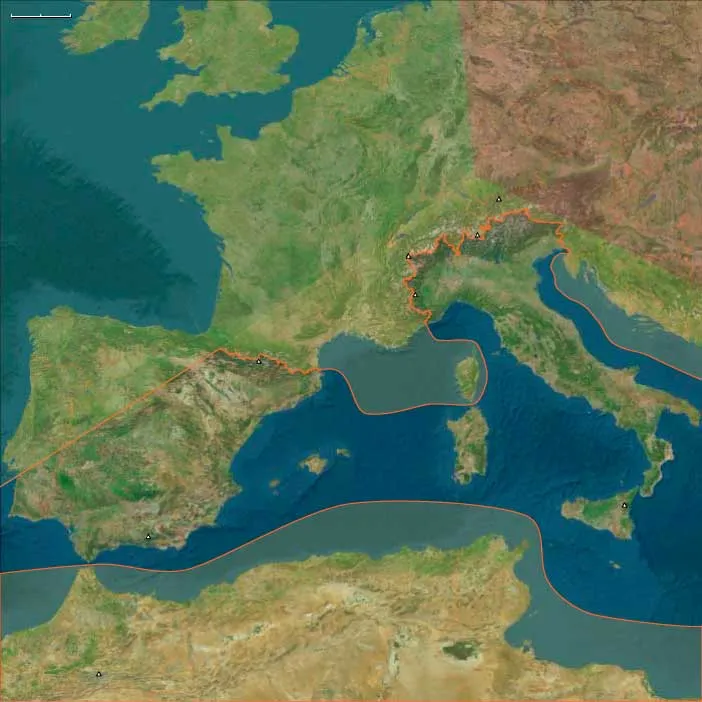
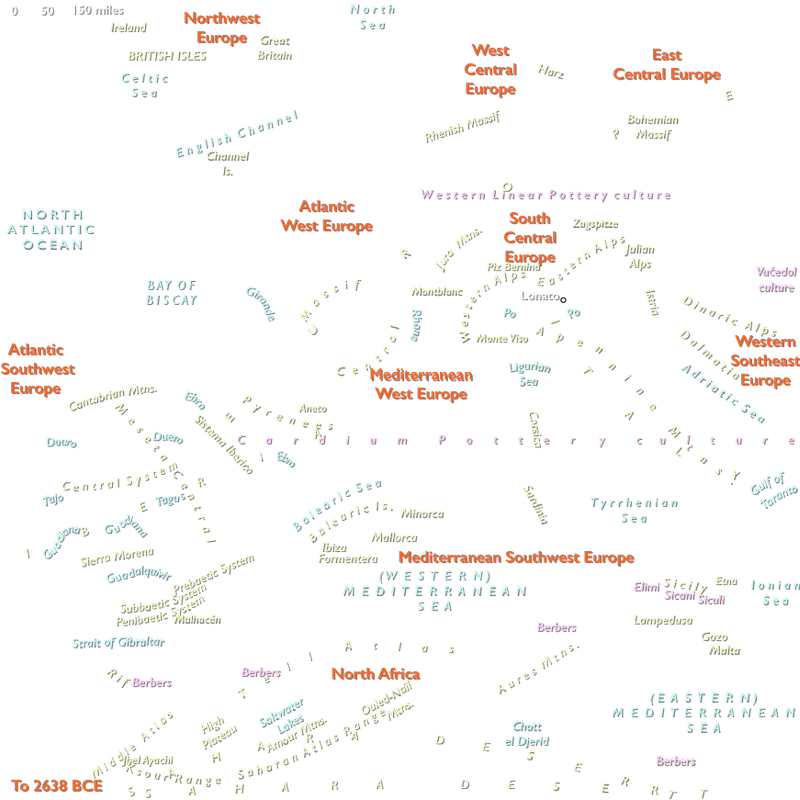
Mediterranean Southwest Europe includes Mediterranean Iberia, the Italian Peninsula, Sicily, Sardinia, Malta, the Balearics, and associated islands within the canonical boundary.
Lower sea level enlarged coastal plains dramatically.
The northern Adriatic became an extensive terrestrial lowland, while Sicily approached the Italian mainland more closely and several other islands gained broader coastal shelves.
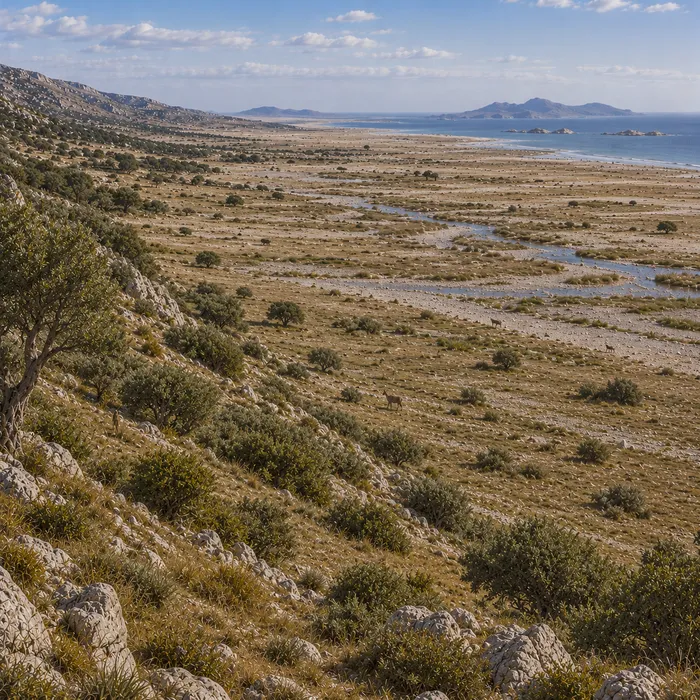
Mediterranean Iberia combined coastal plains, river valleys, limestone uplands, interior plateaus, and mountain refugia.
Italy contained a similarly varied landscape of Apennine valleys, coastal lowlands, river systems, foothills, and expanded Adriatic and Tyrrhenian margins.
The subregion was therefore structured by strong contrasts between peninsular corridors, Mediterranean refugia, mountain interiors, and partially isolated island worlds.
Climate and Environmental Shifts
Marine Isotope Stage 3 brought repeated oscillations between colder-drier and relatively milder or wetter conditions.
Open steppe, grassland, and sparse woodland expanded during colder phases, especially in interior and northern districts.
More temperate woodland persisted or returned in Mediterranean refugia, sheltered valleys, coastal margins, and lower elevations during milder intervals.
Mountain snow and local glaciers expanded and contracted in the Apennines, Pyrenees, and other high ranges.
Rivers altered their discharge and floodplain extent, while lower sea level substantially reorganized the Adriatic, Tyrrhenian, and western Mediterranean coasts.
Mediterranean Southwest Europe therefore offered both severe continental environments and relatively favorable refugia within the same broad region.
Human Presence
Neanderthals occupied both Iberia and Italy early in the interval.
Modern humans entered Italy by roughly 45,000–41,000 years ago and northern Mediterranean Iberia by around 43,000–42,000 years ago.
The transition was regionally uneven.
Some Iberian interior territories were abandoned during severe climatic deterioration around 42,000 years ago and remained sparsely occupied for long intervals.
Elsewhere, modern-human populations became established through coastal, riverine, and refugial landscapes.
By the later part of the eon, Neanderthals had disappeared as a distinct population, while Homo sapiens had become the surviving human population across the continental portions of the subregion.
Subsistence and Settlement
Caves, rockshelters, coastal margins, river valleys, and foothills provided important habitation.
Human groups hunted deer, ibex, horse, wild cattle, and other game according to locality and climate.
Mediterranean woodlands and river valleys supplied fruits, nuts, roots, freshwater foods, birds, and smaller animals.
Marine foods were locally important where suitable shorelines and shellfish habitats were accessible, but they should not be treated as a universal Mediterranean specialization.
Settlement remained mobile and recurrent, with caves, valleys, and productive lowlands repeatedly reused across changing climatic phases.
Technology and Material Culture
Late Mousterian traditions were followed unevenly by Protoaurignacian, Aurignacian, and later Gravettian systems.
Blade and bladelet technologies became increasingly prominent with modern-human populations.
Bone tools, ornaments, pigments, and other selected materials appeared in Upper Paleolithic contexts, although their frequency varied regionally.
Technological change did not occur everywhere at once and should not be treated as one simple replacement horizon.
Obsidian exchange networks characteristic of later Mediterranean prehistory should not be projected into this eon without direct evidence.
Organic technologies made from wood, hide, fiber, bone, and plant materials also formed important parts of everyday life but preserve unevenly.
Movement and Connectivity
Mediterranean Iberian river systems connected coastal lowlands with interior plateaus and mountain refugia.
In Italy, the Po basin, Apennine valleys, and expanded Adriatic plain created major north–south and east–west movement routes.
The northern Adriatic lowland substantially altered regional geography by linking areas now separated by sea.
Pyrenean passes connected Mediterranean Iberia with southern France, while Alpine and northeastern Italian approaches linked the peninsula with Central and Southeast Europe.
Along the coasts, lower sea level widened plains and shortened some crossing distances.
Connectivity nevertheless remained strongly conditioned by mountains, climate, and surviving marine barriers.
Cultural and Symbolic Expressions
Pigments, ornaments, worked bone, and portable symbolic objects became increasingly visible in Upper Paleolithic contexts.
Their appearance accompanied the spread and diversification of modern-human populations, but no single symbolic tradition characterized all of Iberia, Italy, and the Mediterranean islands.
Caves and rockshelters also functioned as persistent social places within mobile settlement systems.
Personal display, clothing, body decoration, and other symbolic practices almost certainly extended beyond what survives archaeologically.
The regional record therefore reflects both cultural change and substantial local variation.
Island Geography
Sicily was more accessible than today because lower sea level narrowed the marine separation from the Italian mainland.
Even so, accessibility did not translate automatically into continuous occupation.
Sardinia, the Balearics, and several smaller islands do not have secure MIS 3 settlement histories.
Malta’s early human chronology likewise requires caution.
Lower sea level enlarged islands and reduced some crossing distances, but it did not transform the western Mediterranean into one continuous landmass.
The island world therefore remained a patchwork of more accessible and more isolated landscapes whose human histories differed sharply.
Environmental Adaptation and Resilience
Human communities adapted to repeated climatic instability through mobility among Mediterranean refugia, river valleys, open plains, mountain margins, and coastal environments.
During severe cold or dry phases, sheltered valleys and southern-facing landscapes preserved more favorable habitats.
Open grasslands supported large herbivores, while woodlands, rivers, and coastal zones supplied complementary resources.
Peninsular geography allowed communities to shift between ecological zones over relatively short distances.
Resilience depended on this access to contrasting habitats and refugia rather than on reliance upon one uniform Mediterranean environment.
Transition
By 28,558 BCE, Homo sapiens populations were established across continental Italy and much of Mediterranean Iberia.
Neanderthals no longer survived as a distinct population, while Protoaurignacian, Aurignacian, and Gravettian traditions had become part of a diverse modern-human archaeological landscape.
The northern Adriatic remained a broad terrestrial lowland, coastal plains remained greatly enlarged, and Mediterranean refugia continued to buffer climatic extremes.
Many islands, however, still lay beyond secure human occupation.
At the close of Late Pleistocene I, Mediterranean Southwest Europe was therefore a landscape of peninsular corridors, enlarged lowstand coasts, mountain refugia, and unevenly accessible islands—one of the principal regions in which Neanderthal populations gave way to diverse modern-human societies.