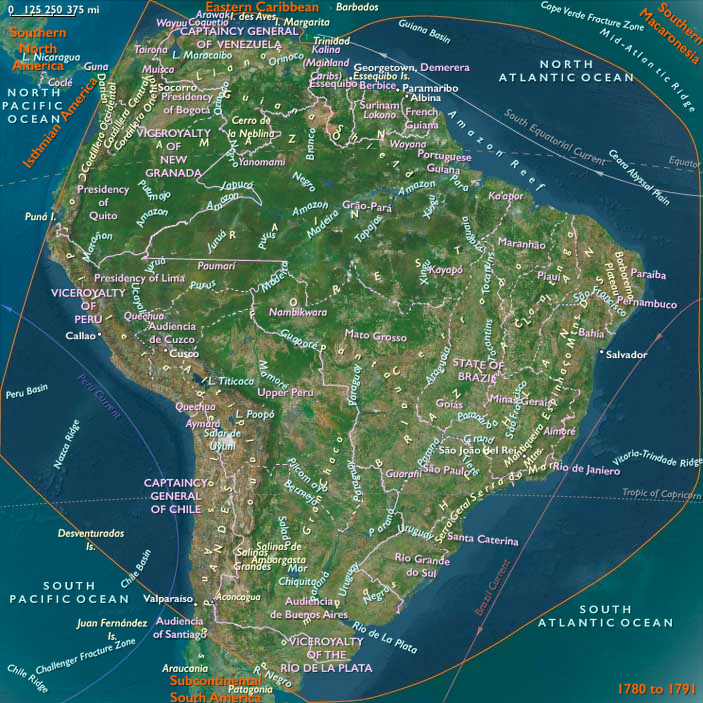
The Inconfidência Mineira is the first attempt…
June 1789 CE
The Inconfidência is inspired by the ideals of the French liberal philosophers of the Age of Enlightenment and the successful American Revolution of 1776.
The conspirators largely belong to the white upper class of minerals-rich Minas Gerais.
Many have studied in Europe, especially in the University of Coimbra, and some have large debts with the colonial government.
In the context of declining gold production, the intention of the Portuguese government to impose the obligatory payment of all debts (the derrama) is a leading cause behind the conspiracy.
The conspirators want to create a republic in which the leader will be chosen through democratic elections.
The capital will be São João del Rei, and Ouro Preto will become a university town.
The structure of the society, including the right to property and the ownership of slaves, will be kept intact.
Eventually, three participants in the independence movement reveal the conspirators' plans to the government, and the rebels are arrested in 1789.
Among the movement's members are the lawyer Alvarenga Peixoto, the poets Tomás Antônio Gonzaga and Cláudio Manuel da Costa, the priest José da Silva de Oliveira Rolim, and the alferes Joaquim José da Silva Xavier (a.k.a. "Tiradentes").
After Joaquim Silvério dos Reis (1756–1792), a member of the conspiracy, informs on the movement before it could take place, Peixoto is captured, arrested, and sent to exile in the city of Ambaca, in Portuguese Angola, another colony of the Portuguese Empire, where he will remain until the end of his life.
People
Commodities
Subjects
Regions
South America
View →Subregions