
A Muslim army is invited into Ceuta …
Years: 710 - 710
A Muslim army is invited into Ceuta by its governor, the possibly legendary Count Julian.
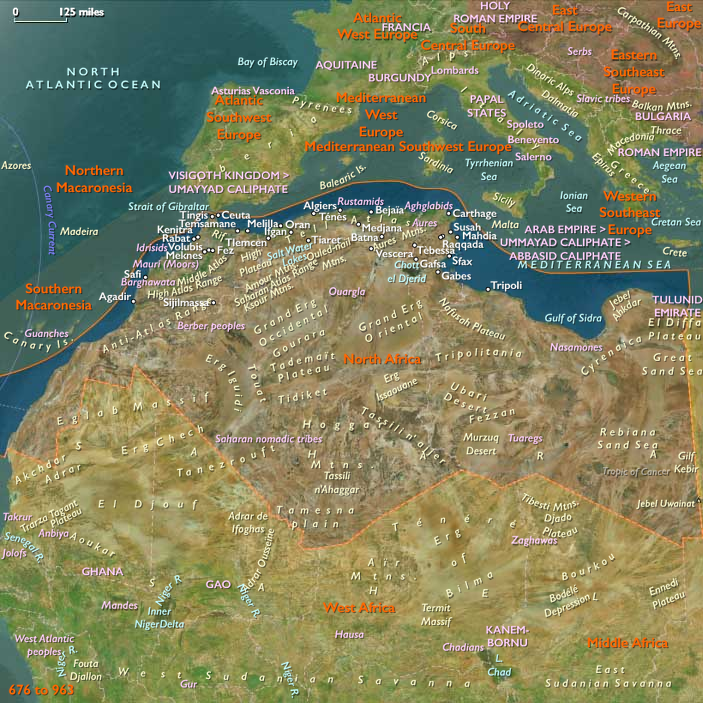
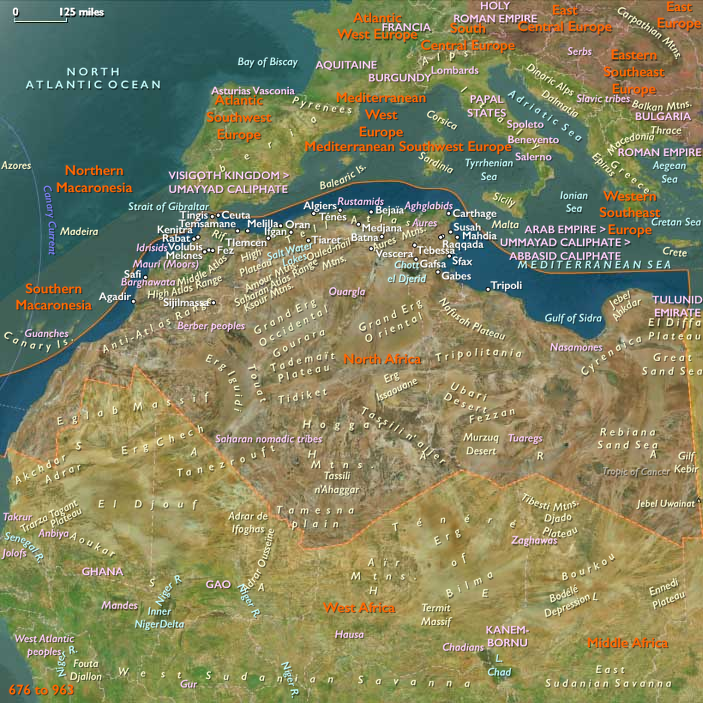
Roman Africa had been largely lost by the end of the seventh century to its Muslim conquerors, who in 711 seize the last outpost at Septem, where Julian, being an opponent of King Roderic of the Visigoths, encourages them to invade the Iberian peninsula.
According to the Egyptian historian Ibn Abd-el-Hakem, writing a century and a half after the events, Julian sent one of his daughters to Roderic's court at Toledo for education (and as a gauge of Julian's loyalty) and Roderic subsequently made her pregnant.
When Julian learned of the affair he removed his daughter from Roderic's court and, out of vengeance, betrayed Hispania to the Muslim invaders, thus making possible the Umayyad conquest of Hispania.
Later ballads and chronicles inflated this tale, Muslims making her out an innocent virgin who was ravished, Christians making her a seductress.
In Spanish she came to be known as la Cava Rumía, but this might well only be a legend.
Personal power politics were more likely at play, as better historical evidence points to a civil war among the Visigothic aristocracy.
Roderic had been appointed to the throne by the bishops of the Visigothic Catholic church—this appointment snubbing the sons of the previous king, Wittiza, who dies or is killed in 710; Wittiza's relatives and partisans had fled Iberia for Julian's protection at Ceuta (Septem), the Pillar of Hercules in North Africa on the northern shore of the Maghreb.
Here they have gathered with Arians and Jews fleeing forced conversions at the church's hands.
At this time, the surrounding area of the Maghreb had recently been conquered by Musa ibn Nusair, who has established his governor, Tariq ibn Ziyad, at Tangier with a Moorish army of seventeen hundred men.
Julian had therefore approached Musa to negotiate the latter's assistance in an effort to topple Roderic.
What is unclear is whether Julian hoped to place a son of Wittiza on the throne and gain power and preference thereby or whether he was intentionally opening up Iberia to foreign conquest.
The latter, though unlikely, isn't inconceivable, given that Julian may have long been on good terms with the Muslims of North Africa and found them to be more tolerant overlords than the Catholic Visigoths.
Moreover, if Julian was the Greek commander of the last imperial outpost in Africa, he would only have had an alliance with the Kingdom of the Visigoths rather than been part of it.
Perhaps, then, in exchange for lands in al-Andalus (the Arab name for the area the Visigoths still called by its Roman name, Hispania), or perhaps to topple a king and his religious allies, Julian provides military intelligence, troops, and ships.
Musa is initially unsure of Julian's project and so in July 710 directs Tarif ibn Malluk to lead a probe of the Iberian coast.
Legend says that Julian participated as a guide and emissary, arranging for Tarif to be hospitably received by supportive Christians—perhaps Julian's kinsmen, friends, and supporters—who agreed to become allies in the contemplated battle for the Visigothic throne.
Locations
People
Groups
- Arab people
- Berber people (also called Amazigh people or Imazighen, "free men", singular Amazigh)
- Jews
- Goths (East Germanic tribe)
- Christianity, Chalcedonian
- Visigothic Kingdom of Spain
- Egypt in the Middle Ages
- Muslims, Sunni
- Umayyad Caliphate (Damascus)
- Roman Empire, Eastern: Heraclian dynasty
- Roman Empire, Eastern: Non-dynastic
Topics
Commodoties
Subjects
Regions
Subregions
Related Events
Showing 10 events out of 55798 total
Years: 710 - 710
Locations
People
Groups
- Arab people
- Berber people (also called Amazigh people or Imazighen, "free men", singular Amazigh)
- Jews
- Goths (East Germanic tribe)
- Christianity, Chalcedonian
- Visigothic Kingdom of Spain
- Egypt in the Middle Ages
- Muslims, Sunni
- Umayyad Caliphate (Damascus)
- Roman Empire, Eastern: Heraclian dynasty
- Roman Empire, Eastern: Non-dynastic
Topics
Commodoties
Subjects
Regions
Subregions