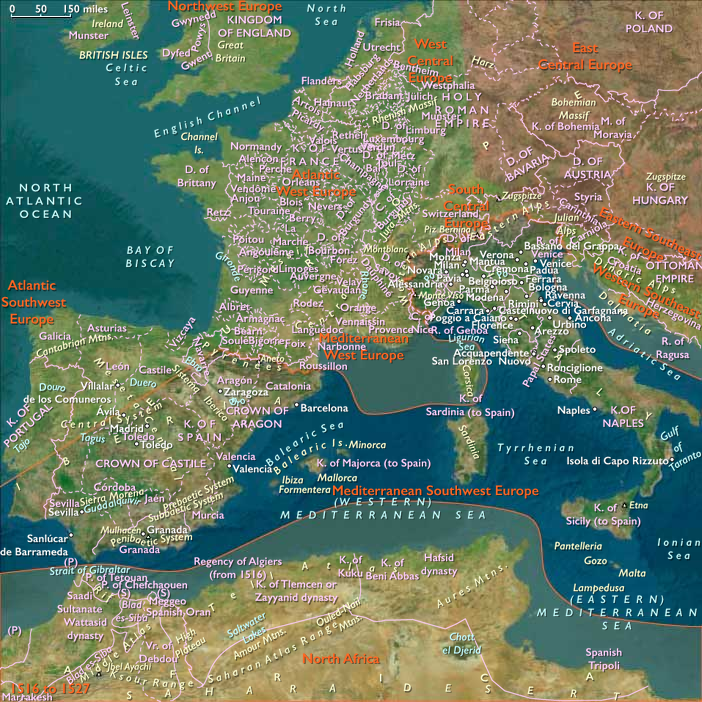
Adriaan Florensz was born on March 2,…
1516 CE
Adriaan Florensz was born on March 2, 1459, in the city of Utrecht, the capital of the Prince-Bishopric of Utrecht, a part of the Burgundian Netherlands in the Holy Roman Empire, into modest circumstances as the son of Florens Boeyensz, also born in Utrecht, and his wife Geertruid.
Adrian will consistently sign with Adrianus Florentii or Adrianus de Traiecto ("Adrian of Utrecht") in later life, suggesting that his family did not yet have a surname but used patronymics only.
Adrian was probably raised in a house on the corner of the Brandsteeg and Oude Gracht that was owned by his grandfather Boudewijn (Boeyen, for short).
His father, a carpenter and likely shipwright, died when Adrian was ten years or younger.
Adrian had studied from a very young age under the Brethren of the Common Life, either at Zwolle or Deventer and was also a student of the Latin school (now Gymnasium Celeanum) in Zwolle.
He had started his studies in June 1476 at the University of Leuven, where he pursued philosophy, theology and Canon Law, thanks to a scholarship granted by Margaret of York, Duchess of Burgundy.
After the regular twelve years of study, Adrian in 1491 became a Doctor of Theology.
He had been a teacher at the University since 1490, was chosen vice-chancellor of the university in 1493, and Dean of St. Peter's in 1498.
In the latter function he was permanent vice-chancellor of the University and de facto in charge of hiring.
His lectures were published, as recreated from his students' notes; among those who attended was the young Erasmus.
Adrian had offered him a professorate in 1502, but Erasmus had refused.
Margaret of Austria, Duchess of Savoy, in November 1506 became Governess of the Habsburg Netherlands and chose Adrian as her advisor.
The next year Emperor Maximilian I had appointed him also tutor to his seven-year-old grandson, and Margaret's nephew, Charles.
Adrian was Charles' advisor by 1512 and his court obligations were so time consuming that he quit his positions at the university.
Charles in 1515 had sent Adrian to Spain to persuade his maternal grandfather, Ferdinand II of Aragon, that the Spanish lands should become under his rule, and not Charles' Spanish-born younger brother Ferdinand, whom his grandfather had in mind.
Adrian succeeded in that just before Ferdinand's death on January 23, 1516.
With the death of King Ferdinand, his mentally unstable daughter Joanna inherits the Crown of Aragon, which consists of Catalonia, Valencia, Naples, Sicily and Sardinia; while her eldest son Charles becomes Governor General.
He had been sworn as the Prince of Asturias, heir-apparent to his mother the Queen Joanna, in the Castilian Cortes of Valladolid of 1506, and that of Madrid in 1510.
On the other hand, in 1502, the Aragonese Cortes gathered in Saragossa had pledged an oath to his mother Joanna as heiress-presumptive, but the Archbishop of Saragossa expressed firmly that this oath could not establish jurisprudence, that is to say, modify the right of the suHowever, as Charles’s assumption the royal title is supported by his grandfather the emperor Maximilian I and the Medici pope Leo X, Charles is proclaimed king of the crowns of Castile and of Aragon, jointly with his mother, after the celebration of Ferdinand II's obsequies on March 14, 1516.
Finally, when the Castilian regent Cardinal Jiménez de Cisneros accepts the fait accompli, he accedes to Charles's desire to be proclaimed king and he imposes his instatement throughout the kingdom.
Charles had been raised in Netherlands and his affairs are mostly controlled by the Flemish noble William de Croÿ, sieur de Chièvres.
Charles V subsequently makes Adrian Bishop of Tortosa and on November 14, 1516 commissions him Inquisitor General of Aragon.
Locations
People
Groups
Topics
Commodities
Regions
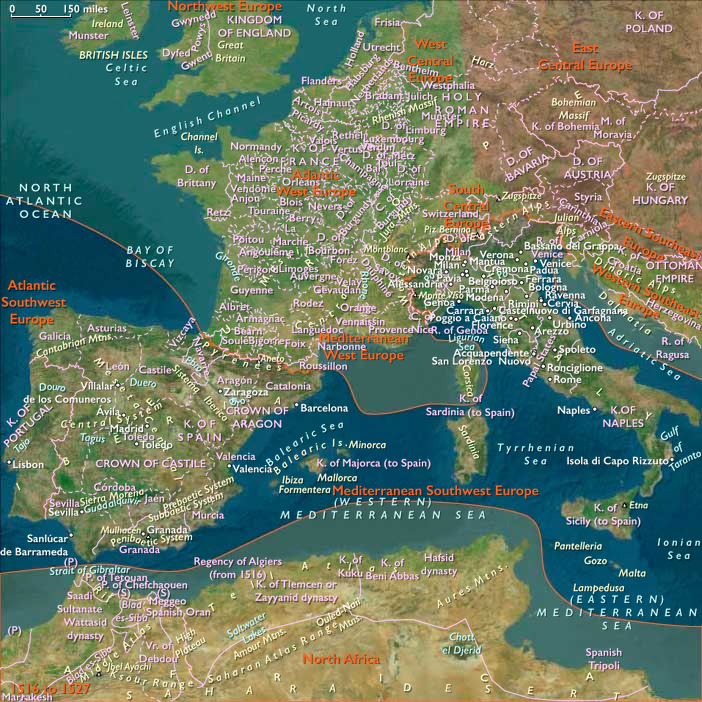
Southwest Europe
View →Subregions