
Atlantic Southwest Europe (189–46 BCE): From Tribal…
189 BCE to 46 BCE
Atlantic Southwest Europe (189–46 BCE): From Tribal Autonomy to Roman Integration
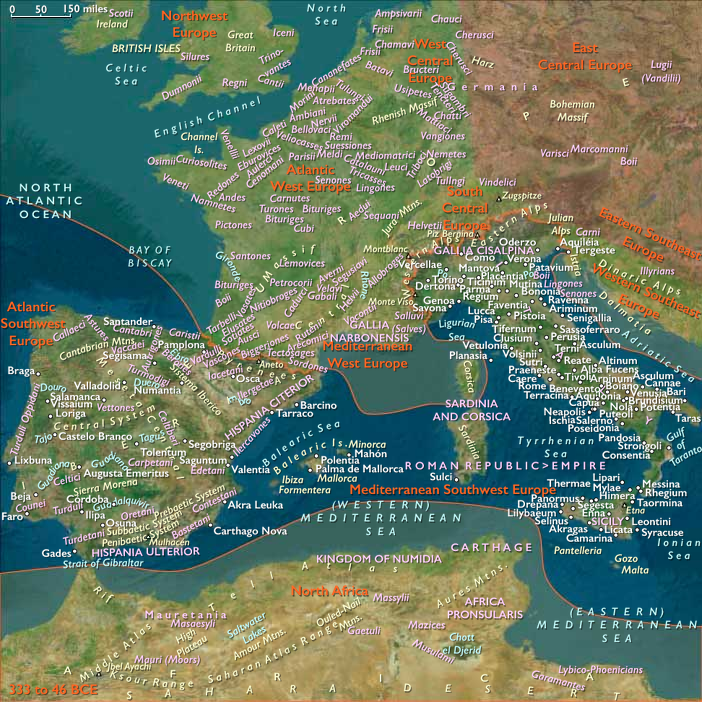
Between 189 and 46 BCE, Atlantic Southwest Europe—encompassing northern and central Portugal, Galicia, Asturias, Cantabria, and northern Spain south of the Franco-Spanish border (43.05548° N, 1.22924° W)—underwent a profound transformation. Initially characterized by vigorous tribal autonomy, the region increasingly encountered direct Roman territorial ambitions following Rome’s victory in the Second Punic War. Over these pivotal decades, the Lusitanians, under charismatic leaders such as Viriathus, spearheaded fierce resistance, while northern tribes—including the Gallaeci, Astures, and Cantabri—persistently defended their independence.
Political and Military Evolution
-
Early Resistance and Diplomacy (189–142 BCE):
Roman expansion into Hispania triggered intense tribal resistance, particularly among the Lusitanians, who effectively united regional tribes. The emergence of the Vascones as a diplomatically cautious group further defined regional dynamics. -
Lusitanian Resistance and Viriathus (141–130 BCE):
Resistance reached its apex under Viriathus, whose guerrilla tactics significantly hindered Roman advancement, creating a lasting legacy of Iberian defiance. -
Roman Consolidation and Northern Autonomy (129–70 BCE):
Following Viriathus’s assassination, southern tribes gradually adapted diplomatically, accepting Roman provincial integration. Northern tribes, however, persisted in resistance, effectively preserving their autonomy through strategic fortifications and resilient alliances. -
Final Roman Campaigns and Integration (69–46 BCE):
Rome escalated military campaigns to fully integrate the region. While Lusitania largely accepted provincial administration, northern tribes remained fiercely independent, setting the stage for future decisive conflicts like the Cantabrian Wars.
Economic Integration and Slavery
-
Throughout the period, tribes significantly deepened their integration into Roman-dominated Mediterranean trade networks, exchanging metals (silver, copper, tin), agricultural goods, salt, timber, and notably, slaves, for Mediterranean luxury goods, ceramics, wine, and olive oil.
-
Slavery remained foundational, profoundly influencing economic and social structures, with slave labor integral to mining operations, agriculture, domestic roles, and trade.
Technological and Cultural Developments
-
Advances in iron metallurgy greatly enhanced agriculture, warfare, and artisanal production, with tribal artisans excelling in intricate weaponry, decorative ornaments, and ceremonial artifacts.
-
Cultural identities remained robust and resilient, synthesizing indigenous Iberian, Celtic, and Roman influences into vibrant artistic expressions and ritual practices, maintaining strong tribal identities and social cohesion.
Tribal Identities and Regional Stability
-
Lusitanians and allied tribes (such as Vettones and Vaccaei) gradually accommodated Roman rule through strategic diplomacy, maintaining local autonomy and economic privileges.
-
Northern tribes (Gallaeci, Astures, Cantabri) and the diplomatically cautious Vascones preserved considerable independence, sustaining resistance and regional autonomy.
Long-Term Historical Legacy
From 189 to 46 BCE, Atlantic Southwest Europe experienced:
-
A profound shift from independent tribal autonomy to significant Roman provincial integration, shaping the region’s political, economic, and cultural evolution for centuries.
-
Sustained and resilient resistance from northern tribes, significantly impacting Roman military strategies and regional history.
-
Deep economic integration into Roman Mediterranean networks, establishing lasting economic structures reliant on slavery, trade, and cultural interaction.
This transformative era decisively positioned Atlantic Southwest Europe on a path toward full incorporation into the Roman Empire, leaving an enduring historical legacy characterized by resilient cultural identities, strategic adaptation, and persistent resistance.
People
Groups
Topics
Commodities
Subjects
Regions
Southwest Europe
View →Subregions
