
Filters:
The trigger for the independence movement in …
Years: 1804 - 1815
The trigger for the independence movement in Spanish America is the Napoleonic intervention in Spain in 1808 and resultant disarray of the Spanish monarchy.
The French forces of Napoleon Bonaparte force the abdication, first of Charles IV and then of his son and immediate successor, Ferdinand VII, who ends up a captive across the Pyrenees.
A Spanish resistance movement arises to fight against the French and the intrusive authorities they impose, and, with significant British help, it ultimately prevails, but for some time most of Spain is in the hands of the French and their Spanish collaborators, and when the rump government that claims to speak for what is left of free Spain—ostensibly in the name of the absent Ferdinand—claims also to exercise authority over the American colonies, the response in New Granada, as elsewhere, is mixed.
The viceroy in Santa Fe, Antonio Amar y Borbon, sidetracks a first move in 1809 by criollo notables to form a governing junta that will rule in Ferdinand's name but enjoy virtual autonomy in practice.
For their part, the leaders of Spain's struggle against Napoleon offers Spanish Americans token representation in their Central Junta and then in the Cortes, or Spanish parliament, which they are reviving after years of disuse.
However, the Spanish Americans will be a small minority despite a population greater than that of Spain, and the Spanish offer does not diminish the ultimate authority that is to be exercised from Spain over the entire Spanish Empire.
It therefore fails to satisfy the criollo lawyers and bureaucrats who aspire to greater control of their destinies (and higher positions for themselves), and with the future of the mother country itself still uncertain, new moves for local autonomy are inevitable.
The year 1810 brings a series of mostly successful efforts to set up American governing juntas: in Caracas on April 19, in Cartagena not long afterward, and finally on July 20 in Santa Fe, where the viceroy is first made a member of the junta but soon is forced out.
Caracas and the rest of Venezuela, which have been little more than nominally subject to the viceroy, will go their own way until in the end Simon Bolivar Palacios, a son of Caracas, combines the independence movements of all northern South America, but neither do the towns and cities of New Granada proper agree to act in unison.
The new authorities in Santa Fe, considering themselves natural successors to the viceroy, seek to establish under their leadership a government for the whole of the former colony.
However, Cartagena and most outlying provinces refuse to cooperate and in 1811 instead form the United Provinces of New Granada, a league even weaker than the Articles of Confederation under which the rebellious British American colonies fought the American War of Independence.
Insisting on the need for strong central authority, Santa Fe refuses to join and instead annexes several adjoining towns and provinces to form the separate state of Cundinamarca, which before long is bogged down in intermittent civil warfare with the United Provinces.
Even so, faced with Spain's refusal to offer meaningful concessions and bitter denunciation of all the Spanish Americans are doing, New Granada reaches the stage of formally declaring independence, doing it piecemeal in the absence of an effective overall government: Cartagena leads the way in 1811; Cundinamarca follows in 1813.
To complicate matters further, still other parts of New Granada—notably Santa Marta on the coast and Pasto in the extreme south—remain loyal to the authorities in Spain and do their best to harass the revolutionaries.
The French forces of Napoleon Bonaparte force the abdication, first of Charles IV and then of his son and immediate successor, Ferdinand VII, who ends up a captive across the Pyrenees.
A Spanish resistance movement arises to fight against the French and the intrusive authorities they impose, and, with significant British help, it ultimately prevails, but for some time most of Spain is in the hands of the French and their Spanish collaborators, and when the rump government that claims to speak for what is left of free Spain—ostensibly in the name of the absent Ferdinand—claims also to exercise authority over the American colonies, the response in New Granada, as elsewhere, is mixed.
The viceroy in Santa Fe, Antonio Amar y Borbon, sidetracks a first move in 1809 by criollo notables to form a governing junta that will rule in Ferdinand's name but enjoy virtual autonomy in practice.
For their part, the leaders of Spain's struggle against Napoleon offers Spanish Americans token representation in their Central Junta and then in the Cortes, or Spanish parliament, which they are reviving after years of disuse.
However, the Spanish Americans will be a small minority despite a population greater than that of Spain, and the Spanish offer does not diminish the ultimate authority that is to be exercised from Spain over the entire Spanish Empire.
It therefore fails to satisfy the criollo lawyers and bureaucrats who aspire to greater control of their destinies (and higher positions for themselves), and with the future of the mother country itself still uncertain, new moves for local autonomy are inevitable.
The year 1810 brings a series of mostly successful efforts to set up American governing juntas: in Caracas on April 19, in Cartagena not long afterward, and finally on July 20 in Santa Fe, where the viceroy is first made a member of the junta but soon is forced out.
Caracas and the rest of Venezuela, which have been little more than nominally subject to the viceroy, will go their own way until in the end Simon Bolivar Palacios, a son of Caracas, combines the independence movements of all northern South America, but neither do the towns and cities of New Granada proper agree to act in unison.
The new authorities in Santa Fe, considering themselves natural successors to the viceroy, seek to establish under their leadership a government for the whole of the former colony.
However, Cartagena and most outlying provinces refuse to cooperate and in 1811 instead form the United Provinces of New Granada, a league even weaker than the Articles of Confederation under which the rebellious British American colonies fought the American War of Independence.
Insisting on the need for strong central authority, Santa Fe refuses to join and instead annexes several adjoining towns and provinces to form the separate state of Cundinamarca, which before long is bogged down in intermittent civil warfare with the United Provinces.
Even so, faced with Spain's refusal to offer meaningful concessions and bitter denunciation of all the Spanish Americans are doing, New Granada reaches the stage of formally declaring independence, doing it piecemeal in the absence of an effective overall government: Cartagena leads the way in 1811; Cundinamarca follows in 1813.
To complicate matters further, still other parts of New Granada—notably Santa Marta on the coast and Pasto in the extreme south—remain loyal to the authorities in Spain and do their best to harass the revolutionaries.
Locations
People
Groups
- Tairona
- Christians, Roman Catholic
- Muisca (Amerind tribe)
- Inquisition, Spanish
- Spaniards (Latins)
- Granada, New Kingdom of (Spanish colony)
- Peru, Viceroyalty of
- Spain, Habsburg Kingdom of
- Quito, Real Audiencia of
- Bogotá, Audiencia de Santa Fe de (Captaincy General of New Granada)
- Spain, Bourbon Kingdom of
- Britain, Kingdom of Great
- New Granada, Viceroyalty of
- New Granada, Viceroyalty of
- Venezuela, Captaincy General of
- Britain (United Kingdom of Great Britain and Ireland)
- Spain, Bonapartist Kingdom of
- Cundinamarca, Free and Independent State
- New Granada, United Provinces of
- Spain, Bourbon Kingdom (first restoration) of
Topics
- Post-Classic Stage (Peru)
- Colonization of the Americas, Spanish
- Encomienda system
- Industrial Revolution, First
- Napoleonic Wars
- Spanish American wars of independence
- Colombian War of Independence
Commodoties
- Gem materials
- Domestic animals
- Oils, gums, resins, and waxes
- Grains and produce
- Textiles
- Ceramics
- Strategic metals
- Slaves
- Sweeteners
- Beer, wine, and spirits
- Land
Subjects
Regions
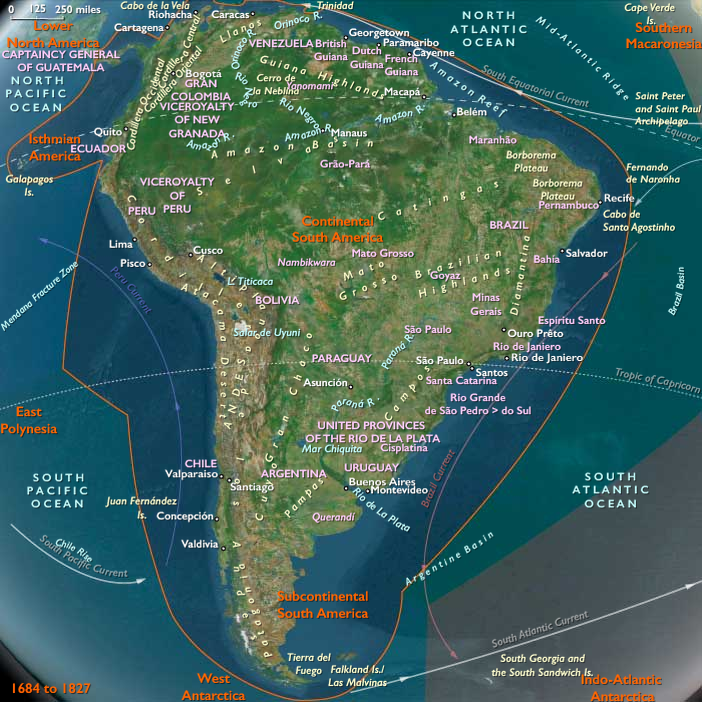
Subregions
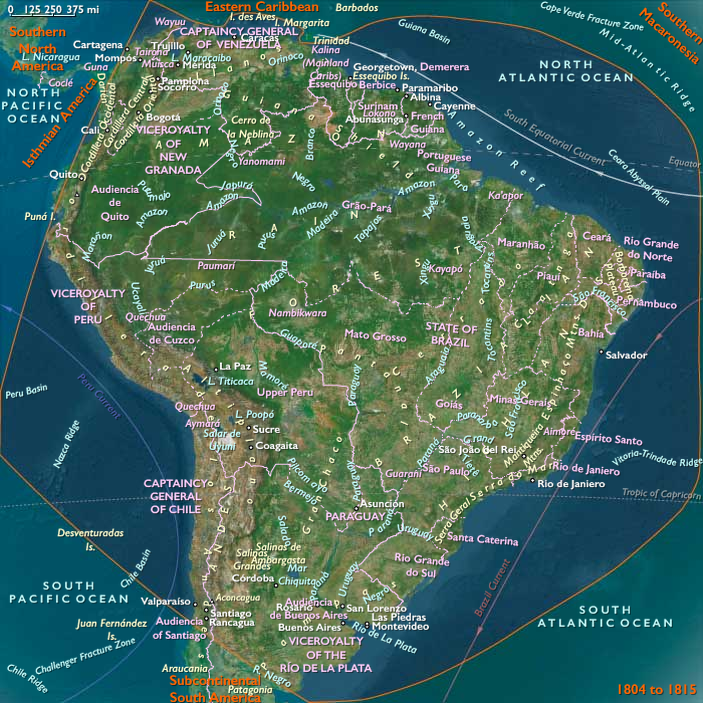
Years: 1804 - 1815
Locations
People
Groups
- Tairona
- Christians, Roman Catholic
- Muisca (Amerind tribe)
- Inquisition, Spanish
- Spaniards (Latins)
- Granada, New Kingdom of (Spanish colony)
- Peru, Viceroyalty of
- Spain, Habsburg Kingdom of
- Quito, Real Audiencia of
- Bogotá, Audiencia de Santa Fe de (Captaincy General of New Granada)
- Spain, Bourbon Kingdom of
- Britain, Kingdom of Great
- New Granada, Viceroyalty of
- New Granada, Viceroyalty of
- Venezuela, Captaincy General of
- Britain (United Kingdom of Great Britain and Ireland)
- Spain, Bonapartist Kingdom of
- Cundinamarca, Free and Independent State
- New Granada, United Provinces of
- Spain, Bourbon Kingdom (first restoration) of
Topics
- Post-Classic Stage (Peru)
- Colonization of the Americas, Spanish
- Encomienda system
- Industrial Revolution, First
- Napoleonic Wars
- Spanish American wars of independence
- Colombian War of Independence
Commodoties
- Gem materials
- Domestic animals
- Oils, gums, resins, and waxes
- Grains and produce
- Textiles
- Ceramics
- Strategic metals
- Slaves
- Sweeteners
- Beer, wine, and spirits
- Land
Subjects
Regions
Subregions