
Andamanasia (1252–1395 CE): Archipelagic Thresholds before the…
1252 CE to 1395 CE
Andamanasia (1252–1395 CE): Archipelagic Thresholds before the Age of Gunpowder
Geographic and Environmental Context
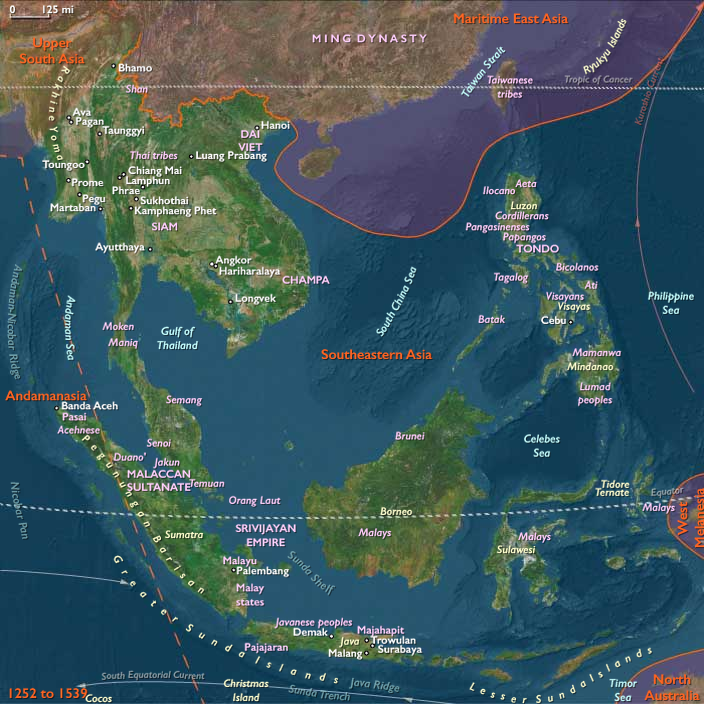
The subregion of Andamanasia stretches along the outer maritime edge of Southeast Asia, encompassing Aceh on northern Sumatra, the islands of Simeulue, Nias, Batu, and Mentawai along Sumatra’s western arc; the Andaman and Nicobar Islands in the Bay of Bengal; the small Myanmarese islands of Preparis, Coco, and Little Coco; and the remote Cocos (Keeling) atolls far into the Indian Ocean.
Together, these islands formed an ecological and cultural hinge between South Asia, Southeast Asia, and the open Indian Ocean—a chain of volcanic and coral lands linking the Straits of Malacca to the Bay of Bengal and the southern monsoon routes.
-
Aceh’s coastal plain opened to the fertile river valleys of northern Sumatra, feeding rice and pepper cultivation.
-
Simeulue, Nias, Batu, and Mentawai formed a rugged outer arc of forested ridges and coral-fringed coasts, vulnerable to earthquakes and tsunamis along the Sunda Megathrust.
-
The Andaman and Nicobar Islands lay within a dense equatorial forest belt, rich in sago palms, yams, and forest fauna.
-
Preparis, Coco, and Little Coco were tiny limestone outcrops scarcely inhabited; the Cocos (Keeling) remained uninhabited but known to navigators as seabird and coconut isles.
Climate and Environmental Shifts
During the early Little Ice Age, the Indian Ocean monsoon alternated between wetter and drier phases:
-
Aceh and northern Sumatra: maintained high fertility with ample rainfall for wet-rice and pepper gardens.
-
Outer islands: periodic earthquakes, storms, and saltwater intrusion shaped settlement mobility.
-
Andaman and Nicobar: heavy rainfall and dense forests nourished foraging and fishing cycles.
-
Cocos (Keeling): uninhabited yet marked by cyclical storm impacts and seabird renewal.
Communities adjusted through diversified subsistence—combining paddy farming, swidden horticulture, reef fishing, and forest foraging—to buffer climatic and seismic instability.
Societies and Political Developments
Aceh and Northern Sumatra
By the mid-13th century, Aceh emerged as a critical node in the Strait of Malacca—a harbor society drawing Muslim, Indian, and Chinese traders.
-
Islamic influence deepened through Sufi teachers and mercantile guilds; mosques and Arabic-script inscriptions appeared in coastal towns.
-
Local rulers organized irrigation works and pepper cultivation, and by the late 14th century Aceh’s courts began to assert political autonomy that foreshadowed its rise as a full Islamic kingdom in later centuries.
-
Inland valleys and coastal plains supported small walled towns, while hill populations supplied forest goods and resins.
The Outer Sumatran Islands (Simeulue, Nias, Batu, Mentawai)
-
Simeulue and Nias: maintained mixed economies of taro, yam, banana, and sago cultivation with fishing and forest trade.
-
Clan longhouses and wooden statuary expressed lineage prestige; in Nias, megalithic monuments and stone platforms commemorated feasting and ancestor offerings.
-
Mentawai villages emphasized harmony with forest spirits, carving wooden effigies and maintaining shamanic rituals of balance (simagre).
-
Batu Islands: linked the chain through canoe routes carrying coconuts, timber, and forest produce to Sumatra’s ports.
-
Raiding and captive exchange tied these islands uneasily to the Sumatran coast but also into its trade orbit.
The Andaman and Nicobar Islands
-
Populated by small-scale forager and fisher communities, the islands sustained dense, kin-based societies dependent on sago, yams, pigs, and shellfish.
-
Coastal groups built dugout canoes for reef fishing and short-range voyaging.
-
Relations with passing ships alternated between resistance and cautious exchange—coconuts, resin, and turtle shell for metal or cloth.
-
Nicobarese communities engaged sporadically with regional traders, while Andamanese groups preserved isolation through strict taboos and forest sanctuaries.
Preparis, Coco, and the Cocos (Keeling)
-
These smaller islands, rarely inhabited, served as navigational reference points for sailors between Bengal, Sri Lanka, and the Malacca Straits.
-
The Cocos (Keeling) atolls remained uninhabited but already entered Indian Ocean lore as provisioning stops marked by seabirds and coconuts.
Economy and Trade
-
Agriculture: Aceh’s irrigated rice and pepper gardens formed the regional economic core; outer islands relied on swidden taro, yams, bananas, and coconuts.
-
Fishing and foraging: provided protein and trade commodities—fish, turtle shell, and dried sea goods.
-
Crafts: iron blades, woven cloth, and pottery circulated from Aceh to Nias and Mentawai; woodcarving and shell tools persisted locally.
-
Trade corridors:
-
The Strait of Malacca connected Aceh to Sumatra, Java, India, and China.
-
Outer island canoes supplied coconuts, forest resins, and captives to Sumatra’s harbors.
-
Andaman and Nicobar shores served as waypoints for Bay of Bengal shipping; their inhabitants engaged in limited barter and guarded their autonomy.
-
Preparis–Coco–Cocos routes completed the link between the Bengal coast and Malacca.
-
The region’s prosperity depended on Aceh’s coastal trade, which drew Muslim merchants and established early Islamic institutions at the fringe of the Buddhist and Hindu Southeast Asian world.
Technology and Material Culture
-
Agricultural tools: iron plowshares, sickles, and buffalo traction spread through Aceh’s farming systems.
-
Architecture:
-
Acehnese houses elevated on stilts to avoid floods.
-
Nias and Mentawai longhouses stood on high posts with elaborately carved façades marking clan heritage.
-
-
Watercraft: outrigger canoes and dugouts served both trade and warfare.
-
Metalwork and textiles: local blacksmiths forged blades and farming tools; women produced barkcloth and woven cotton garments.
-
Art: ancestor figures, stone seats, and shamanic masks symbolized prestige and connection to the spirit world.
Belief and Symbolism
-
Aceh: Islam spread through mercantile and Sufi networks, blending with pre-Islamic Malay rituals; mosques and tomb inscriptions embodied new cosmologies.
-
Nias and Mentawai: maintained ancestor veneration and ritual feasting; megaliths and carved figures ensured lineage continuity.
-
Andaman and Nicobar: oral traditions celebrated creation spirits and forest guardians; dances and taboos governed resource use.
-
Peripheral islets: carried only symbolic presence in sailors’ lore, marked by migratory birds and sea omens.
Across Andamanasia, belief systems fused environmental reverence with social memory—linking rice, forest, and sea within a unified sacred ecology.
Adaptation and Resilience
-
Agricultural–maritime balance: households combined wet-rice or swidden gardens with fishing and trade to offset monsoon variability.
-
Architecture: longhouses raised above ground minimized flood and quake risk.
-
Mobility: flexible settlement patterns allowed migration after disasters.
-
Communal reciprocity: feasts and exchange rituals redistributed resources after storms or scarcity.
-
Environmental ethics: ritual taboos on overharvesting ensured sustainable use of forest and reef systems.
Technology and Power Shifts (Conflict Dynamics)
-
Aceh: emerged as a strategic power controlling the Malacca approach; Islamic courts mediated trade between India, China, and the archipelago.
-
Outer islands: intermittent raiding and tribute created unstable but enduring ties with coastal Sumatran ports.
-
Andaman and Nicobar: resisted outside control; their seafaring independence and environmental knowledge deterred permanent settlement.
-
Uninhabited atolls: remained neutral navigation zones—important for seafarers but untouched by conquest.
Transition and Long-Term Significance
By 1395 CE, Andamanasia had matured into a frontier of converging worlds:
-
Aceh stood at the threshold of the Islamic era, commanding the Strait of Malacca and connecting Indian Ocean and Southeast Asian trade.
-
Nias, Mentawai, and Simeulue preserved rich megalithic and ancestor-centered traditions despite coastal pressures.
-
Andamanese and Nicobarese peoples sustained autonomy through forest wisdom and selective engagement with passing ships.
-
The Preparis, Coco, and Cocos (Keeling) islets—still uninhabited—entered the cartographic imagination of Indian Ocean mariners.
Andamanasia thus formed a liminal world between continents and oceans: part frontier, part refuge, part trading corridor. Its peoples balanced subsistence and seafaring, ritual and resilience—prefiguring the age of intensified maritime competition that would follow with Islam’s expansion and the arrival of European fleets in the 15th century.
Images

Andamanasia (with civilization) ©2024-26 Electric Prism, Inc. All rights reserved.
Groups
Topics
Commodities
Subjects
Regions
Southeast Asia
View →Subregions
