
Andamanasia (820 – 963 CE): Srivijayan Supremacy,…
820 CE to 963 CE
Andamanasia (820 – 963 CE): Srivijayan Supremacy, Austronesian Traditions, and Local Autonomies
Geographic and Environmental Context
Andamanasia includes the Andaman and Nicobar Islands in the Bay of Bengal; Aceh on northern Sumatra, together with Simeulue, Nias, the Batu Islands, and the Mentawai Islands; the Cocos (Keeling) Islands; and the small Myanmarese islands of Preparis, Coco, and Little Coco.
-
The Andaman and Nicobar Islands supported small-scale horticulture, fishing, and foraging.
-
Northern Sumatra (Aceh and its offshore islands) was strategically located along the Bay of Bengal–Strait of Malacca sea-lanes.
-
Nias, Simeulue, and the Mentawais sustained horticultural villages and megalithic traditions, oriented to local exchange and ritual.
-
The Cocos (Keeling) and Preparis–Coco islets were uninhabited but served as waypoints for voyagers.
Climate and Environmental Shifts
-
Warm, humid tropical climate dominated, with predictable monsoon cycles.
-
Agricultural productivity in northern Sumatra was enhanced by reliable rainfall.
-
Cyclones and tectonic activity occasionally disrupted coastal communities but did not undermine overall stability.
Societies and Political Developments
-
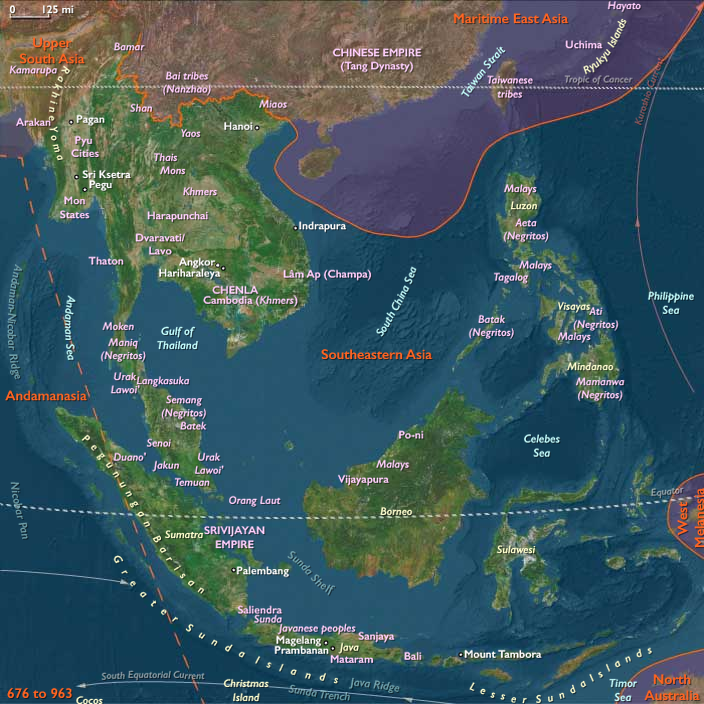
Srivijaya, based in Palembang (southern Sumatra), was at its height of power in this period.
-
It controlled the Strait of Malacca and extended influence into northern Sumatra, including Aceh.
-
Through tribute and naval supremacy, it dominated regional commerce.
-
-
Barus and Lambri existed as local ports:
-
Barus was already known for its camphor, but at this stage operated under Srivijayan influence.
-
Lambri was a small coastal settlement, not yet mentioned in outside records.
-
-
Andamanese peoples (Onge, Jarwa, Sentinelese) sustained hunter-gatherer lifeways, autonomous from external powers.
-
Nicobar Islanders practiced Austronesian horticulture and canoe voyaging, tied together by kinship and ritual exchange.
-
Nias and Mentawai societies developed fortified villages, stone monuments, and ritual feasting economies.
Economy and Trade
-
Srivijaya’s power rested on taxing shipping through Malacca and controlling trade between India and China.
-
Camphor from Barus was exported under Srivijayan control, reaching markets in the Middle East and China.
-
Lambri played a marginal role, overshadowed by larger Srivijayan ports farther south.
-
Inter-island exchange among the Nicobars, Nias, and Simeulue circulated food surpluses, pigs, and ritual valuables.
-
Andamanese subsisted locally, avoiding integration into these trade networks.
Subsistence and Technology
-
Andamanese: bows, spears, and canoes for fishing and hunting.
-
Nicobar Islanders: outrigger canoes, coconut arboriculture, taro, and yam horticulture.
-
Nias: stone-working traditions, fortified villages, and ritual architecture.
-
Srivijaya: naval technologies capable of patrolling sea-lanes and supporting long-distance trade.
Movement and Interaction Corridors
-
The Strait of Malacca was firmly controlled by Srivijaya, linking China to India.
-
Northern Sumatra’s ports (Barus, Aceh, Lambri) fell within Srivijaya’s shadow, participating indirectly in Indian Ocean commerce.
-
The Nicobars served as a stepping-stone for Bay of Bengal voyaging.
-
The Preparis and Cocos (Keeling) islands acted as navigational reference points but were not permanently inhabited.
Belief and Symbolism
-
Andamanese spirituality centered on animist traditions of forest and sea spirits.
-
Nicobarese and Mentawai rituals emphasized ancestor veneration and fertility.
-
Nias: megalithic monuments and ritual feasts embodied mana (sacred power).
-
Srivijaya was a Buddhist polity, patronizing monasteries and transmitting Buddhism into the region, though northern Sumatra itself remained a cultural frontier with animist traditions.
Adaptation and Resilience
-
Island societies thrived on ecological diversity: reef, forest, and horticulture.
-
Integration into Srivijaya’s trading sphere provided northern Sumatran ports with stability and access to external goods.
-
Local autonomy in Nias, Simeulue, and the Mentawais ensured resilience through kinship and ritual economies.
-
Srivijaya’s naval dominance protected trade routes and secured prosperity for its tributary ports.
Long-Term Significance
By 963 CE, Andamanasia was dominated by the Srivijayan Empire, with northern Sumatran ports like Barusintegrated into its commercial system and Lambri still marginal. Local Austronesian island societies retained autonomy, but Srivijaya’s control of Indian Ocean trade routes ensured that this subregion was firmly within its orbit. This would change in the following centuries as Srivijaya declined, allowing Barus and Lambri to emerge as independent hubs.
Images

Andamanasia (with civilization) ©2024-26 Electric Prism, Inc. All rights reserved.
Groups
Commodities
Subjects
Regions
Southeast Asia
View →Subregions
