
Andamanasia (1108 – 1251 CE): Island Seafarers,…
1108 CE to 1251 CE
Andamanasia (1108 – 1251 CE): Island Seafarers, Austronesian Traditions, and Coastal Exchange
Geographic and Environmental Context
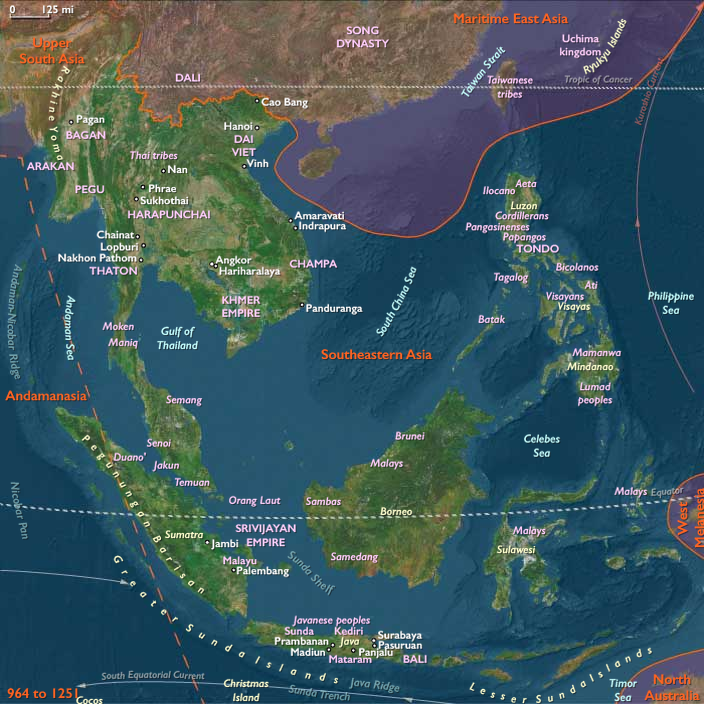
Andamanasia includes the Andaman and Nicobar Islands in the Bay of Bengal; Aceh on northern Sumatra, together with Simeulue, Nias, the Batu Islands, and the Mentawai Islands; the Cocos (Keeling) Islands; and the small Myanmarese islands of Preparis, Coco, and Little Coco.
-
The Andaman and Nicobar Islands were forested, with marine-rich coasts sustaining small-scale foragers and horticulturalists.
-
Aceh at the northern tip of Sumatra was strategically positioned on the sea-lanes between the Bay of Bengal and the Strait of Malacca.
-
Offshore islands like Simeulue, Nias, Batu, and the Mentawais supported horticulture, fortified villages, and elaborate ritual traditions.
-
The Cocos (Keeling) Islands and Preparis–Coco islets were uninhabited but served as navigational markers and seasonal resource bases.
-
Lambri and Barus, on Sumatra’s northern and western coasts, emerged as internationally recognized ports, anchoring the subregion in global commerce.
Climate and Environmental Shifts
-
The Medieval Warm Period stabilized monsoons, supporting taro, yam, and rice horticulture in the Nicobars and western Sumatra, and sustaining fisheries throughout the islands.
-
Tropical storms and cyclones were recurring hazards in the Bay of Bengal and along Sumatra’s coast.
-
Occasional tsunamis in this tectonic zone reshaped settlements and resource use.
Societies and Political Developments
-
Andamanese groups (Onge, Jarwa, Sentinelese) maintained autonomous, kin-based hunter-gatherer societies, resisting contact with outsiders.
-
Nicobar Islanders practiced mixed horticulture and canoe-borne trade, reinforcing Austronesian connections.
-
Nias and Mentawai societies organized around village-based chiefdoms, fortified stone villages, and ritual feasting systems.
-
Aceh, Lambri, and Barus linked the subregion to the wider Indian Ocean world:
-
Lambri was noted in Chinese Song records and Arab travelogues for elephants, camphor, and cloves.
-
Barus was famed for camphor of unmatched quality, drawing Arab, Indian, and Chinese merchants to its port.
-
Aceh’s coastal towns gained new prominence as meeting points for Indian Ocean merchants.
-
-
Srivijaya, once dominant from its base in Palembang, was in decline by this period. While it had influenced northern Sumatra in earlier centuries, its authority no longer extended effectively to Barus, Lambri, and Aceh, which operated as independent entrepôts.
Economy and Trade
-
Horticulture and arboriculture: coconuts, breadfruit, taro, yams, bananas.
-
Fishing, turtle hunting, and reef harvesting remained central in smaller islands.
-
Trade goods: Barus exported camphor; Lambri supplied elephants, spices, and forest products.
-
Arab, Persian, and Chinese merchants frequented Lambri and Barus, establishing cosmopolitan trading communities.
-
Inter-island exchange in Simeulue, Nias, and the Mentawais moved pigs, mats, ornaments, and ritual valuables.
Subsistence and Technology
-
Andamanese: bows, canoes, and spears for foraging and fishing.
-
Nicobarese and Mentawaians: swidden horticulture, outrigger canoes, and bark-fiber crafts.
-
Nias: stone fortifications, megalithic monuments, and prestige artifacts tied to ritual feasting.
-
Northern Sumatran ports: outrigger and larger vessels capable of long-range Indian Ocean voyages.
Movement and Interaction Corridors
-
The Bay of Bengal–Malacca corridor made Aceh, Lambri, and Barus pivotal stops between India, Sri Lanka, and China.
-
Nicobars tied into Bay of Bengal networks, while Nias and Simeulue were part of inter-island circuits.
-
The Cocos (Keeling) Islands and Preparis–Coco islets were used as navigation landmarks.
-
Merchant records from Song China and the Islamic world confirm direct voyages to Barus and Lambri by this period.
Belief and Symbolism
-
Andamanese spirituality centered on forest and sea spirits.
-
Nicobar and Mentawai beliefs emphasized ancestor veneration and fertility rituals.
-
Nias traditions included megalithic monuments and feasting as demonstrations of mana (sacred power).
-
Lambri and Barus blended local animism with early Hindu-Buddhist and Islamic influences, as foreign merchants introduced new religious practices.
Adaptation and Resilience
-
Breadfruit preservation and coconut-based arboriculture supported food stability.
-
Inter-island exchange created redundancy in times of scarcity.
-
Lambri and Barus prospered by shifting from Srivijayan dependency to direct participation in global trade.
-
Fortifications and prestige feasts in Nias and Simeulue reinforced resilience against raiding.
Long-Term Significance
By 1251 CE, Andamanasia was divided between isolated foraging societies in the Andamans, Austronesian horticulturalists in the Nicobars and Mentawais, and internationally active ports like Lambri and Barus in northern Sumatra. The decline of Srivijaya allowed these ports to emerge as autonomous entrepôts, recognized in Chinese, Arab, and Indian records. Through their camphor, elephants, and spices, Lambri and Barus inserted Andamanasia directly into the Indian Ocean trading system, marking the subregion’s transition from a peripheral cultural sphere to a significant maritime crossroads.
Images

Andamanasia (with civilization) ©2024-26 Electric Prism, Inc. All rights reserved.
Groups
Topics
Commodities
Subjects
Regions
Southeast Asia
View →Subregions
