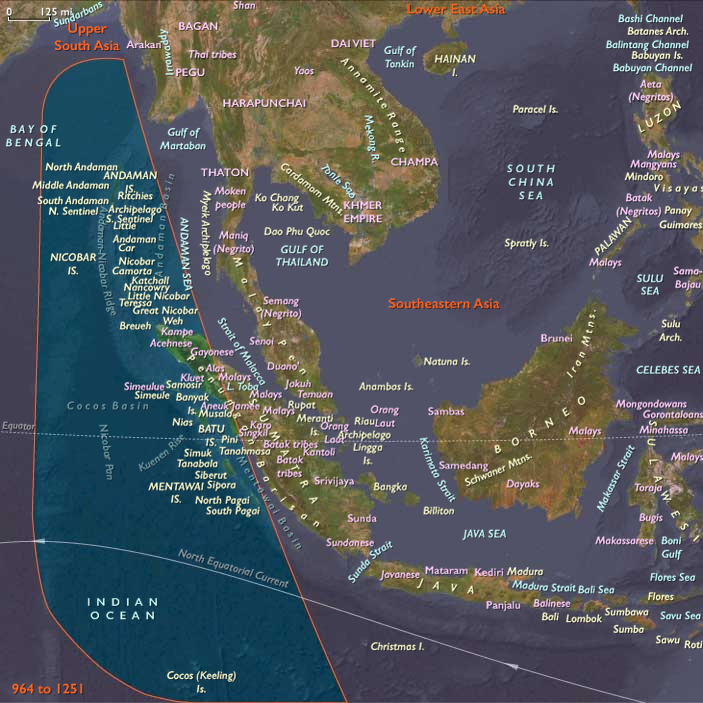
Andamanasia (964 – 1107 CE): Srivijayan Shadow,…
964 CE to 1107 CE
Andamanasia (964 – 1107 CE): Srivijayan Shadow, Island Autonomy, and Emerging Ports
Geographic and Environmental Context
Andamanasia includes the Andaman and Nicobar Islands in the Bay of Bengal; Aceh on northern Sumatra, together with Simeulue, Nias, the Batu Islands, and the Mentawai Islands; the Cocos (Keeling) Islands; and the small Myanmarese islands of Preparis, Coco, and Little Coco.
-
The Andaman and Nicobar Islands supported forager-horticultural communities in a forest and reef environment.
-
Aceh and the northern Sumatran coast occupied a critical position on the Bay of Bengal–Malacca trade corridor.
-
Offshore islands such as Nias and the Mentawais maintained stratified village polities with strong ritual traditions.
-
The Cocos (Keeling) Islands and Preparis–Coco islets were uninhabited but served as occasional stopovers for voyagers.
-
Ports like Lambri (near Aceh) and Barus (on Sumatra’s west coast) began attracting greater attention from Indian Ocean merchants.
Climate and Environmental Shifts
-
The onset of the Medieval Warm Period improved monsoon reliability and supported horticultural productivity in Sumatra’s coastal hinterlands.
-
Storms and occasional tsunamis along the seaboard challenged settlements but also renewed coastal fertility.
-
Atolls such as the Nicobars remained vulnerable to droughts, buffered by inter-island exchange.
Societies and Political Developments
-
Andamanese societies (Onge, Jarwa, Sentinelese) remained autonomous hunter-gatherers, avoiding sustained outside contact.
-
Nicobar Islanders practiced mixed horticulture and maintained Austronesian cultural and exchange traditions.
-
Nias and Mentawai polities developed fortified villages, ritual feasting economies, and megalithic traditions tied to prestige and social rank.
-
Srivijaya, based in Palembang, still exerted influence in northern Sumatra, but its grip was weakened after the Chola raid of 1025, which struck at the heart of its power.
-
Ports such as Lambri and Barus increasingly acted independently:
-
Barus grew in prominence as the world’s most famous source of camphor, coveted in the Islamic world and China.
-
Lambri began to appear in Chinese Song records as a coastal polity exporting elephants, camphor, and other forest products.
-
Economy and Trade
-
Agriculture and arboriculture: coconuts, taro, breadfruit, bananas, yams.
-
Marine resources: fishing, turtle hunting, and reef exploitation formed core subsistence.
-
Barus: exported camphor of the highest quality; trade drew Arab, Persian, and Indian merchants.
-
Lambri: exported elephants, spices, and forest products, increasingly recognized in Song and Arab texts.
-
Srivijaya: though diminished, continued to tax shipping and influence trade patterns through Palembang and Malacca.
-
Inter-island trade in Nias and Simeulue redistributed pigs, ornaments, mats, and ritual valuables.
Subsistence and Technology
-
Andamanese: bows, canoes, spears; ecological knowledge anchored foraging lifeways.
-
Nicobars and Mentawais: outrigger canoes, swidden gardens, and coconut arboriculture.
-
Nias: stone fortifications, ritual megaliths, and prestige artifacts tied to social hierarchy.
-
Northern Sumatra: maritime craft capable of regional Indian Ocean voyages, connecting Aceh and Barus directly to traders.
Movement and Interaction Corridors
-
The Bay of Bengal–Malacca trade route passed by Aceh, with Srivijaya still attempting to mediate trade, though less effectively after 1025.
-
Barus became a regular stop for foreign merchants seeking camphor.
-
Lambri began appearing in travelogues, indicating growing importance as a distinct port-polity.
-
The Nicobars and Preparis–Coco islands served as staging points for smaller-scale Austronesian voyaging.
Belief and Symbolism
-
Andamanese spirituality: forest and sea spirits, mediated by shamans.
-
Nicobar and Mentawai traditions: ancestor veneration, fertility rituals, and feasting economies.
-
Nias: megalithic monuments expressed mana (sacred power) and prestige.
-
Northern Sumatran ports (Lambri, Barus): local animism was gradually intersecting with Hindu-Buddhist influences from Srivijaya and early Islamic presence brought by traders.
Adaptation and Resilience
-
Island societies maintained ecological balance through diversified diets and inter-island exchange.
-
Camphor trade made Barus economically resilient, attracting multi-cultural communities.
-
Lambri prospered by capitalizing on its coastal forests and elephant trade.
-
Srivijaya’s decline opened opportunities for independent polities to assert themselves, building resilience through direct trade links.
Long-Term Significance
By 1107 CE, Andamanasia was a zone of transition: Srivijaya’s authority in northern Sumatra weakened after the Chola raid, allowing Barus and Lambri to emerge as independent entrepôts. While hunter-gatherers in the Andamans and horticulturalists in Nias, Simeulue, and the Mentawais retained traditional patterns, the rise of northern Sumatran ports foreshadowed the subregion’s integration into global Indian Ocean trade.
Images

Andamanasia (with civilization) ©2024-26 Electric Prism, Inc. All rights reserved.
Groups
Commodities
Subjects
Regions
Southeast Asia
View →Subregions