
Atlantic Southwest Europe (388–399 CE): Imperial Reorganization,…
388 CE to 399 CE
Atlantic Southwest Europe (388–399 CE): Imperial Reorganization, Germanic Pressures, and Deepening Christian Authority
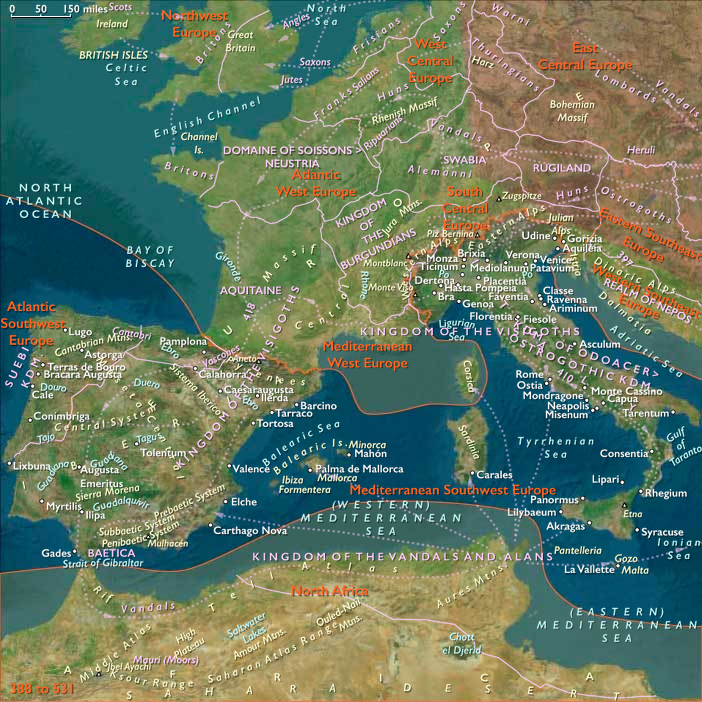
Between 388 and 399 CE, Atlantic Southwest Europe—encompassing northern and central Portugal, Galicia, Asturias, Cantabria, and northern Spain south of the Franco-Spanish border (43.05548° N, 1.22924° W)—entered an era shaped by imperial reorganization under Emperor Theodosius I and the increasingly tangible pressures from Germanic incursions. Despite the broader turbulence affecting the Roman Empire, this region maintained considerable internal stability, thanks to strong local governance, resilient economic networks, and deeply rooted Christian institutions that significantly reinforced regional identity and cohesion.
Political and Military Developments
Imperial Consolidation Under Theodosius I
-
Following his victory in 388 CE over the usurper Magnus Maximus, Emperor Theodosius I (r. 379–395 CE)—himself of Iberian origin—restored relative imperial stability in the western provinces, including Atlantic Southwest Europe. His administrative reforms reaffirmed imperial authority and provincial governance, strengthening bureaucratic oversight through the Diocese of Hispania, administered from Tarraco (modern Tarragona).
-
Provincial administration continued to rely heavily on local elites (curiales), who efficiently managed civic affairs, regional security, taxation, and infrastructure maintenance, ensuring local stability and cohesion despite external pressures.
Increased Germanic Pressure and Defensive Measures
-
Germanic pressures became increasingly acute, with groups such as the Franks intensifying coastal raids along Atlantic settlements, particularly in Galicia and Lusitania. While these incursions disrupted commerce and settlements, they had not yet resulted in permanent Germanic settlement, though they foreshadowed future instability.
-
Roman authorities reinforced defensive fortifications along the coastline and key urban centers, improving local readiness against these growing threats. Auxiliary military units stationed in Asturias, Cantabria, and Galicia remained vigilant, though Rome's broader military capabilities were strained by frontier tensions elsewhere.
Economic and Technological Developments
Sustained Regional Production and Trade Resilience
-
Despite disruptions, Atlantic Southwest Europe sustained robust economic activity. Key economic sectors included gold and silver mining in Asturias and Galicia, olive oil and grain production from Lusitania, and fish products and salt processing in coastal hubs such as Olissipo (Lisbon) and Bracara Augusta (Braga).
-
Regional trade remained resilient, maintaining stable commercial ties to Gaul, North Africa, and Mediterranean markets, despite challenges posed by pirate activities and intermittent disruptions from Germanic raids.
Continued Decline of Urban Life and Rise of Rural Economies
-
The era witnessed the continued gradual decline of smaller urban centers, though major cities like Emerita Augusta, Bracara Augusta, and Asturica Augusta (Astorga) retained prominence as administrative and economic hubs.
-
Wealthy local elites increasingly moved to fortified rural estates (villae), which became primary centers of economic productivity and administration. This shift accelerated the regional trend toward localized economic and social systems, laying foundations for medieval feudal structures.
Cultural and Religious Developments
Deepening Christian Dominance and Institutionalization
-
Christianity became decisively dominant throughout Atlantic Southwest Europe, profoundly shaping regional culture and governance. Following Emperor Theodosius I’s declaration of Nicene Christianity as the state religion (380 CE), Christianity was firmly entrenched among elites and increasingly prevalent among broader populations.
-
Prominent bishoprics—such as those in Emerita Augusta, Bracara Augusta, and Asturica Augusta—expanded their influence significantly. Bishops and clergy assumed critical civic and administrative roles, solidifying Christianity’s social authority and institutional power.
Decline of Traditional Paganism and Ongoing Syncretism
-
Traditional Roman polytheism and indigenous Iberian religious practices experienced further decline, particularly in urban areas where Christian churches and basilicas replaced former temples. However, rural populations in Galicia, northern Portugal, and Asturias maintained indigenous customs and local religious traditions, leading to a distinctive regional syncretism blending Christian and pagan practices.
Civic Identity and Provincial Cohesion
-
Civic identity increasingly blended traditional Roman, Iberian, and emerging Christian cultural elements, strengthening regional cohesion despite broader imperial instability. The universal Roman citizenship established in earlier centuries persisted as an essential component, complemented and transformed by local cultural and religious identities.
Notable Tribal Groups and Settlements
-
Lusitanians: Continued economic prosperity and adaptive governance, deeply integrating Christian traditions into local social structures.
-
Vettones and Vaccaei: Maintained stability and regional autonomy, effectively managing economic and religious transitions.
-
Gallaeci, Astures, Cantabri: Sustained cultural resilience, maintaining traditional indigenous identities while progressively adopting Christianity.
-
Vascones: Successfully preserved diplomatic neutrality, territorial autonomy, cultural distinctiveness, and internal stability, contributing significantly to broader regional resilience.
Long-Term Significance and Legacy
Between 388 and 399 CE, Atlantic Southwest Europe:
-
Benefited significantly from Theodosius I’s administrative reforms, strengthening regional governance and imperial oversight amid escalating external pressures.
-
Effectively sustained economic resilience and productivity, accelerating shifts toward rural-based economies and fortified villa structures, laying critical foundations for future medieval economic patterns.
-
Experienced the decisive institutionalization of Christianity, fundamentally reshaping regional identities, social structures, and governance frameworks, setting long-term precedents for future religious and cultural evolution.
This era reinforced Atlantic Southwest Europe's trajectory toward a stable, resilient, culturally distinct region, deeply influenced by the early foundations of medieval social, economic, and religious structures.
Groups
Topics
Commodities
Subjects
Regions
Southwest Europe
View →Subregions
