
Atlantic Southwest Europe (508–519 CE): Post-Visigothic Realignment,…
508 CE to 519 CE
Atlantic Southwest Europe (508–519 CE): Post-Visigothic Realignment, Suebic Autonomy, and Ecclesiastical Leadership
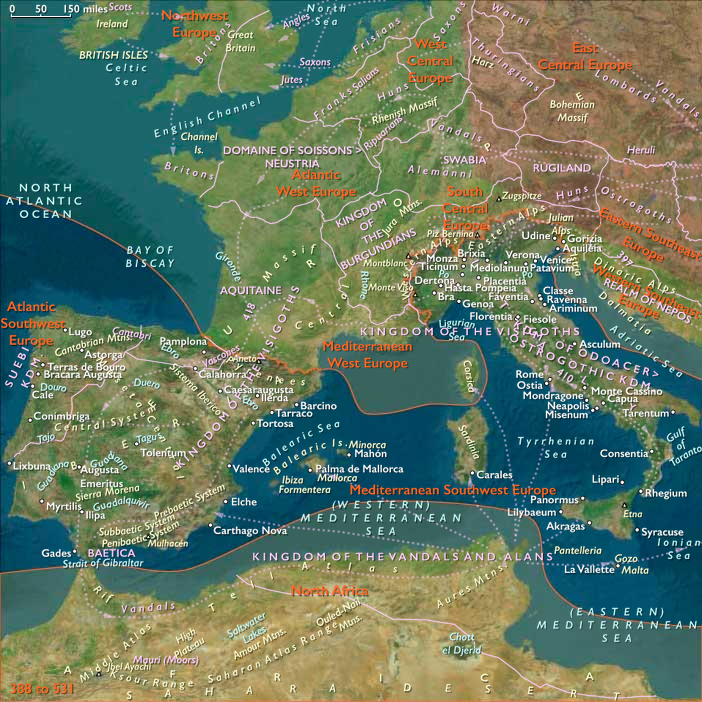
Between 508 and 519 CE, Atlantic Southwest Europe—covering northern and central Portugal, Galicia, Asturias, Cantabria, and northern Spain south of the Franco-Spanish border (43.05548° N, 1.22924° W)—entered a period marked by significant regional realignment following the Visigothic defeat by the Franks at the Battle of Vouillé (507 CE). With the Visigoths’ center of gravity shifting south into Iberia, the Suebic Kingdom in Gallaecia and northern Portugal reaffirmed its autonomy, stabilizing its political and economic standing. Christianity continued strengthening institutionally, solidifying its role as the region’s core cultural and social framework.
Political and Military Developments
Suebic Autonomy and Consolidation After Visigothic Decline
-
Following the Visigothic defeat at Vouillé, the Suebic kingdom under King Veremund (r. c. 469–508 CE) and his successor experienced increased autonomy and stability, effectively freed from immediate external threats. From their capital at Bracara Augusta (Braga), the Suebi maintained effective governance and strengthened internal cohesion.
-
The weakened Visigoths, relocating southward into Hispania and establishing their new capital at Toletum (Toledo), significantly reduced pressure on Atlantic Southwest Europe, allowing the region greater freedom to cultivate local governance and political structures.
Further Decentralization and Local Autonomy
-
Throughout Lusitania, Asturias, Cantabria, and adjacent territories, governance remained decentralized and locally autonomous. Regional elites, tribal chiefs, and influential bishops effectively assumed full authority, managing local affairs, defense, and taxation without significant external interference.
-
The Vascones remained autonomous, politically neutral, culturally distinct, and internally stable, largely unaffected by regional political changes.
Economic and Technological Developments
Sustained Economic Prosperity and Stability
-
Economic conditions remained consistently stable, driven by robust agricultural production (grain, olives, vineyards), active mining operations (gold and silver in Galicia and Asturias), and reliable livestock husbandry. Local manufacturing industries, including textiles, pottery, and metalwork, continued without major disruptions.
-
Coastal trade settlements, particularly Olissipo (Lisbon) and Bracara Augusta, maintained steady trade with Atlantic and Mediterranean markets, emphasizing regional and local economic networks rather than imperial-scale trade.
Continued Dominance of Villa Economies
-
Fortified villa-based economies solidified their status as the dominant socio-economic system, managing agricultural production, local administration, and community defense. These estates, governed by local elites and ecclesiastical authorities, continued laying foundations for medieval feudal systems.
-
Urban centers such as Bracara Augusta, Emerita Augusta, and Asturica Augusta retained their significance primarily as religious, cultural, and administrative hubs, though they saw diminishing urban populations relative to rural estates.
Cultural and Religious Developments
Further Expansion and Maturation of Christian Institutions
-
Christianity continued to deepen its institutional reach, embedding itself firmly as the region’s primary cultural and social force. Bishoprics, notably those of Braga, Emerita Augusta, and Asturica Augusta, reinforced their civic authority, guiding local governance, community mediation, and social cohesion.
-
Monastic institutions expanded notably, assuming critical roles in cultural preservation, education, social welfare, and agricultural innovation. Monasteries became central elements of regional society, decisively shaping local cultural and social identities.
Syncretism and Cultural Integration
-
Cultural integration persisted as Germanic settlers, notably the Suebi, fully embraced Christianity, increasingly blending with local Iberian, Roman, and Celtic communities. Regional cultures continued to reflect a distinctive synthesis of these traditions.
-
Rural populations, especially in Galicia, Asturias, and northern Portugal, maintained unique regional forms of Christianity intertwined with older indigenous customs, reinforcing enduring cultural identities.
Civic Identity and Local Governance
-
Civic identities solidified around localized community affiliations, tribal traditions, and ecclesiastical structures. Local leaders—bishops, elite families, and tribal chiefs—assumed primary governance roles, shaping deeply rooted regional autonomy and cohesive local identities.
Notable Tribal Groups and Settlements
-
Suebi: Reinforced political stability, successfully adapting to broader Iberian realignments and consolidating their kingdom’s autonomy and internal cohesion.
-
Lusitanians, Vettones, Vaccaei: Skillfully navigated political realities, retaining significant local autonomy through strategic governance, diplomacy, and strong community leadership.
-
Gallaeci, Astures, Cantabri: Continued robust indigenous identities, cultural resilience, and local autonomy, pragmatically adapting to shifting external conditions.
-
Vascones: Maintained uninterrupted autonomy, diplomatic neutrality, internal stability, and cultural uniqueness, unaffected by broader regional transformations.
Long-Term Significance and Legacy
Between 508 and 519 CE, Atlantic Southwest Europe:
-
Consolidated regional autonomy following Visigothic setbacks, reaffirming the Suebic kingdom’s political and territorial integrity, significantly shaping future medieval structures in Galicia and northern Portugal.
-
Reinforced localized villa-based economies and regional governance structures, setting clear precedents for medieval economic and administrative patterns.
-
Deepened the institutional strength and cultural centrality of Christianity, firmly embedding religious institutions into the foundations of regional identity and medieval governance.
This era further strengthened Atlantic Southwest Europe’s trajectory toward a stable, autonomous, and culturally distinctive medieval society, characterized by resilient governance, economic adaptability, and influential ecclesiastical leadership.
People
Groups
Topics
Commodities
Subjects
Regions
Southwest Europe
View →Subregions
