
Atlantic Southwest Europe (544–555 CE): Late Suebic…
544 CE to 555 CE
Atlantic Southwest Europe (544–555 CE): Late Suebic Consolidation, Ecclesiastical Ascendancy, and Cultural Integration
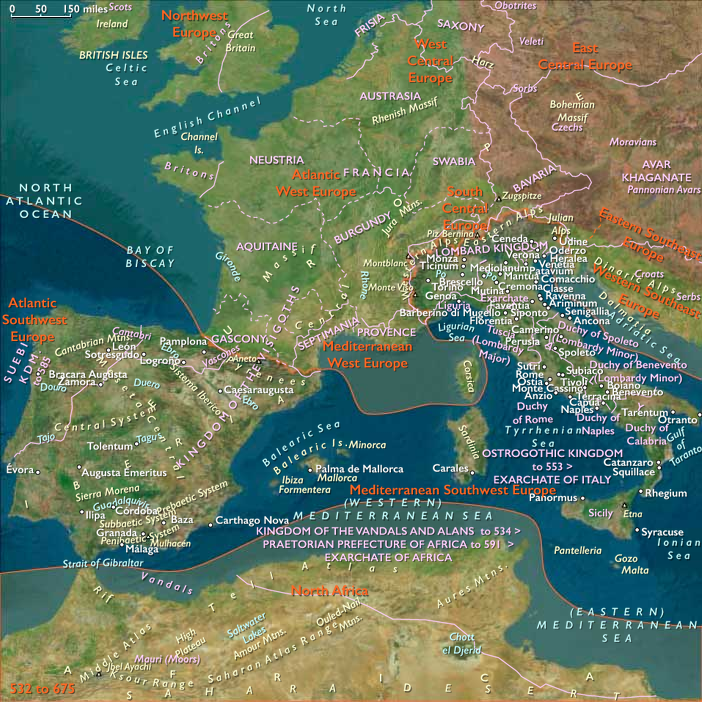
Between 544 and 555 CE, Atlantic Southwest Europe—encompassing northern and central Portugal, Galicia, Asturias, Cantabria, and northern Spain south of the Franco-Spanish border (43.05548° N, 1.22924° W)—continued to experience political stability under late Suebic rule. The period was marked by further religious transformation, with the definitive shift toward Chalcedonian Christianity strengthening regional cultural integration. Local governance remained robust, while economic resilience and villa-based structures further solidified the foundations of medieval society.
Political and Military Developments
Sustained Suebic Political Stability
-
Under successive Suebic kings following Theodemund, the kingdom maintained stable governance from its administrative capital at Bracara Augusta (Braga). Diplomatic and strategic caution characterized Suebic policies, preserving internal cohesion and regional autonomy while avoiding significant conflict with neighboring Visigoths.
-
Although formally independent, the Suebic kingdom maintained careful diplomatic relations with the Visigothic rulers based at Toletum (Toledo), ensuring relative peace and internal stability.
Continuation of Decentralized Regional Autonomy
-
Lusitania, Asturias, Cantabria, and surrounding territories maintained high levels of localized autonomy, governed effectively by influential local families, bishops, and tribal leaders. These local authorities oversaw defense, administrative functions, and economic management independently from distant political centers.
-
The Vascones continued their long-standing tradition of political neutrality, territorial independence, and internal stability, remaining culturally distinct and unaffected directly by broader Iberian political shifts.
Economic and Technological Developments
Stable Regional Economy and Localized Prosperity
-
Economic continuity persisted through stable agricultural production (grain, olives, vineyards), mining operations (gold and silver in Galicia and Asturias), livestock husbandry, and local industries (pottery, textiles, metalwork).
-
Coastal settlements, notably Olissipo (Lisbon) and Bracara Augusta, maintained stable commercial exchanges, primarily regional and local in scope, supplemented occasionally by Mediterranean trade.
Rural Dominance and Emerging Feudal Structures
-
Villa-based rural economies became thoroughly entrenched as dominant economic units. Fortified estates served as autonomous production centers, local administrative hubs, and defensive positions. Managed by local aristocratic and ecclesiastical figures, these structures firmly anticipated medieval feudal economies.
-
Urban centers, such as Bracara Augusta, Emerita Augusta, and Asturica Augusta, persisted primarily as ecclesiastical, administrative, and cultural centers but gradually lost economic prominence relative to rural estates.
Cultural and Religious Developments
Definitive Shift toward Chalcedonian Christianity
-
Around 550 CE, according to Gregory of Tours, the Suebic King Chararic experienced a pivotal conversion to Chalcedonian Christianity, attributed to the miraculous healing of his son through the relics of Saint Martin of Tours. Although historical details about Chararic remain uncertain and debated, this narrative symbolizes the beginning of the broader Suebic shift from Arianism toward Chalcedonian orthodoxy.
-
The Suebic Kingdom, previously adhering to Arian Christianity, decisively moved toward full acceptance of Chalcedonian (Nicene) orthodoxy. This shift greatly facilitated integration with the local Romanized Iberian population and solidified ecclesiastical authority in regional governance.
-
Bishops, particularly at Braga, Emerita Augusta, and Asturica Augusta, increasingly dominated civic leadership, mediating between rulers and local communities, further embedding Christianity as the central pillar of social and cultural life.
Expansion and Influence of Monasticism
-
Monastic communities continued expanding, playing critical roles in education, agricultural productivity, cultural preservation, and social welfare. Monasteries became significant landowners and centers of authority, profoundly influencing regional social and cultural dynamics.
Cultural Integration and Syncretism
-
The integration of Germanic (Suebic), Romanized Iberian, indigenous, and Celtic populations deepened, reinforcing regional identities characterized by cultural and religious syncretism.
-
Rural populations in Galicia, Asturias, and northern Portugal continued blending traditional indigenous practices with Christian rituals, creating distinctive local religious expressions.
Civic Identity and Local Governance
-
Civic identities became firmly localized, defined by religious affiliation, tribal traditions, and community-based governance. Local elites, bishops, and tribal leaders assumed primary administrative roles, ensuring deep-rooted regional autonomy.
Notable Tribal Groups and Settlements
-
Suebi: Maintained stable governance and autonomy, successfully adapting religiously and politically, significantly influencing the region's medieval identity.
-
Lusitanians, Vettones, Vaccaei: Sustained autonomy through effective governance, diplomacy, and resilient local institutions.
-
Gallaeci, Astures, Cantabri: Continued indigenous traditions and governance structures, maintaining resilience and cultural autonomy amidst changing external influences.
-
Vascones: Preserved territorial independence, neutrality, cultural distinctiveness, and internal stability, remaining largely unaffected by regional political dynamics.
Long-Term Significance and Legacy
Between 544 and 555 CE, Atlantic Southwest Europe:
-
Consolidated its political stability and regional autonomy under late Suebic rule, solidifying a foundational identity distinct from the broader Iberian Visigothic territories.
-
Firmly entrenched localized economic structures and villa-based economies, decisively anticipating medieval feudal forms.
-
Marked the definitive acceptance of Chalcedonian Christianity, profoundly shaping regional religious, cultural, and social integration for centuries to come.
This era significantly advanced Atlantic Southwest Europe's transition toward a stable and integrated medieval society, deeply influenced by strong local governance, resilient economic structures, and powerful ecclesiastical institutions.
People
Groups
Commodities
Subjects
Regions
Southwest Europe
View →Subregions
