
Atlantic Southwest Europe (616–627 CE): Ecclesiastical Stability…
616 CE to 627 CE
Atlantic Southwest Europe (616–627 CE): Ecclesiastical Stability and Regional Autonomy Under Visigothic Rule
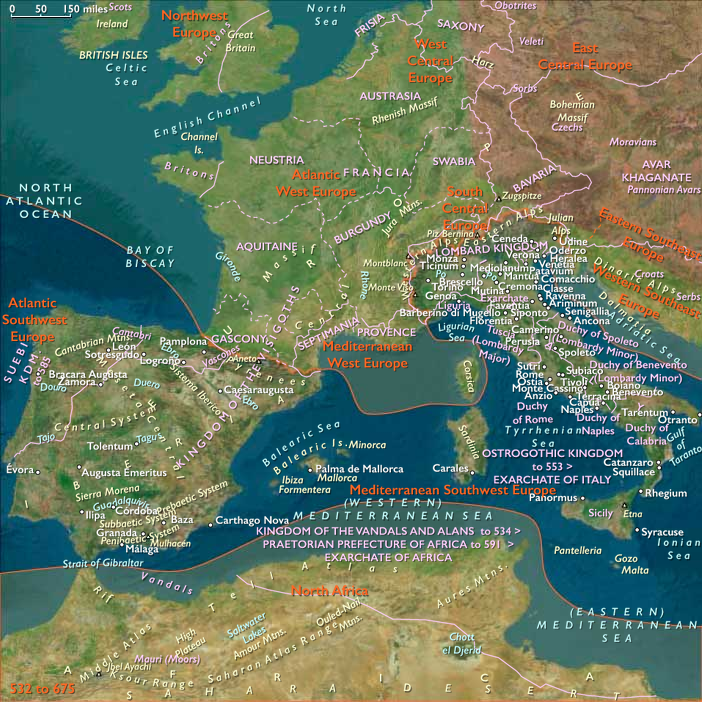
Between 616 and 627 CE, Atlantic Southwest Europe—covering Galicia, northern and central Portugal, Asturias, Cantabria, and northern Spain south of the Franco-Spanish border (43.05548° N, 1.22924° W)—experienced ongoing stability within the Visigothic Kingdom. Although central governance from Toletum (Toledo) strengthened under kings Sisebut (612–621 CE) and Suinthila (621–631 CE), local authority, ecclesiastical power, and regional autonomy persisted, deepening the region’s integration into orthodox Chalcedonian Christianity.
Political and Military Developments
-
King Sisebut (612–621 CE) consolidated royal authority throughout former Suebic territories, strengthening centralized administration yet respecting regional autonomy, especially in Galicia and northern Lusitania.
-
King Suinthila (621–631 CE) continued this policy, promoting internal peace and stability, allowing local aristocrats and bishops significant autonomy in managing their territories.
Economic and Social Developments
-
Economic stability continued, sustained by rural villa-based economies focusing on agriculture (grain, vineyards, olives), mining (gold and silver, notably from Galicia and Asturias), livestock husbandry, and local manufacturing (textiles, pottery, metalwork).
-
Coastal settlements, including Bracara Augusta (Braga) and Olissipo (Lisbon), maintained modest but stable maritime trade networks, connecting the region to Mediterranean and North Atlantic markets.
Cultural and Religious Developments
Reinforcement of Chalcedonian Orthodoxy
-
Ecclesiastical structures solidified further, with influential bishoprics (notably Braga, Emerita Augusta, and Asturica Augusta) playing central roles in community governance, social cohesion, and education.
-
Monastic communities continued to expand, becoming influential landholders and important centers for literacy, agricultural innovation, social welfare, and cultural preservation.
Persistent Regional Traditions
-
Rural and mountainous regions—especially Galicia, Asturias, and northern Portugal—maintained distinctive local religious customs, blending orthodox Christianity with indigenous Celtic and Iberian traditions. This cultural synthesis reinforced regional identity, even as orthodox ecclesiastical institutions gained strength.
Civic Identity and Local Governance
-
Despite increasing royal centralization under Visigothic rule, local civic identity and decentralized governance structures persisted. Bishops, local aristocratic families, and tribal leaders retained considerable autonomy, fostering strong regional cohesion.
Notable Tribal Groups and Settlements
-
Galicians and Lusitanians: Continued resilient decentralized governance and cultural traditions, pragmatically integrating into Visigothic political structures without sacrificing significant local autonomy.
-
Astures and Cantabri: Maintained traditional governance and cultural identity, managing their territories with minimal external interference.
-
Vascones: Remained politically neutral, culturally distinct, and territorially independent, largely isolated from broader Iberian political developments.
Long-Term Significance and Legacy
Between 616 and 627 CE, Atlantic Southwest Europe:
-
Deepened its integration into the Visigothic kingdom without sacrificing significant local autonomy, balancing centralized royal authority with regional governance structures.
-
Further solidified Chalcedonian ecclesiastical institutions and religious orthodoxy, shaping long-term regional identity.
-
Maintained cultural distinctiveness, economic stability, and political cohesion, continuing its trajectory toward medieval feudal organization.
This era reinforced the resilient social and religious foundations that defined Atlantic Southwest Europe's enduring medieval character.
People
Groups
Commodities
Subjects
Regions
Southwest Europe
View →Subregions
