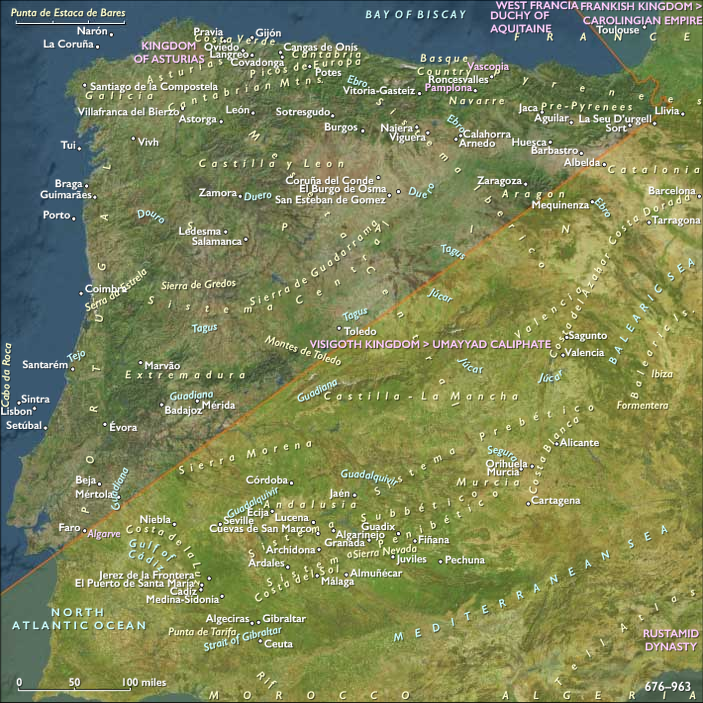
Atlantic Southwest Europe (748–759 CE): Fortification of…
748 CE to 759 CE
Atlantic Southwest Europe (748–759 CE): Fortification of the Asturian Frontier and Regional Consolidation
Between 748 and 759 CE, Atlantic Southwest Europe—encompassing Galicia, northern and central Portugal, Asturias, Cantabria, and northern Spain south of the Franco-Spanish border (43.05548° N, 1.22924° W)—experienced further consolidation and territorial stabilization under Asturian leadership. King Alfonso I (739–757 CE) continued strengthening the region’s strategic defenses against al-Andalus, enhancing economic resilience, reinforcing ecclesiastical structures, and solidifying a distinct Christian political identity.
Political and Military Developments
Asturian Territorial Consolidation under Alfonso I
King Alfonso I continued his proactive military strategy, reinforcing the "Desert of the Duero"—an intentionally depopulated defensive buffer zone southward toward the Douro River. This strategic measure significantly reduced Islamic military incursions from al-Andalus by creating a challenging barrier for invading armies, stabilizing and securing Asturian territories.
Internal Stability and Local Autonomy
Regional leaders in Galicia, northern Portugal, and Cantabria supported Alfonso’s defensive policies, cooperating militarily and politically while retaining considerable local autonomy. This decentralized governance allowed the Asturian kingdom to maintain stability and unity despite the challenges posed by periodic Islamic raids.
Economic Developments
Stability and Economic Growth
The continued security provided by Asturian defenses allowed regional economies to stabilize and gradually expand. Villa-based rural estates flourished, producing grain, olives, wine, livestock, and artisanal goods. Mining activities, especially gold and silver extraction in Galicia and Asturias, resumed strong economic importance, contributing significantly to regional wealth and stability.
Reinvigorated Maritime and Local Trade
Maritime trade through coastal towns like Bracara Augusta (Braga) and small ports along Galicia and northern Portugal modestly increased. Though regional in scope, these trade networks ensured economic continuity and stability, connecting Atlantic Southwest Europe to broader North Atlantic and Mediterranean trade routes.
Cultural and Religious Developments
Enhanced Ecclesiastical Leadership
Influential bishoprics such as Braga, Lugo, Iria Flavia, and Asturica Augusta further consolidated their civic authority, serving as critical centers of regional governance and education. Bishops and monastic leaders provided essential moral and administrative leadership, strongly embedding orthodox Christianity into community life.
Continued Monastic Expansion
Monastic communities expanded further, serving as crucial cultural, educational, and economic institutions. They safeguarded manuscripts, fostered scholarship, provided social welfare, and supported agricultural innovation, decisively shaping regional culture and identity.
Robust Cultural Syncretism
The longstanding fusion of orthodox Christianity with indigenous Celtic and Iberian traditions remained vigorous, particularly in rural Galicia, Asturias, and northern Portugal. This cultural synthesis profoundly influenced local identity, strengthening community cohesion and regional distinctiveness.
Civic Identity and Governance
Formalization of Regional Kingdom Structures
The Asturian kingdom gradually developed more centralized governance under King Alfonso I, though significant autonomy remained for regional aristocrats and ecclesiastical leaders. Civic identities increasingly coalesced around allegiance to Asturias, now seen as the central Christian political authority and primary defender against Islamic Iberia.
Notable Tribal Groups and Settlements
-
Astures and Cantabri: Provided essential military and political leadership, strongly shaping the Asturian kingdom’s identity and defensive posture.
-
Galicians and Lusitanians: Maintained effective local governance and economic stability, pragmatically supporting Asturian central authority while preserving considerable regional autonomy.
-
Vascones: Continued political neutrality, territorial independence, and cultural distinctiveness, largely insulated from broader Iberian political dynamics.
Long-Term Significance and Legacy
Between 748 and 759 CE, Atlantic Southwest Europe:
-
Further solidified defensive structures, significantly stabilizing the Asturian kingdom’s territorial integrity and laying a durable foundation for sustained Christian resistance.
-
Strengthened regional economic stability, ecclesiastical governance, and cultural identity, directly influencing subsequent medieval political and social structures.
-
Preserved robust local governance and distinct regional identities, shaping the region’s enduring medieval character.
This era decisively reinforced Asturian leadership and established enduring political, economic, and cultural foundations for Atlantic Southwest Europe, significantly shaping the region’s medieval trajectory.
People
Groups
Topics
Commodities
Subjects
Regions

Southwest Europe
View →Subregions