
Atlantic Southwest Europe (976–987 CE): Dynastic Challenges,…
976 CE to 987 CE
Atlantic Southwest Europe (976–987 CE): Dynastic Challenges, Almanzor’s Raids, and Regional Resilience
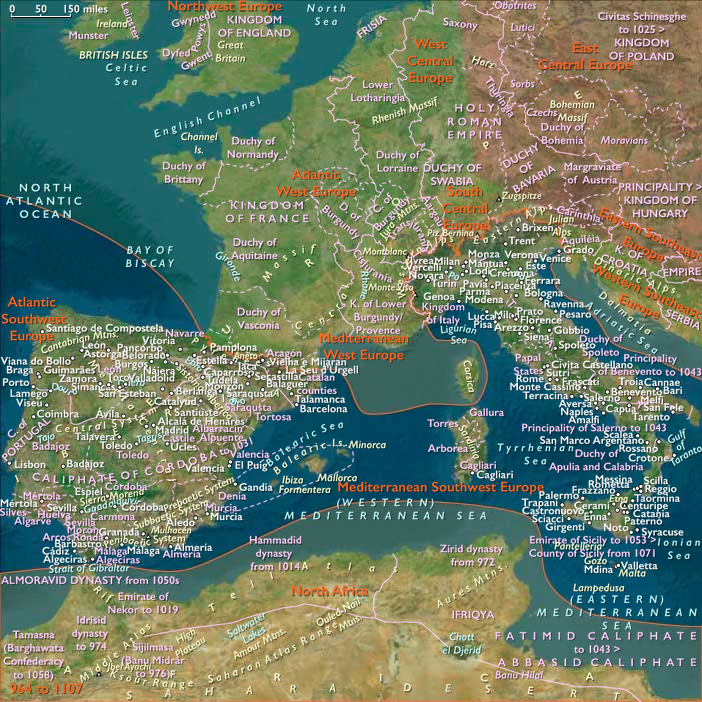
Between 976 and 987 CE, Atlantic Southwest Europe—including Galicia, northern and central Portugal, Asturias, Cantabria, and northern Spain south of the Franco-Spanish border (43.05548° N, 1.22924° W)—entered an era marked by significant political challenges, frontier turbulence, and resilient local responses. The period was shaped profoundly by the growing power of the Caliphate of Córdoba under its powerful military leader, Almanzor (Al-Mansur), whose aggressive military raids challenged Christian territories. Internal dynastic issues within the Kingdom of León under Ramiro III (966–984 CE) and subsequent leadership transitions compounded regional instability. Meanwhile, the Basque Kingdom of Pamplona maintained autonomy under Sancho II Garcés Abarca (970–994 CE), while the Kingdom of Viguera persisted as a minor but symbolic regional entity. In the County of Portugal, enduring local autonomy and civic cohesion helped maintain relative stability.
Political and Military Developments
Dynastic Instability and Internal Tensions in León
Under the young King Ramiro III (966–984 CE), the Kingdom of León experienced increasing dynastic tensions, aristocratic rivalries, and weakened central authority. Noble factions sought influence, weakening effective frontier defenses and administrative cohesion, setting the stage for subsequent political instability.
Almanzor’s Aggressive Campaigns (from 977 CE)
The rise of Almanzor, the powerful military leader and de facto ruler of the Caliphate of Córdoba from 977 CE onward, dramatically reshaped regional dynamics. Launching aggressive raids against Christian kingdoms, Almanzor targeted key cities, monasteries, and settlements along the Duero frontier and beyond, significantly destabilizing the southern frontier of León and disrupting regional security.
Basque Stability under Pamplona
In contrast to León’s difficulties, Sancho II Garcés Abarca of Pamplona maintained political independence, strategically balancing diplomacy and defense to mitigate Almanzor’s pressures. Despite challenges, Pamplona’s autonomy and resilience provided a critical bulwark of stability, highlighting Basque political agility during turbulent times.
Persistence of the Kingdom of Viguera
The small Kingdom of Viguera (970–1005 CE), centered in the Rioja region under Ramiro Garcés, continued as a minor political entity. Though relatively inconsequential, Viguera’s existence reflected ongoing internal Basque dynastic complexity and regional decentralization trends.
Resilience and Stability in the County of Portugal
The County of Portugal effectively maintained political cohesion, territorial stability, and local administrative autonomy during this turbulent period. Its strategic governance ensured continued economic prosperity and frontier security, providing stability amid León’s broader challenges.
Economic Developments
Economic Resilience amid Frontier Raids
Despite Almanzor’s disruptive raids along the frontier, core economic activities—including agriculture (grain, vineyards, olives), artisanal crafts, livestock husbandry, and mining (notably gold and silver in Galicia and Asturias)—persisted robustly. Localized economies showed considerable resilience, adapting effectively to regional instability.
Maritime Trade Continuity
Coastal settlements, notably Bracara Augusta (Braga) and smaller ports in Galicia and northern Portugal, maintained stable maritime commerce. Consistent economic interactions with broader Atlantic and Mediterranean networks remained reliable, ensuring continued regional prosperity despite inland disruptions.
Cultural and Religious Developments
Challenges to Santiago de Compostela
Almanzor’s increasing aggression posed significant threats to Santiago de Compostela, prompting defensive fortifications and heightened security measures. Despite looming threats, the pilgrimage tradition continued attracting pilgrims from throughout Europe, maintaining Santiago’s cultural and religious prominence.
Ecclesiastical Authority and Social Stability
Bishoprics—including Braga, Lugo, Asturica Augusta, and Santiago de Compostela—provided essential community cohesion, moral guidance, and governance, particularly amid political and military turmoil. Ecclesiastical institutions emerged as crucial stabilizing forces, reinforcing local resilience.
Monastic Continuity and Cultural Preservation
Monastic communities preserved scholarly traditions, manuscripts, agricultural innovation, and educational activities despite external threats. Their resilience maintained regional cultural continuity and intellectual vitality, ensuring the preservation of historical heritage.
Enduring Syncretic Traditions
Local integration of orthodox Christianity with indigenous Celtic and Iberian traditions persisted strongly, reinforcing regional distinctiveness and social cohesion amid adversity, particularly in rural Galicia, Asturias, and northern Portugal.
Civic Identity and Governance
Local Autonomy and Decentralized Resilience
Amid weakened central authority in León, local aristocratic leaders, ecclesiastical authorities, and community governance structures increasingly assumed responsibility for defense and administration. Civic identities became more localized, with communities relying on self-sufficient, autonomous governance to maintain stability.
Stable Basque Autonomy
The Basques, under Sancho II Garcés, maintained firm territorial independence and political autonomy through skillful diplomacy, defensive strategy, and internal cohesion, decisively shaping regional politics.
Notable Tribal Groups and Settlements (continued)
-
Galicians and Lusitanians: Effectively sustained resilient local governance, economic stability, and cultural autonomy, pragmatically adapting to shifting political circumstances and reinforcing the foundations of the County of Portugal’s identity.
-
Basques (Pamplona): Maintained stable political autonomy, diplomatic skill, and cohesive governance under Sancho II Garcés Abarca, influencing broader regional stability.
-
Viguera (Rioja Region): Although minor politically, its persistence underscored regional fragmentation trends and internal Basque family complexities during this period.
Long-Term Significance and Legacy
Between 976 and 987 CE, Atlantic Southwest Europe:
-
Experienced intensified frontier pressures from Almanzor’s aggressive raids, highlighting vulnerabilities in centralized Leónese authority but also demonstrating notable regional resilience and local adaptability.
-
Maintained political stability and cultural cohesion in Pamplona, demonstrating effective strategies of autonomy, diplomatic flexibility, and internal governance amid external threats.
-
Preserved and reinforced the County of Portugal’s territorial cohesion and administrative autonomy, laying crucial foundations for Portuguese identity despite broader regional disruptions.
This era significantly tested regional institutions, governance structures, and community resilience, shaping Atlantic Southwest Europe's capacity to withstand external pressures, maintain local autonomy, and reinforce distinctive medieval identities.
Groups
Topics
Commodities
Subjects
Regions
Southwest Europe
View →Subregions
