
Atlantic West Europe (1072–1083): Consolidating Norman Power, …
Years: 1072 - 1083
Atlantic West Europe (1072–1083): Consolidating Norman Power, Capetian Stabilization, and Cluniac Influence
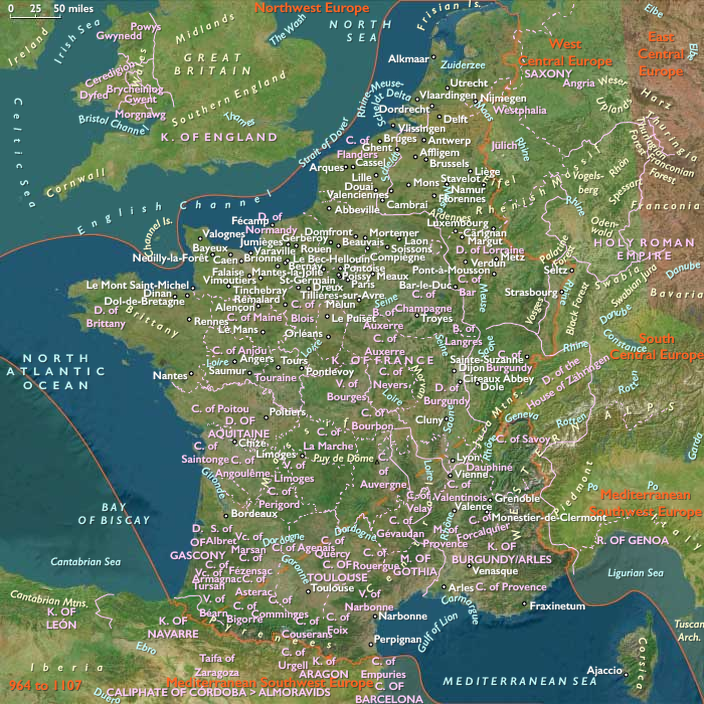
The era 1072–1083 in Atlantic West Europe—including the Low Countries, Normandy, Brittany, Aquitaine, the Duchy of Burgundy, the County of Burgundy (Franche-Comté), Alsace, and central France—was marked by further consolidation of Norman power across the English Channel, gradual stabilization under the Capetian monarchy, continued feudal struggles, and sustained ecclesiastical reform centered around Cluniac ideals.
Political and Military Developments
-
Normandy and England: Norman Consolidation
- William the Conqueror (r. 1035–1087) spent much of this era solidifying his rule in England, suppressing revolts (notably the Revolt of the Earls in 1075), building fortifications, and restructuring governance through the imposition of Norman feudalism.
- Normandy benefited from increased resources flowing from England, enhancing its continental power.
-
France: Slow Capetian Consolidation
- King Philip I (r. 1060–1108) continued the cautious strengthening of royal authority, albeit within narrow limits. His reign remained marked by the careful balancing of powerful regional lords such as the Dukes of Normandy, Aquitaine, and Burgundy.
-
Aquitaine: Strong Ducal Rule
- William VIII of Aquitaine (r. 1058–1086) maintained strong rule, keeping local nobility in check and safeguarding Aquitaine’s independence from Capetian encroachment.
-
Brittany: Maintaining Independence
- Hoël II of Brittany (r. 1066–1084), with Duchess Hawise, sought to preserve Breton autonomy amid Norman and Angevin pressure, successfully maintaining internal stability.
-
Duchy of Burgundy: Strength and Autonomy
- Robert I (r. 1032–1076) followed by his grandson Hugh I (r. 1076–1079) and subsequently Eudes I (r. 1079–1103), managed the duchy effectively, ensuring its continued autonomy from Capetian control and maintaining internal cohesion.
-
County of Burgundy (Franche-Comté) and Alsace
- William I the Great (r. 1057–1087) consolidated his hold on Franche-Comté, enhancing its alignment with the Holy Roman Empire, further separating it politically and culturally from the Duchy of Burgundy.
- Alsace continued to prosper economically, positioned between the German Empire and France, fostering significant trade and cultural exchanges.
-
Flanders and the Low Countries
- Robert I the Frisian (r. 1071–1093) emerged victorious from succession struggles, stabilizing the region. Flanders' commercial dominance in textile trade continued to expand, enhancing its regional influence.
Economic and Social Developments
-
Increased Trade and Urbanization
- The textile industry in Flemish cities (Bruges, Ypres, Ghent) grew significantly, fueling urbanization and broader economic integration across northern Europe.
- Norman-controlled England and Normandy saw increasing economic and cultural exchanges, boosting Normandy's prosperity.
-
Feudal Structures and Territorial Control
- Feudal bonds solidified further, especially in England and Normandy, where Norman elites held cross-channel landholdings, reshaping the social and political landscape.
Religious and Cultural Developments
-
Cluniac and Gregorian Reforms
- The Cluniac reform movement, emphasizing monastic purity and church autonomy, expanded throughout France, Burgundy, and Aquitaine, influencing secular governance.
- Gregorian reforms continued to challenge secular intervention in ecclesiastical matters, laying groundwork for future conflicts like the Investiture Controversy.
-
Cultural Transmission
- Norman rule in England fostered cultural exchange, spreading continental architectural styles (Romanesque) and administrative practices.
Legacy and Long-term Significance
The era 1072–1083 solidified transformative processes begun earlier in the century:
- William the Conqueror's stable control of England permanently altered Norman fortunes, creating a powerful cross-channel dominion.
- Capetian royal authority remained cautious yet steady, emphasizing diplomacy over direct confrontation with powerful dukes.
- Cluniac and Gregorian reforms continued to shape religious institutions, influencing church-state relations significantly.
These developments would shape subsequent political alignments, economic growth patterns, and cultural dynamics throughout Atlantic West Europe for decades to come.
People
- Conan II
- Hawise of Rennes
- Hoël II
- Hugh I
- Odo I, Duke of Burgundy
- Philip I of France
- Robert I of Burgundy
- Robert I, Count of Flanders
- Robert II of France
- William I
- William VIII,Duke of Aquitaine
- William the Conqueror
Groups
- Aquitaine, (Carolingian) Kingdom of
- Flanders, County of
- Anjou, County of
- Normandy, Duchy of
- England, (Anglo-Saxon) Kingdom of
- Brittanny, Duchy of
- Burgundy, County of
- Aquitaine, (Angevin) Duchy of
- France, (Capetian) Kingdom of
- Burgundy, Duchy of
- England, (Norman) Kingdom of
Topics
Commodoties
Subjects
Regions
Subregions
Related Events
Filter results
Showing 10 events out of 33 total
Maximilian of Austria, Margaret’s Betrothal, and the Treaty of Arras (1482–1492)
In 1482, Archduke Maximilian of Austria strategically betrothed his young daughter, Margaret of Austria, to the Dauphin of France (later Charles VIII) as part of the Treaty of Arras. This diplomatic arrangement—intended to ease tensions following the Burgundian succession crisis—would significantly impact relations between the Habsburgs and the French crown, shaping regional politics in Atlantic West Europe.
Diplomatic Context of Margaret’s Betrothal (1482)
The Treaty of Arras (1482) was negotiated in response to intense pressure from King Louis XI of France, Maximilian’s persistent adversary who contested the Burgundian inheritance following the death of Charles the Bold. Under the treaty’s terms, the three-year-old Margaret was engaged to Louis XI's young son, Charles, as part of an agreement intended to confirm peace between France and the Burgundian Netherlands.
In exchange, Maximilian reluctantly offered a substantial dowry: the territories of Burgundy, Artois, and Franche-Comté. These concessions significantly strengthened France’s territorial position in Atlantic West Europe.
Changing Fortunes and the Breton Marriage Crisis (1491)
Initially, Margaret remained at the French court awaiting her marriage to Charles VIII. However, circumstances dramatically shifted with the death of Francis II, Duke of Brittany, in 1488, leaving his duchy to his young daughter, Anne of Brittany. With the French crown eager to secure control of Brittany, the regent, Anne of France—Charles VIII’s elder sister—maneuvered to end Charles’s betrothal to Margaret.
In 1491, taking advantage of Maximilian’s distraction by dynastic disputes in Central Europe, Charles VIII decisively repudiated his earlier engagement to Margaret, compelled Anne of Brittany to repudiate her unconsummated marriage to Maximilian, and instead married Anne himself. Margaret, humiliated and left politically isolated, nevertheless remained at the French court.
Diplomatic Repercussions and Margaret’s Continued Residence in France
Margaret’s continued presence in France from 1482 to 1493, despite the repudiation of her betrothal, effectively rendered her a political hostage, ensuring Maximilian’s cooperation or at least restraint in matters involving France. Margaret’s detention at the French court symbolized ongoing diplomatic tensions, underscoring both her father's tenuous position and the complicated relations between France and the Habsburgs.
Resolution with the Treaty of Senlis (1493)
The situation was resolved only after Maximilian regained the upper hand militarily and diplomatically in 1493. The subsequent Treaty of Senlis on May 23, 1493, restored a measure of equilibrium. Margaret finally returned to her father, and the treaty adjusted territorial claims: Maximilian retained the Franche-Comté and Artois, while France held the Duchy of Burgundy itself, stabilizing the fragile Franco-Habsburg balance of power—albeit temporarily.
Long-Term Consequences and Historical Significance
The repudiation of Margaret’s betrothal had lasting diplomatic and dynastic implications. It deepened antagonisms between the French crown and the Habsburgs, tensions that would fuel future geopolitical rivalries. Margaret herself emerged as a prominent figure, notably as a capable governor of the Netherlands in later years, and became instrumental in subsequent Habsburg diplomatic negotiations. Meanwhile, Brittany's annexation reshaped French territorial integrity, permanently integrating the duchy into the French kingdom and symbolizing the royal drive towards centralized monarchy in late medieval Atlantic West Europe.
Thus, the complicated diplomatic maneuvers surrounding Margaret’s betrothal and its subsequent repudiation underscore the interplay of personal, dynastic, and political ambitions in shaping the geopolitics of late medieval Europe.
Jean Hey's Madonna in Glory with Saints and Donors (c. 1498)
In 1498, French painter Jean Hey, later known as the Master of Moulins, created his renowned masterpiece, the monumental Triptych of Moulins, for the Cathedral of Moulins. This remarkable altarpiece, celebrated for its exquisite technique and sophisticated realism, portrays Peter II, Duke of Bourbon, and his wife, Anne of France, alongside their daughter, Suzanne, offering a profound meditation on piety, family legacy, and political symbolism.
Historical Context: The Bourbons and the Crown
The commission emerged amid significant political transformations in late 15th-century France. Peter II had risen to prominence under King Louis XI, whose careful manipulation of noble alliances reshaped the balance of power among France's greatest houses. Initially betrothed to Marie d'Orléans—a union opposed by Louis XI to limit noble power—Peter was instead married to the king's daughter, Anne of France, on November 3, 1473, binding the Bourbon family firmly to the crown.
Under Louis XI, Peter's loyalty and reliability earned him substantial rewards, including a seat on the royal council and the fief of Bourbonnais. By the time Louis XI died in 1483, Peter was one of the few nobles who had consistently maintained royal favor, entrusted even on the king's deathbed with safeguarding royal interests. Subsequently, he and Anne guided young Charles VIII's early reign (1483–1491), influencing royal policies and strengthening their power base within the Bourbonnais region.
By 1488, the couple had consolidated significant territorial power. Peter, initially Count of Clermont and Beaujeu, inherited the substantial domains of his family, including the Duchy of Bourbon and the Counties of Forez and La Marche, following the death of his elder brother. Together, Peter and Anne strategically expanded their territories, acquiring Bourbon-Lancy in December 1488 and conducting territorial exchanges, such as trading l'Isle-en-Jordain with the Armagnacs in 1489. Significantly, these newly acquired domains were granted with the remarkable freedom to designate inheritance as they pleased, outside customary feudal restrictions.
The birth of their daughter, Suzanne, on May 10, 1491, secured their lineage, though earlier reports of an heir born in 1476 remain contradictory, suggesting either a miscarriage or stillbirth. Suzanne's eventual inheritance became a critical dynastic issue.
However, by 1491, their influence over French politics waned as Charles VIII reached maturity and began making independent—and sometimes controversial—decisions, such as marrying Anne, Duchess of Brittany, despite Peter and Anne's objections. Charles's untimely death in 1498 and Louis XII's succession saw Peter withdraw from active court politics, choosing instead to dedicate his remaining years to family, notably his cherished daughter Suzanne.
Cultural and Artistic Significance
The Triptych of Moulins symbolizes both personal piety and the assertion of dynastic prestige. Jean Hey (the Master of Moulins) infused the altarpiece with richly symbolic details, combining northern Renaissance realism with Burgundian elegance. The central panel, portraying the Virgin and Child in majesty, and side panels featuring Peter and Anne in devotional poses, subtly reinforce themes of dynastic continuity, moral virtue, and divine favor. The altarpiece thus embodies the intertwined political ambitions and devotional culture characteristic of late medieval nobility, marking a high point in artistic patronage within Atlantic West Europe.
Culturally and artistically, Jean Hey's work at Moulins epitomizes the transition from the Late Gothic to early Renaissance aesthetics, influencing later artistic developments in France and the Low Countries. Politically, the altarpiece memorializes the height of Bourbon influence, preceding their gradual political decline at the French royal court.
This period thus marks a notable intersection of artistic brilliance, political symbolism, and shifting noble fortunes in Atlantic West Europe.
Atlantic West Europe: Shifting Alliances, Renaissance Patronage, and Early Reformation (1504–1515)
The era from 1504 to 1515 in Atlantic West Europe is defined by intensified geopolitical rivalries, a flourishing Renaissance culture increasingly shaped by royal patronage, and early tremors of religious reform that foreshadow larger upheavals to come. France and the Low Countries remain central, as their rulers navigate shifting alliances and conflicts, while economic prosperity and artistic achievements provide the backdrop to this critical transitional period.
Political and Military Developments
The early part of the era sees the continuing consolidation of Habsburg authority in the Low Countries, as Philip the Handsome asserts his dominance until his sudden death in 1506, after which the regency of his widow, Joanna of Castile, and subsequently his sister, Margaret of Austria, shapes political stability and cultural prosperity in the region. Margaret’s capable governance reinforces Habsburg control, overseeing diplomatic, cultural, and economic flourishing, especially in cities like Antwerp, Ghent, and Bruges.
In France, the ambitious Louis XII continues his attempts at territorial expansion, notably in Italy, sustaining the costly and complex Italian Wars. His rivalry with the Habsburgs escalates further when young Charles of Habsburg, Philip’s heir, begins inheriting vast European territories, heralding future conflicts.
This period also witnesses England’s increased involvement in continental affairs under Henry VIII, complicating diplomatic relations in Atlantic West Europe. In 1513, Louis XII suffers a major setback at the Battle of the Spurs against English and Habsburg forces, reflecting the ongoing military volatility in the region.
Economic Developments
Economic prosperity continues, notably in the flourishing trading city of Antwerp, which further solidifies its position as Europe's most important commercial hub. Antwerp benefits from expanding international trade routes, connecting northern Europe with Mediterranean and newly emerging transatlantic markets.
In France, royal patronage supports urban and commercial growth, especially in cities such as Lyon, Rouen, and Paris, which develop thriving markets for luxury goods, textiles, and fine craftsmanship. Increased investment in trade infrastructure—such as roads, bridges, and marketplaces—facilitates internal commerce, supporting France’s economic resilience despite ongoing wars.
Cultural and Artistic Flourishing
The years from 1504 to 1515 represent a high point in Renaissance artistic patronage in Atlantic West Europe. The courts of Louis XII in France and Margaret of Austria in the Low Countries become leading centers of culture and art, drawing renowned artists and humanists.
Margaret's court in Mechelen becomes an influential center of music, literature, and visual arts, hosting leading Flemish artists such as Jan Gossaert (Mabuse), whose works introduce Italian Renaissance motifs, nudity, and classical themes to northern traditions.
In France, royal patronage elevates the careers of artists and scholars, including French court painter Jean Perréal, as well as poets and humanists who enrich cultural life with Italianate learning and aesthetics.
Religious and Intellectual Developments
The early sixteenth century witnesses subtle yet important movements toward religious reform and humanist thought. In France, scholars such as Jacques Lefèvre d'Étaples begin questioning traditional interpretations of scripture, laying intellectual groundwork for future reformers. Though still within the Catholic fold, these movements signal broader shifts in religious thought and practice that will soon erupt in the Reformation.
Meanwhile, humanism becomes increasingly influential, promoting educational reform and critical thinking, and fostering a new scholarly rigor in theology and philosophy across the region.
Technological and Societal Shifts
Technological advances, especially in printing, continue reshaping society. The increasing availability of printed books accelerates the spread of Renaissance humanism and early reformist ideas. Military technology also advances, with artillery and improved fortifications becoming common in warfare, transforming battle tactics and city defenses.
Societal shifts include growing urban influence, as prosperous merchant classes in the Low Countries and France gain prominence, gradually challenging traditional aristocratic structures and feudal privilege.
Long-term Consequences and Significance
The period from 1504 to 1515 serves as a crucial bridge to the transformative events of the early sixteenth century. The geopolitical rivalry between France and the Habsburgs intensifies, setting the stage for future conflicts. Economically, Antwerp and other major cities solidify their roles in the expanding global trade network. Culturally, royal courts in France and the Low Countries foster an artistic and intellectual flourishing that profoundly impacts European culture. Crucially, emerging religious ideas anticipate the seismic changes of the Protestant Reformation, ensuring that this era will shape Europe's religious, political, and cultural landscape profoundly in the decades to come.
Jacopo de' Barbari at the Court of Margaret of Austria (after 1509)
After 1509, the renowned Italian artist Jacopo de' Barbari—noted as a painter, engraver, and designer of woodcuts—worked in the Netherlands, notably at the humanist-influenced court of Margaret of Austria. His presence and distinctive artistic approach profoundly influenced Flemish Renaissance art, notably introducing Italian Renaissance ideals and classical humanist themes into the northern artistic tradition.
Artistic Influence and Significance
Jacopo's distinctly Italianate interest in classical mythology, elegant depictions of the nude, and graceful figurative style significantly impacted the work of younger Flemish painters such as Jan Gossaert (Mabuse) and Bernard van Orley. Through his emphasis on harmonious proportions, classical subjects, and refined anatomical accuracy, Jacopo introduced Flemish artists to Italian Renaissance techniques and humanist aesthetics, profoundly altering the trajectory of northern European painting.
His signature mark—the caduceus, the classical emblem of Mercury—symbolized his intellectual commitment to humanism, reflecting his fusion of classical motifs with innovative artistic expression. The caduceus emblem also served as a symbolic expression of Jacopo’s broader intellectual interests, aligning him closely with the humanist values of Margaret’s court.
Cultural Context and Court Patronage
The court of Margaret of Austria was an important center of humanist learning, artistic patronage, and cultural exchange in early 16th-century Europe. Jacopo’s presence and activity at this court exemplified the growing cultural interaction between northern and Italian Renaissance traditions. By blending the elegance and grace of Italian classical ideals with the detailed realism and rich symbolism characteristic of Flemish art, Jacopo fostered an influential artistic dialogue that would deeply shape the Flemish Renaissance.
Legacy and Consequences
Jacopo de' Barbari’s influence on northern European painting endured well beyond his lifetime, as subsequent generations of Flemish artists continued to integrate classical humanism and Renaissance aesthetics into their works. His pioneering role in fostering artistic exchanges between Italy and northern Europe made him a crucial figure in the broader European Renaissance, leaving a lasting imprint on the evolution of Atlantic West European art.
Siege of Thérouanne: Henry VIII’s Encampment and Military Challenges (July 1513)
In July 1513, the English siege of Thérouanne under King Henry VIII encountered stiff resistance from the French garrison commanded by Antoine de Créquy, Sieur de Pont-Remy. Despite determined efforts, the English forces—led by George Talbot, Earl of Shrewsbury—initially made limited progress. Shrewsbury set up artillery batteries and began mining operations toward the town walls, but the defenders, comprising both French and German soldiers, countered effectively, responding vigorously with sustained artillery fire, including one distinctive regular cannon shot nicknamed the "whistle" by the English troops.
Challenges and Setbacks
The siege faced logistical and tactical setbacks. Notably, two English cannons—prominently named "John the Evangelist" and the "Red Gun"—had been abandoned en route, and French skirmishing hindered their recovery, resulting in casualties among the English forces. The chronicler Edward Hall notes the significant involvement of prominent English commanders, including Henry Bourchier, Earl of Essex, and highlights tactical counsel offered by the Welsh nobleman Rhys ap Thomas.
Reports of the siege’s slow progress and logistical inefficiencies spread widely, reaching diplomatic observers as far away as Venice, damaging England's military reputation abroad. An Imperial agent of Margaret of Savoy, observing the siege, reported critically that two "obstinate men" dominated English decision-making: Charles Brandon, Viscount Lisle (whom he referred to as the "Grand Esquire"), and Cardinal Thomas Wolsey, the king’s influential Almoner.
Henry VIII’s Encampment
Henry VIII himself occupied a heavily fortified and carefully arranged encampment east of Thérouanne. English chroniclers vividly described Henry’s personal accommodations, including a robust wooden cabin equipped with an iron chimney, surrounded by elaborate, colorful tents of blue, yellow, and white fabric, prominently displaying the royal heraldic symbols—such as the Lion, Dragon, Greyhound, Antelope, and Dun Cow. The encampment itself was carefully positioned and fortified with extensive artillery, emphasizing Henry’s determination to maintain pressure on Thérouanne despite initial setbacks.
Military and Political Implications
The slow progress and tactical difficulties during the siege highlighted logistical weaknesses and challenged English military prestige. Nonetheless, the determined effort and significant resources allocated demonstrated Henry’s seriousness about projecting military power on the European continent, reinforcing his diplomatic leverage within the Holy League alliance.
Consequences and Legacy
The siege of Thérouanne became a significant military and symbolic event in Henry VIII’s early reign. Though fraught with operational difficulties, the eventual surrender of Thérouanne (later in the campaign) contributed to Henry’s personal reputation as a warrior-king. The siege also brought to prominence key figures—most notably Wolsey and Brandon—who would shape English politics and military strategy throughout the coming decades.
Henry VIII Meets Emperor Maximilian at Aire-sur-la-Lys (August 1513)
In August 1513, Emperor Maximilian I arrived at Aire-sur-la-Lys to join forces personally with King Henry VIIIduring the ongoing campaign against France. This significant diplomatic and military meeting took place amid carefully orchestrated ceremony and contrasting symbolism. Maximilian and his court appeared in black mourning attire, grieving the recent death of his wife, Bianca Maria Sforza, while Henry and his entourage wore vibrant, luxurious cloth-of-gold, highlighting the splendor and confidence of English royalty.
Diplomatic Ceremony and Symbolism
On August 11, King Henry, dressed in elegant, light armor, traveled to Aire-sur-la-Lys with his richly attired retinue, presenting a stark visual contrast to Maximilian's somber mourning clothes. Henry subsequently hosted Maximilian at his elaborate encampment from the weekend beginning August 13, entertaining the Emperor beneath an impressive tent and gallery lavishly decorated with cloth-of-gold, symbolizing English wealth, royal prestige, and diplomatic ambition.
Impact and Reactions
This meeting between the English king and the Holy Roman Emperor was received with considerable enthusiasm and seen as highly significant diplomatically. News of their personal encounter delighted Henry’s queen, Catherine of Aragon, who expressed pride and satisfaction in a letter to Cardinal Thomas Wolsey. Catherine saw this personal diplomacy as both a great honor for Henry and an event that would notably enhance Maximilian’s reputation throughout Europe, elevating the prestige and unity of the Holy League alliance.
Strategic and Political Implications
The presence of Emperor Maximilian personally alongside Henry at Aire-sur-la-Lys signified a remarkable moment of diplomatic cooperation within the Holy League, emphasizing the seriousness of European efforts against French dominance. The dramatic contrast between Maximilian’s somber mourning and Henry’s golden extravagance symbolized not only differences in personal circumstances but also distinct national styles of royal representation and power projection.
Consequences and Legacy
The diplomatic encounter at Aire-sur-la-Lys reinforced England’s emergent role as a key player on the European political stage, demonstrating Henry VIII’s strategic ambition and personal diplomacy. It further solidified the bond between Henry and Maximilian, influencing subsequent military and diplomatic actions in the ongoing conflict with France, and helping establish the young English king’s international stature and confidence.
Fall and Destruction of Thérouanne (August 1513)
On August 22, 1513, after a prolonged siege and intense diplomatic maneuvering, the strategically significant French fortress-town of Thérouanne surrendered to the English forces led by King Henry VIII and his commander George Talbot, Earl of Shrewsbury. Following the decisive encounter at Guinegate (the so-called "Battle of the Spurs"), Henry’s forces repositioned their encampment south of Thérouanne on August 20, no longer fearing French counterattacks.
Negotiations and Surrender
Initially resistant and unimpressed by displays of captured French banners, the defending French and German garrison under Antoine de Créquy eventually capitulated due to severe shortages of essential supplies. Diplomatic sources confirmed that these supply issues proved critical in bringing defenders to negotiations. Following the surrender, Shrewsbury ceremonially presented the keys of Thérouanne to King Henry, symbolizing English victory and dominance.
Systematic Demolition of Thérouanne
Upon receiving control of the town, Henry immediately ordered its comprehensive demolition, intending to permanently disable Thérouanne’s strategic value to France. Approximately eight to nine hundred English soldiers began dismantling its defensive structures, systematically tearing down town walls and three major defensive bastions, pushing the ruins into the town’s deep, dry defensive ditches. These ditches contained deeper pits specifically designed to be set aflame, generating choking smoke as a defensive measure against attackers.
International Observations and Plans for Complete Destruction
The Milanese ambassador to Emperor Maximilian, Paolo Da Laude, reported that English plans went beyond simple demolition; he learned of intentions to completely burn the town once the defensive structures had been dismantled. This measure highlighted Henry VIII’s determination to prevent any future reoccupation or military use of Thérouanne, clearly conveying the severity of English strategic objectives.
Consequences and Legacy
The comprehensive destruction of Thérouanne marked a powerful demonstration of English military capability and Henry’s personal ambition to decisively weaken French power in the region. This episode symbolized a shift toward ruthless tactical policies, underlining the era’s increasingly destructive nature of warfare. Thérouanne’s demolition served both strategic and symbolic purposes: it demonstrated the English capacity for sustained military campaigns abroad, greatly enhancing Henry VIII’s prestige among European allies, while severely diminishing French regional defenses.
The Siege of Thérouanne and French Attempts to Relieve the Town (August 1513)
In August 1513, as the English siege of Thérouanne tightened under King Henry VIII, French commanders made vigorous and creative attempts to resupply the beleaguered fortress town. Facing increasingly desperate circumstances, French commanders undertook bold missions to break through English lines, highlighting both the strategic value of the town and the determined resilience of its defenders.
The Successful Resupply by Fonterailles (July–August 1513)
Earlier, in late July 1513, a daring French relief expedition led by Fonterailles successfully penetrated English lines, delivering crucial supplies—gunpowder and food provisions, notably bacon—to Thérouanne. Aided by artillery cover from the town's defenses, Fonterailles reinforced the garrison with about eighty fresh soldiers, boosting the morale and confidence of the defenders. Reports sent back to Venice described significant English casualties, approximately three hundred men, emphasizing the effectiveness of the operation.
Fonterailles confidently declared afterward that the town could endure until further aid arrived on a larger scale. These events provided temporary encouragement to French resistance, but also alerted English commanders to their vulnerability to swift French countermeasures.
The Subsequent French Relief Attempt: Stradiotes and Cavalry (August 16, 1513)
Encouraged by Fonterailles' partial success, the French attempted another ambitious resupply in mid-August. A larger relief force was assembled at Blangy, composed of mixed companies of heavy cavalry (gendarmes), pikemen, and specialized stradiotes—light cavalry of Balkan origin noted for their distinctive equipment: short stirrups, small spears, curved Turkish swords, and distinctively shaped hats. According to chronicler Edward Hall, each stradiot carried a side of bacon and a sack of gunpowder for delivery to the besieged town.
To distract and divide English attention, French commanders—La Palice, Louis, Duke of Longueville, and Charles IV, Duke of Alençon—split their forces. The heavy cavalry units, separated into two groups, attempted coordinated maneuvers intended to occupy the English and enable the swift, lightly armed stradiotes to slip through the siege lines.
English Defensive Measures and Strategic Response
In anticipation, English forces under King Henry VIII and George Talbot, Earl of Shrewsbury, had already repositioned and reinforced their lines. Henry had personally overseen securing the strategically important position at the Tower of Guinegate, expelling French spear-armed cavalry stationed there. English artillery and troops maintained tight vigilance, prepared to counter any further French attempts at breakthrough.
To improve tactical flexibility and response times, English engineers had improved defenses around the siege perimeter. Reports dispatched to Venice noted significant English casualties from earlier skirmishes, reflecting the real costs and stakes involved in the siege operations. Nevertheless, the English remained resolute in their determination to maintain the siege.
Consequences and Legacy
Despite determined French relief attempts, ultimately these efforts failed to break the siege decisively, with the English and their allies soon gaining the upper hand. Yet, the episodes illustrate vividly the complexity, intensity, and ingenuity of military engagements during the early 16th century. The encounters around Thérouanne particularly underscore the rapidly evolving tactics of combined arms warfare, the increasing importance of mobile units such as the stradiotes, and the logistical challenges faced by European commanders.
The siege of Thérouanne, culminating in English victory and the town’s eventual destruction, became emblematic of Henry VIII’s aggressive early foreign policy, vividly capturing the blend of chivalric symbolism, strategic maneuvering, and ruthless practical tactics characteristic of warfare in Atlantic West Europe in the early sixteenth century.
The Battle of the Spurs (August 16, 1513)
On August 16, 1513, the Battle of the Spurs (La Journée d'Esperons) took place near Thérouanne, marking a significant English victory during King Henry VIII's French campaign. This clash vividly illustrated the decisive power of tactical awareness and effective use of combined cavalry and infantry forces, leaving lasting consequences for the French military position in northern France.
Prelude: Early French Maneuvers and English Vigilance
French forces under commanders Jacques de La Palice, Louis d'Orléans, Duke of Longueville, and Charles IV, Duke of Alençon, intended to surprise the besieging English army at dawn, relieving the strategically important garrison of Thérouanne. However, their movements were promptly detected by English "border prickers"—light cavalry from the English-Scottish borders famed for their vigilance and scouting skill—who alerted Henry VIII to the impending French advance.
Responding swiftly, Henry organized a substantial force from the siege lines, dispatching a vanguard of approximately 1,100 cavalry followed by 10,000–12,000 infantry.
The Engagement near Bomy and French Tactical Errors
La Palice's cavalry encountered English scouts near the village of Bomy, approximately five miles from Thérouanne. Recognizing their plans had been compromised, the French hesitated on an exposed hillside, ostensibly to allow their stradiots—specialized Albanian light cavalry tasked with delivering supplies—to reach Thérouanne. This hesitation proved a critical tactical misjudgment.
English mounted archers dismounted and delivered sustained, flanking arrow fire from a nearby hedgerow. Simultaneously, English heavy cavalry formed opposite La Palice, who now realized the strength and preparedness of Henry’s approaching infantry.
The English Cavalry Charge and French Rout
With the French delayed and vulnerable, the Clarenceux Herald famously encouraged the Earl of Essex to initiate a cavalry charge. The subsequent English cavalry attack struck precisely as the French began retreating, throwing their ranks into chaos. At this critical juncture, the stradiots—already repelled by Thérouanne’s defenders' cannon fire—collided disastrously with their own heavy cavalry, exacerbating French confusion. Additionally, the timely arrival of Imperial cavalry forces, allied with Henry, further sealed the French collapse.
Panic overtook the French cavalrymen, who, in their rush to escape, discarded lances, banners, and even cut away their horses' heavy armor. This chaotic retreat earned the clash its enduring nickname, "Battle of the Spurs," highlighting the speed with which French cavalry fled the field.
Consequences of the Battle
The English pursuit lasted approximately three miles, capturing high-ranking French prisoners including Jacques de La Palice, the famous knight Pierre Terrail, seigneur de Bayard, and the Duke of Longueville. Sir Rhys ap Thomasnotably captured four French standards. Overall, English forces claimed nine French standards and captured twenty-one noble prisoners clad in luxurious cloth-of-gold.
Reports recorded about three thousand French casualties, compared to minimal English losses, which included only three notable soldiers killed.
Despite formal Imperial cooperation, friction emerged between English and Imperial troops concerning the fate of captured prisoners. Some noble captives taken by Imperial forces were reportedly released without being presented to Henry VIII, highlighting underlying tensions within the allied camp.
During the battle, Thérouanne's garrison launched a diversionary attack on Charles Somerset, Lord Herbert'sposition, but their attempt achieved little strategic success.
Strategic Significance and Legacy
The decisive English victory at the Battle of the Spurs marked a significant morale and strategic triumph for Henry VIII, bolstering his reputation as a successful military leader. The defeat severely weakened French attempts to relieve Thérouanne, contributing directly to its surrender and destruction shortly afterward. The clash also reinforced the growing importance of English tactical flexibility, particularly the effectiveness of combined arms and disciplined infantry support against traditional heavy cavalry charges.
The Battle of the Spurs thus became an iconic military event during Henry’s reign, exemplifying England’s emergence as a formidable power in early 16th-century European warfare.
Henry VIII's Victories, Siege of Tournai, and the Aftermath of Flodden (September 1513)
In early September 1513, the combined English and Imperial forces under King Henry VIII and Emperor Maximilian I capitalized on their recent victory at Thérouanne, quickly shifting their strategic focus to the wealthy Flemish city of Tournai, despite Henry’s initial preference for attacking the strategically valuable port of Boulogne.
Diplomatic and Strategic Realignments
On September 5, the Florentine ambassador reported the English successes to Pope Julius II, who promptly conveyed congratulations to Cardinal Thomas Wolsey, Henry’s trusted counselor and diplomatic architect of the campaign. Simultaneously, discussions among the allied commanders had redirected their focus to the wealthy city of Tournairather than Boulogne, Henry’s initially preferred target. The siege and capture of Tournai promised greater economic and symbolic gains for the allied coalition, further undermining French authority in northern France.
Battle of Flodden and Anglo-Scottish Relations
Amid these events, Henry VIII received dramatic and symbolic news from England. His wife, Queen Catherine of Aragon, who had governed as Rector and Governor of England during his absence, sent the bloodstained coat and gauntlets of the Scottish king, James IV, slain at the Battle of Flodden on September 9. Catherine humorously but dramatically suggested to Henry that he use the Scottish king's coat as his battle banner, writing pointedly that while she had contemplated sending the body itself, "Englishmen's hearts would not suffer it." Her words swiftly became legendary, captured in contemporary reports as:
"As Henry had sent her a captive duke, she should soon send him a king."
The Scottish defeat and James IV’s death had immense significance, severely weakening the Scottish threat on England’s northern border and bolstering Henry’s domestic reputation.
Henry’s Triumph at Lille and Flemish Celebrations
Following these decisive victories, Henry and Maximilian visited St. Pol, St. Venan, Neve, and Béthune before arriving at Lille on September 10, 1513, where Margaret of Savoy held court. Henry’s ceremonial entry into Lille was notably grandiose, reflecting his enhanced stature following the battlefield successes. That evening, chroniclers recorded Henry VIII playing musical compositions on various instruments—especially the lute—to the delight of Margaret’s sophisticated court.
Siege and Capture of Tournai
Concurrent with these diplomatic celebrations, the siege and capture of Tournai proceeded quickly. The city’s wealth and economic prominence made it a strategic prize for Henry, significantly offsetting the costly, arduous siege of Thérouanne. Henry’s successful entry into Tournai on September 23, 1513, further secured England’s military prestige in Europe, placing the English firmly on the European geopolitical stage.
Strategic and Political Consequences
Henry’s triumphs at Thérouanne, Tournai, and indirectly at Flodden represented a watershed moment. These victories marked a rare and impressive assertion of English military and diplomatic strength, significantly enhancing England’s prestige among European allies and rivals. Domestically, Catherine of Aragon’s prominent role in governing England and her notable symbolic gestures after Flodden increased her popularity and reinforced Henry’s own image as a martial king.
Yet these victories were not without complexities. Reports suggested friction persisted between English and Imperial troops, particularly concerning prisoners and spoils. Nonetheless, Henry’s personal command and conspicuous success significantly elevated his international status, setting a standard he would strive repeatedly to emulate throughout his reign.
Long-term Consequences and Historical Significance
These interconnected events profoundly impacted European politics, confirming the importance of the Anglo-Imperial alliance and illustrating the increasing sophistication and complexity of Renaissance warfare. Henry’s successful campaign shaped English policy and strategic ambitions for decades, reinforced the emergence of Cardinal Wolsey as a diplomatic force, and firmly positioned Henry VIII as a central actor on the European stage.
Years: 1072 - 1083
People
- Conan II
- Hawise of Rennes
- Hoël II
- Hugh I
- Odo I, Duke of Burgundy
- Philip I of France
- Robert I of Burgundy
- Robert I, Count of Flanders
- Robert II of France
- William I
- William VIII,Duke of Aquitaine
- William the Conqueror
Groups
- Aquitaine, (Carolingian) Kingdom of
- Flanders, County of
- Anjou, County of
- Normandy, Duchy of
- England, (Anglo-Saxon) Kingdom of
- Brittanny, Duchy of
- Burgundy, County of
- Aquitaine, (Angevin) Duchy of
- France, (Capetian) Kingdom of
- Burgundy, Duchy of
- England, (Norman) Kingdom of
