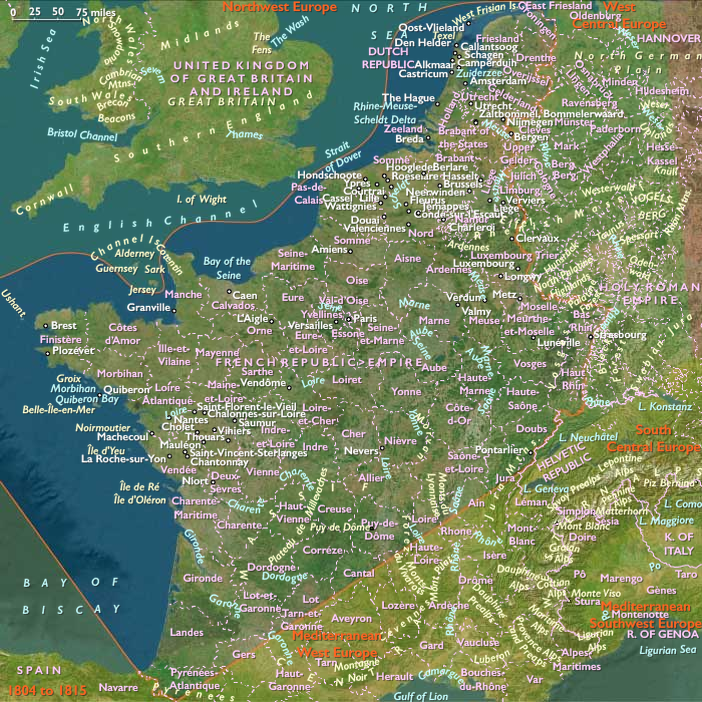
Atlantic West Europe (1804–1815): The Napoleonic Empire,…
1804 CE to 1815 CE
Atlantic West Europe (1804–1815): The Napoleonic Empire, Continental Domination, and Revolutionary Legacies
From 1804 to 1815, Atlantic West Europe—covering northern France, the Low Countries (modern Belgium, Netherlands, Luxembourg), and regions along the Atlantic and English Channel coasts—was profoundly shaped by the rise, peak, and dramatic fall of Napoleon’s French Empire. This era witnessed extensive military conquest, aggressive administrative centralization, and significant social and economic reforms, culminating in Napoleon’s defeat at Waterloo. The period’s transformative events set critical foundations for the political and cultural landscapes of modern Europe.
Political and Military Developments
Rise of Napoleon’s Empire (1804–1807)
-
In 1804, Napoleon Bonaparte crowned himself Emperor of the French, establishing the First French Empire (1804–1815). Centralized imperial governance replaced the revolutionary republic, consolidating power around Napoleon’s authority.
-
Napoleon rapidly expanded his territorial domination, decisively defeating Austria and Russia at the Battle of Austerlitz (1805), and subjugating Prussia following battles like Jena-Auerstedt (1806), gaining direct control over much of western and central Europe.
Direct Rule and Reshaped Territories
-
Atlantic West Europe fell under direct French control or influence: the Netherlands became the Kingdom of Holland (1806–1810) under Louis Bonaparte, Napoleon’s brother, and was subsequently annexed directly into the French Empire (1810–1813).
-
Belgium and Luxembourg were incorporated as integral French departments, subject to direct administrative, legal, and economic integration, profoundly altering local governance and institutions.
Continental System and Economic Warfare (1806–1814)
-
Napoleon enforced the Continental System (1806–1814), a blockade aimed at economically isolating Britain by restricting trade between Britain and continental Europe. Ports such as Antwerp, Amsterdam, and Nantes were severely impacted, reshaping Atlantic maritime commerce and disrupting regional economies.
-
Smuggling flourished, especially along the North Sea and Atlantic coasts, creating widespread economic dislocation, local resistance, and resentment against French authority.
Decline and the Wars of Liberation (1812–1814)
-
Napoleon’s disastrous 1812 Russian campaign severely weakened his army, encouraging European nations to unite against French hegemony. In 1813, a coalition (Britain, Prussia, Austria, Russia, Sweden) decisively defeated Napoleon at Leipzig (Battle of the Nations), driving French forces back to their borders.
-
France faced invasions and internal collapse; in 1814, Napoleon was compelled to abdicate and exiled to Elba, briefly restoring the Bourbon monarchy under Louis XVIII.
Waterloo and Napoleon’s Final Defeat (1815)
-
Napoleon’s dramatic return from exile (Hundred Days, March–June 1815) culminated in the decisive Battle of Waterloo (June 18, 1815), fought near Brussels. His defeat by allied British, Prussian, and Dutch forces permanently ended his imperial ambitions and reshaped Europe’s political landscape.
Economic Developments: Transformation and Struggle
Industrial and Commercial Impacts
-
Napoleon’s centralized administrative reforms stimulated regional infrastructure, particularly roads, canals, and ports (Antwerp notably became an imperial naval and commercial hub), laying important foundations for later industrialization.
-
The Continental System disrupted maritime trade severely, particularly harming Dutch and Belgian merchant economies and causing widespread economic hardship along the Atlantic coast.
Agricultural Pressures and Rural Hardship
-
Heavy taxation and conscription negatively impacted rural communities across northern France and the Low Countries. Agricultural productivity declined as rural labor forces diminished, exacerbating food shortages, poverty, and local unrest.
Social and Cultural Developments
Napoleonic Reforms and Social Changes
-
Napoleon codified revolutionary gains in the Napoleonic Code (Civil Code, 1804), ensuring legal equality, property rights, secular civil marriage, and administrative rationalization across his empire, profoundly influencing subsequent European legal traditions.
-
These reforms significantly impacted social structures in the Low Countries and northern France, reshaping local governance, family life, and civic rights, while solidifying central authority.
Cultural Patronage and Imperial Glory
-
Napoleon promoted imperial grandeur through significant architectural projects, notably Parisian monuments (Arc de Triomphe, begun 1806), influencing architectural trends in regional cities like Brussels and Amsterdam, which saw major public projects reflecting imperial symbolism.
-
Neoclassical art and architecture flourished under Napoleon’s patronage, reinforcing imperial power, civic order, and cultural prestige throughout Atlantic West Europe.
Intellectual and Educational Developments
Centralized Education and Enlightenment Legacy
-
Napoleon further centralized education systems, creating state-controlled lycées, universities, and technical schools, notably establishing the Imperial University system (1808) to standardize curricula, promote national identity, and train administrative elites across France and occupied regions.
-
These reforms deeply influenced education in the Low Countries, laying foundations for modern educational institutions and enduring state involvement in education.
Intellectual Life Under Imperial Rule
-
Intellectual life, although constrained by imperial censorship, flourished in institutions such as the University of Ghent (1817), fostering Enlightenment ideals, scientific innovation, and practical research benefiting local industry and governance.
Religious Developments: Reconciliation and Control
Concordat and Religious Policy
-
Napoleon consolidated state control over religion through the Concordat of 1801, normalizing relations with the Catholic Church, reestablishing Catholicism as a state-sanctioned but tightly controlled religion.
-
In Atlantic West Europe, this reconciliation partially restored religious stability, albeit subordinated under state authority, significantly shaping regional religious practices and church-state relations.
Legacy and Historical Significance
The period from 1804 to 1815 represented a pivotal era for Atlantic West Europe, profoundly influencing its political, economic, social, and cultural trajectories:
-
Politically, Napoleon’s imperial regime introduced revolutionary administrative and legal reforms, permanently reshaping governance structures and centralizing state power.
-
Economically, the Continental System disrupted maritime commerce, but imperial investments significantly advanced regional infrastructure, facilitating later industrial growth.
-
Socially, the Napoleonic Code institutionalized revolutionary egalitarian principles, transforming social structures, civic rights, and property relationships.
-
Culturally, Napoleonic patronage fostered Neoclassical artistic expression, influencing European cultural and intellectual life for generations.
Ultimately, Napoleon’s dramatic rise and fall established enduring legacies in governance, law, education, and cultural identity, significantly shaping the subsequent historical development of Atlantic West Europe and beyond.
Groups
Topics
Commodities
Subjects
Regions
West Europe
View →Subregions