
Atlantic West Europe (16–27 CE): Strengthened Roman…
16 CE to 27 CE
Atlantic West Europe (16–27 CE): Strengthened Roman Integration and Provincial Prosperity
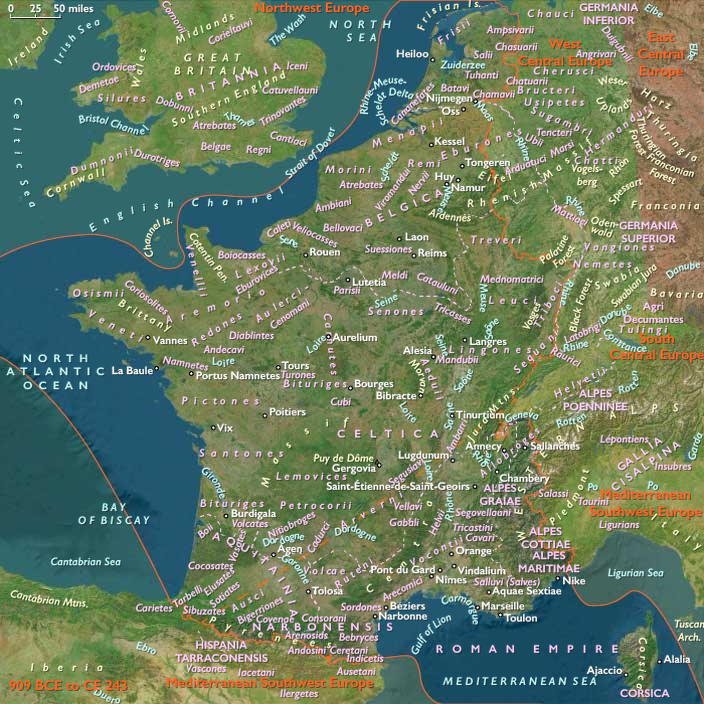
From 16 to 27 CE, Atlantic West Europe—including Aquitaine, the Atlantic coast, northern and central France, Alsace, and the Low Countries—experienced deepened integration within the Roman Empire under Emperor Tiberius, fostering provincial stability, economic prosperity, and significant cultural assimilation.
Political and Military Developments
Imperial Stability under Tiberius
-
Emperor Tiberius (r. 14–37 CE) maintained Augustus’s policies of peace and effective provincial administration, ensuring continued stability and prosperity across Gaul.
-
Efficient governance reinforced local allegiance, especially among the Gallo-Roman aristocracy, whose power and wealth steadily increased.
Frontier and Military Management
-
The Rhine frontier was strongly fortified and systematically patrolled, deterring Germanic incursions and safeguarding trade and settlement in Alsace and the Low Countries.
-
Roman military presence in northern Gaul provided stable conditions for economic development and urban growth.
Economic and Social Developments
Expansion of Trade Networks
-
Atlantic ports, notably Burdigala (Bordeaux), thrived as trade hubs exporting wine, agricultural produce, and manufactured goods across the Empire, particularly toward Britain and the Mediterranean.
-
The Roman road network continued to expand, enhancing commerce, communication, and cultural exchanges among key cities including Lutetia (Paris), Durocortorum (Reims), and coastal communities.
Urban Development and Infrastructure
-
Roman infrastructure projects intensified, marked by further construction of roads, aqueducts, bridges, and public buildings (forums, baths, amphitheaters), significantly enhancing the quality of urban life.
-
Rapid urban growth facilitated increased migration from rural areas, consolidating urban centers as key administrative and economic nodes.
Cultural and Religious Developments
Deepening Romanization
-
Local elites increasingly adopted Roman customs, language, and lifestyle, solidifying a distinctly Gallo-Roman identity.
-
Latin became the primary administrative and literary language, further uniting the diverse regional communities.
Religious Syncretism and Cultural Fusion
-
Indigenous deities continued to be syncretized with Roman gods, contributing to religious harmony and cultural blending.
-
The Imperial Cult expanded significantly, serving both political cohesion and social integration, especially among provincial aristocracies.
Key Figures and Events
-
Tiberius (r. 14–37 CE): His prudent and stable governance provided sustained peace, allowing Atlantic West Europe to prosper economically and culturally.
Long-Term Significance
By 27 CE, Atlantic West Europe was thoroughly integrated into the Roman imperial system:
-
Stable governance under Tiberius facilitated enduring economic prosperity, cultural assimilation, and urbanization.
-
Strong frontier defenses guaranteed security, enabling ongoing regional development.
-
The increasingly prominent Gallo-Roman elite played essential roles in maintaining local governance, laying enduring social foundations that defined the character of the region for generations to come.
People
Groups
Commodities
Subjects
Regions
West Europe
View →Subregions
