
Atlantic West Europe (448–459): Sidonius Apollinaris and …
Years: 448 - 459
Atlantic West Europe (448–459): Sidonius Apollinaris and the Emergence of Romano-Gallic Leadership
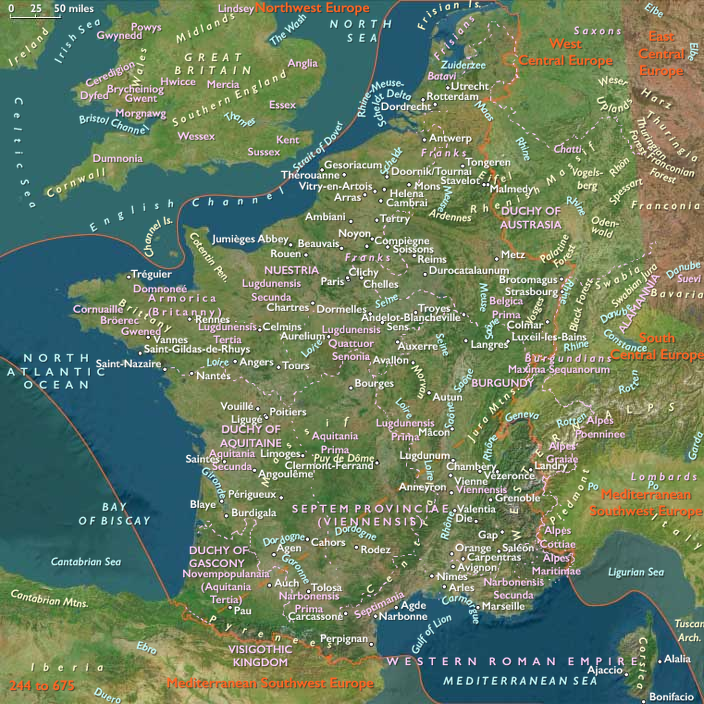
Between 448 and 459, Atlantic West Europe—spanning northern and western Gaul, Aquitaine, Burgundy, and the Rhône valley—underwent significant transformation, as Roman political authority collapsed completely and was replaced by the Visigothic and Burgundian kingdoms. This period saw the rise of influential Romano-Gallic figures such as Sidonius Apollinaris, whose careers illustrate the fusion of Roman civic traditions and Christian episcopal leadership amid the shifting political landscape.
Political and Military Developments
-
Visigothic Dominance and Roman Decline:
-
Visigothic King Theodoric II (r. 453–466) continued to consolidate power, ruling from Toulouse and extending dominance into Aquitaine and the Loire valley, while maintaining Roman administrative frameworks.
-
The Battle of the Catalaunian Plains (451), fought near modern-day Troyes, temporarily halted Attila the Hun’s invasion of Gaul, marking the last significant display of Roman military coordination in the region. Roman forces under General Aetius cooperated with Visigothic and other allied tribes, demonstrating the increasing reliance on barbarian allies.
-
-
Establishment of Burgundian Kingdom:
-
Under kings like Gundioc (r. c. 437–473), the Burgundian kingdom firmly took shape, centered on Lyon and the Rhône Valley. The Burgundians strengthened their integration with Roman culture and administration, creating a stable Romano-Germanic polity.
-
Economic and Social Developments
-
Urban Decline and Ruralization:
-
Cities continued to diminish as centers of administration, population, and economy, while rural villas and fortified estates (villae) became increasingly significant as regional centers of power and economic activity.
-
Agricultural self-sufficiency became widespread, emphasizing local, rather than long-distance, trade due to continued instability.
-
-
Rise of Romano-Gallic Aristocracy:
-
A new elite class of Romano-Gallic aristocrats emerged, merging Roman traditions with Germanic customs. They often maintained influential roles within the new barbarian kingdoms, serving as mediators between Roman and Germanic populations.
-
Religious and Cultural Developments
-
Sidonius Apollinaris and Episcopal Leadership:
-
Sidonius Apollinaris (c. 430–489), born into a prominent Gallo-Roman aristocratic family, rose to prominence in this era, serving as bishop of Clermont from 470 (though already politically active in the previous decades). His extensive writings vividly portray life in late Roman Gaul, blending classical education, Christian piety, and political pragmatism.
-
Sidonius’ career symbolizes the increasing power and social responsibility of bishops, who now represented the primary source of authority and continuity in urban and regional communities.
-
-
Christianization of Barbarian Rulers:
-
The integration of Germanic leaders into Christian frameworks accelerated, with bishops often guiding rulers in governance and morality, further legitimizing barbarian rule within Roman societal traditions.
-
Legacy and Significance
By 459, Atlantic West Europe had experienced dramatic shifts:
-
The Western Roman Empire’s power dissolved, replaced by the Burgundian and Visigothic kingdoms, which integrated Roman cultural practices and administrative methods with Germanic rule.
-
The rise of prominent Romano-Gallic figures, particularly Sidonius Apollinaris, exemplified how regional leadership adapted and thrived amid the new political realities, preserving continuity between Roman civic identity and Christian governance.
-
Bishops emerged decisively as both spiritual and secular leaders, bridging the late Roman world and the nascent medieval order.
People
Groups
- Polytheism (“paganism”)
- Franks
- Gallo-Roman culture
- Armorica
- Gallia Lugdunensis (Roman province)
- Gallia Belgica (Roman province)
- Gallia Aquitania (Roman province)
- Saxons
- Burgundians (East Germanic tribe)
- Christianity, Nicene
- Gaul, Praetorian prefecture of
- Hunnic Empire
- Visigoths, Realm of the
- Roman Empire, Western (Ravenna)
- Britain, Sub-Roman
- Burgundians, (first) Kingdom of the
- Visigothic Kingdom of Toulouse
- Burgundians, (second) Kingdom of the
Topics
- Roman Age Optimum
- Late Antiquity
- Migration Period
- Hun Raids on the Roman Empire
- Saxon Raids of 407-550
- Visigothic Raids on the Roman Empire, Later
- Catalaunian Plains, Battle of the
Commodoties
Subjects
Regions
Subregions

Years: 448 - 459
People
Groups
- Polytheism (“paganism”)
- Franks
- Gallo-Roman culture
- Armorica
- Gallia Lugdunensis (Roman province)
- Gallia Belgica (Roman province)
- Gallia Aquitania (Roman province)
- Saxons
- Burgundians (East Germanic tribe)
- Christianity, Nicene
- Gaul, Praetorian prefecture of
- Hunnic Empire
- Visigoths, Realm of the
- Roman Empire, Western (Ravenna)
- Britain, Sub-Roman
- Burgundians, (first) Kingdom of the
- Visigothic Kingdom of Toulouse
- Burgundians, (second) Kingdom of the
Topics
- Roman Age Optimum
- Late Antiquity
- Migration Period
- Hun Raids on the Roman Empire
- Saxon Raids of 407-550
- Visigothic Raids on the Roman Empire, Later
- Catalaunian Plains, Battle of the
Commodoties
Subjects
Regions
Subregions