
Atlantic West Europe (472–483): The Consolidation of …
Years: 472 - 483
Atlantic West Europe (472–483): The Consolidation of Visigothic and Burgundian Dominance
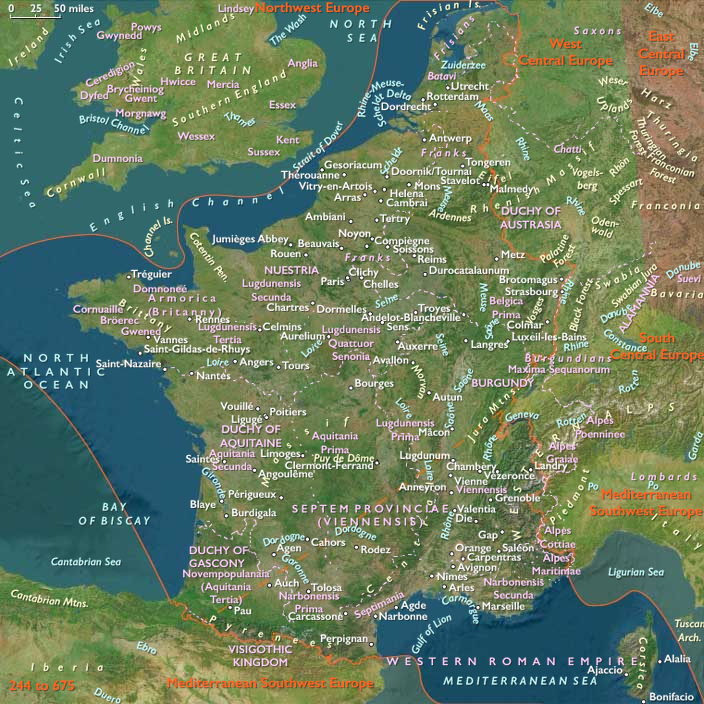
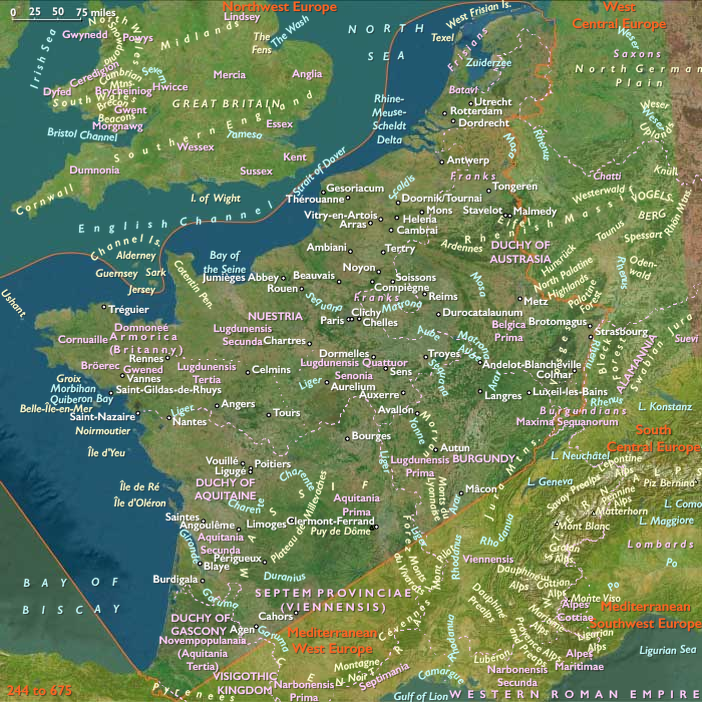
Between 472 and 483, Atlantic West Europe—spanning Gaul north of Aquitaine, west to Brittany, eastward to Burgundy, and along the Rhône Valley—entered a decisive period of political realignment. Visigothic and Burgundian kingdoms expanded their authority, establishing clearer territorial boundaries while deepening integration with Roman political, social, and religious traditions.
Political and Military Developments
-
Visigothic Expansion under Euric (466–484):
-
King Euric decisively consolidated Visigothic authority, capturing critical Roman holdouts, notably Arles and Marseille (476–477), completing the conquest of southern Gaul.
-
By 475, Euric’s kingdom stretched from the Loire Valley southward across Aquitaine to the Pyrenees, encompassing the entire Atlantic coast, firmly establishing Toulouse as the Visigothic capital.
-
-
Establishment of the Burgundian Kingdom:
-
Under King Gundioc (r. c. 437–473) and subsequently his son Gundobad (r. 473–516), the Burgundian Kingdom solidified control over the Rhône Valley, extending authority northward into the Saône basin and westward into central Gaul.
-
Gundobad strengthened the Burgundian kingdom’s political coherence, founding a stable dynasty and integrating Roman and Germanic legal traditions.
-
-
The Fall of the Western Roman Empire (476):
-
Odoacer's deposition of Emperor Romulus Augustulus in 476 marked the end of imperial Roman authority in the west. Atlantic West Europe had already transitioned to regional Germanic governance, largely insulated from the political shock of the empire’s collapse.
-
This pivotal moment confirmed the shift toward independent, regionally-based governance by Germanic rulers, signaling the permanent end of Roman political unity.
-
Economic and Social Developments
-
Ruralization and Local Economies:
-
The decline of urban administrative structures accelerated, with cities increasingly functioning as fortified administrative centers rather than economic hubs.
-
Economic activity gravitated toward self-sufficient rural estates, monastic communities, and territories controlled by regional aristocracies and bishops.
-
-
Continued Aristocratic Influence:
-
Gallo-Roman aristocrats remained influential by serving in high positions within the Visigothic and Burgundian administrations, preserving Roman administrative practices and traditions within new Germanic structures.
-
Aristocratic families formed alliances with Germanic rulers through marriage and cooperation, bridging Roman and Germanic worlds.
-
Religious and Cultural Developments
-
Episcopal Authority and Leadership:
-
Bishops continued to rise as prominent civic leaders, mediating between the Romano-Gallic populations and the new Germanic ruling elites. Bishops such as Sidonius Apollinaris (died c. 489) of Clermont played central roles in maintaining stability and Roman cultural continuity.
-
Episcopal sees emerged as essential local governance centers, handling secular administration, taxation, and defense in an increasingly fragmented society.
-
-
Religious Toleration and Cultural Integration:
-
Despite the Visigoths' Arian Christian faith and the Burgundians’ initial Arian adherence, Catholic Christianity persisted throughout Gaul, enjoying relative tolerance under Germanic rulers.
-
This environment allowed for continuity in religious institutions, educational systems, and cultural traditions rooted in late Roman society.
-
Legacy and Significance
By 483, Atlantic West Europe witnessed transformative shifts:
-
Visigothic and Burgundian kingdoms established secure, territorially cohesive states, incorporating Roman administrative structures and aristocratic support.
-
The Western Roman Empire’s collapse in 476 cemented the transition from imperial rule to regional governance by Germanic leaders.
-
Bishops emerged as central figures, safeguarding cultural continuity, bridging Roman tradition and Germanic political realities, and setting foundations for medieval societal structures.
People
Groups
- Polytheism (“paganism”)
- Franks
- Gallo-Roman culture
- Armorica
- Gallia Lugdunensis (Roman province)
- Gallia Belgica (Roman province)
- Gallia Aquitania (Roman province)
- Saxons
- Burgundians (East Germanic tribe)
- Christianity, Arian
- Gaul, Praetorian prefecture of
- Visigoths, Realm of the
- Roman Empire, Western (Ravenna)
- Britain, Sub-Roman
- Visigothic Kingdom of Toulouse
- Burgundians, (second) Kingdom of the
- Christianity, Chalcedonian
Topics
- Roman Age Optimum
- Late Antiquity
- Migration Period
- Fall of the Western Roman Empire
- Saxon Raids of 407-550
- Visigothic Raids on the Roman Empire, Later
Commodoties
Subjects
Regions
Subregions
Years: 472 - 483
People
Groups
- Polytheism (“paganism”)
- Franks
- Gallo-Roman culture
- Armorica
- Gallia Lugdunensis (Roman province)
- Gallia Belgica (Roman province)
- Gallia Aquitania (Roman province)
- Saxons
- Burgundians (East Germanic tribe)
- Christianity, Arian
- Gaul, Praetorian prefecture of
- Visigoths, Realm of the
- Roman Empire, Western (Ravenna)
- Britain, Sub-Roman
- Visigothic Kingdom of Toulouse
- Burgundians, (second) Kingdom of the
- Christianity, Chalcedonian
Topics
- Roman Age Optimum
- Late Antiquity
- Migration Period
- Fall of the Western Roman Empire
- Saxon Raids of 407-550
- Visigothic Raids on the Roman Empire, Later
Commodoties
Subjects
Regions
Subregions