
Beverley, a borough in Humberside county in…
1129 CE
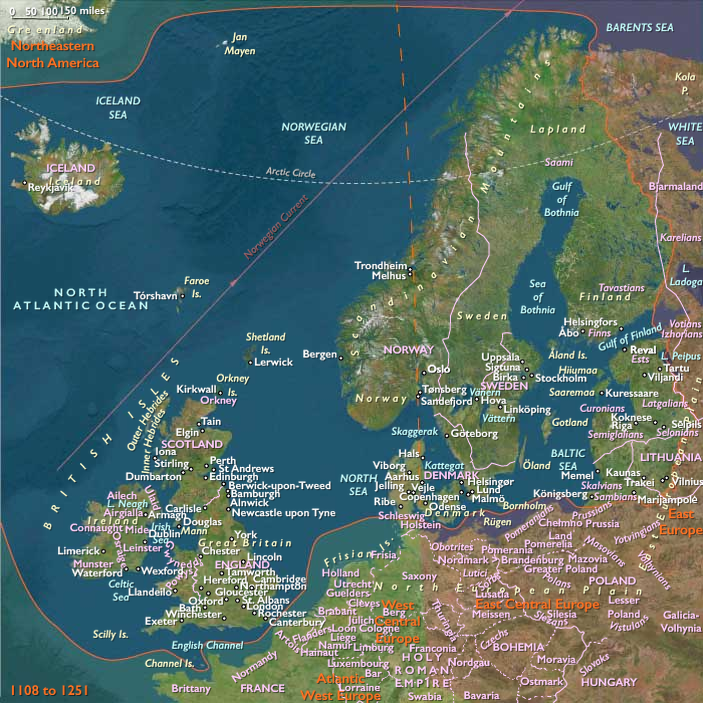
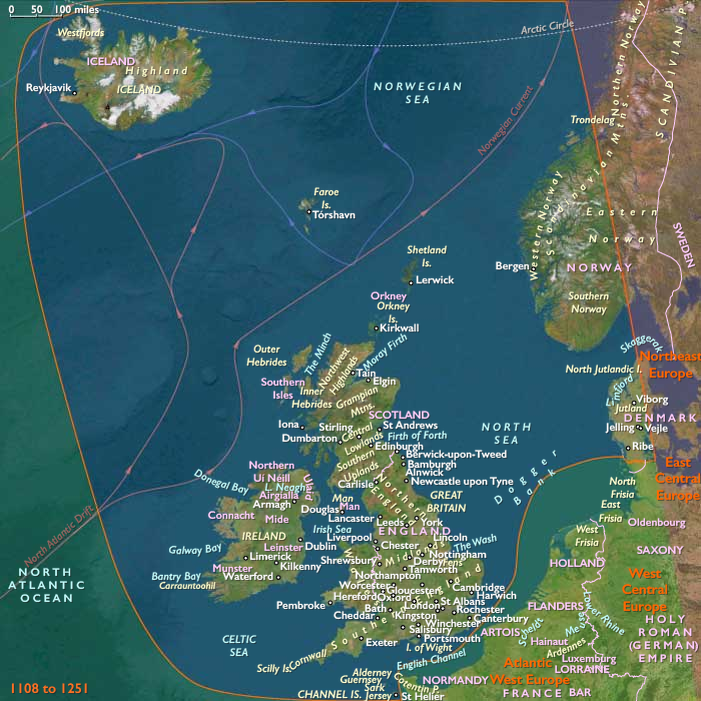
Beverley, a borough in Humberside county in northern England, about four miles (six kilometers) northwest of Hull, had grown up around a monastery established in the eighth century.
Receiving its first charter in 1129, it will become an important market town.
Locations
Subjects
Regions
North Europe
View →Subregions
Northwest Europe
View →Related Events
No active filters.
Showing 10 events out of 49233 total
Another Jurchen invasion across the Yangtze River in 1129 causes the Nanjing-based Song government, under emperor Gaozong, to retreat south to Lin'an (in modern Hangzhou), from where the southern Song dynasty, as its rulers become known, control only a truncated southern regime.
The Jurchen conquest of northern China and shift of capitals from Kaifeng to Lin'an is the dividing line between the Northern Song Dynasty and Southern Song Dynasty.
Greek art begins to develop a much stronger humanistic approach, now with a greater concern for naturalism and for conveying a strongly emotional quality.
A beautiful icon known as “Our Lady of Vladimir,” painted in Constantinople about 1130, shows the Virgin embracing the Child, no longer displaying her divine child to the people but interacting with it in more human terms, as the child turns toward her and clings to her neck.
The icon is a version of the Eleusa (tenderness) type.
Unlike some icons with a special following in religious terms the high artistic quality of the work is universally agreed, and the Vladimirskaya, as Russians call it, is generally accepted as the finest of the few Byzantine icons surviving from its period.
Two knights, Hugues de Payens and Geoffroi de Saint-Omer, had in late 1118 or early 1120 established the Poor Knights of Christ and the Temple of Solomon, or Knights Templar, as a religious community to protect pilgrims in the Holy Land; six or seven other join them in their mission.
Baldwin II, king of Jerusalem, had given them quarters in a wing of the royal palace in the area of the former Jewish Temple, and from this they derive their name.
By the pontificate of Honorius II, the Knights Templar had not yet received any official sanction from the papacy.
To rectify this situation, some members of the order appeared before the Council of Troyes in 1129, where the Council expressed its approval of the order and commissioned the influential Cistercian monk and mystic Bernard of Clairvaux to draw up the order’s rules, which he hopes will serve as a model of Christian chivalry, and which now include the notion of fighting the enemies of God under vows of poverty, chastity, and obedience.
The order and the rules are subsequently approved by Pope Honorius.
Their habit is a white cloak with a red cross, the Templars, divided into knights, chaplains, sergeants, and craftsmen, organized under a grand master and general council, are responsible only to the pope, not secular rulers.
Although both Templars and Hospitallers take monastic vows, their principal function is soldiering.
In a papal bull issued by Pope Paschal II, Raymond de Puy, who had succeeded Gerard in 1120 as head of the Hospitallers, substitutes the Augustinian rule for the Benedictine and begins building the power of the organization.
It will soon acquire wealth and lands and combine the task of tending the sick with waging war on Islam.
Along with the Templars, the Hospitallers will rapidly become the most formidable military order in the Holy Land.
Duisburg, chartered in 1129, is a thriving commercial center established in Roman times in western Germany, located on the east bank of the Rhine River at its junction with the Ruhr River and the Rhine-Herne Canal.
Li Tang has worked for most of his life as a painter at the court of Song Emperor Huizong in Kaifeng.
The highly influential Li, a pivotal figure in the transition from the monumentally scaled landscape tradition of the Northern Song period to the more intimate mode of the succeeding Southern Song period, is renowned for his so-called ax-cut brushstroke, which he employs to finely depict sharply faceted rock surfaces, as in his celebrated scroll painting “Whispering Pines in the Mountains”, executed in 1124.
After the Jurchen invasion in 1126, he had fed with the court to Hangzhou, becoming director of the imperial painting academy there until his death in 1130, at about eighty.
King Stephen, having been informed in 1129 after the death of Duke Álmos that his blind cousin was still living in Hungary, had invited Béla to his court.
Upon the king's request, Béla had married Jelena, a daughter of Serbian Duke Uroš I of Raska, and the king had granted the couple estates near Tolna.
John has spent most of his reign with his troops, thwarting threats from the Pechenegs, Hungarians, and Serbs.
In 1130, he allies Constantinople with the German emperor Lothair II (III) against Roger II of Sicily.
Conferences for peace had ensued after the Cholan defeat of the Eastern Chalukyas in an important battle in 1122, followed by plans for intermarriage between the contending dynasties, and ending in 1130 with the Eastern Chalukya dynasty’s absorption into the Chola.
The Kakatiya family becomes a Cholan feudatory.
An Augustinian convent, situated in central Switzerland between Lakes Brienz and Thun in the Bernese Alps (and the nucleus of the future town of Interlaken) is founded in 1130.
Cardinal Pietro Pierleoni was born to the powerful Roman family of the Pierleoni, the son of the Consul Pier Leoni.
As a second son with ambitions, Pietro was destined for an ecclesiastical career.
He studied in Paris and entered the Benedictine Abbey of Cluny.
Later he went to Rome and occupied several important positions.
In 1130, Pope Honorius II lies dying and the cardinals decide that they willentrust the election to a commission of eight men, led by papal chancellor Haimeric, who has his candidate Cardinal Gregory Papareschi hastily elected as Pope Innocent II.
He is consecrated on February 14, the day after Honorius' death.
On the same day, the other cardinals announce that Innocent has not been canonically elected and choose, as Pope Anacletus II, Pierleoni, a Roman whose family members are the enemy of Haimeric's supporters, the Frangipani.
Anacletus' supporters are a mixture of anyone opposed to Haimeric, making him powerful enough to take control of Rome while Innocent is forced to flee North.
However, north of the Alps, Innocent gains the crucial support of St. Bernard of Clairvaux, Peter the Venerable, and other prominent reformers who personally help him to gain recognition from European rulers such as Emperor Lothar III, leaving Anacletus with few patrons.
Anacletus had been a relatively acceptable candidate for the Papacy, being well-respected, so rumors centering on his descent from a Jewish convert were spread to blacken his reputation.
Among Anacletus' supporters are duke William X of Aquitaine, who decides for Anacletus against the will of his own bishops, and the powerful Roger II of Sicily, whose title of "King of Sicily" Anacletus approves shortly after his accession.