With French troops massing on the Prussian…
March 1812 CE
Had he not, France would have certainly invaded Prussia.
The Franco-Austrian alliance signed in March is much less demanding of the Austrians, who go behind Napoleon's back to inform the Russians that they intend to avoid combat as much as possible.
Following the ratification, over three hundred officers—a quarter of the Prussian officer corps—resign their commissions, most going into exile in Russia, some to Spain or England.
Scharnhorst, who had presided over the Prussian military reforms, resign as Chief of the General Staff and moves to Silesia, remaining one of the king's military advisors.
His assistants Carl von Clausewitz, the military writer, and Hermann von Boyen leave for Russia.
General August Neidhardt von Gneisenau, who is scathing of the king, resigns and goes to England.
The head of the Prussian police, Justus Gruner, joins the émigré Baron vom Stein in exile in Prague and is imprisoned by the Austrians for his own safety.
He had been charged with stirring up anti-French sentiment in Prussia prior to the publication of the treaty.
Following the outbreak of war, Stein will move from Prague to Saint Petersburg.
All these officers pin their hopes on the example of the successful Spanish uprising of 1808 and the prospects of a "sixth coalition" funded by Britain.
Locations
People
Groups
Regions
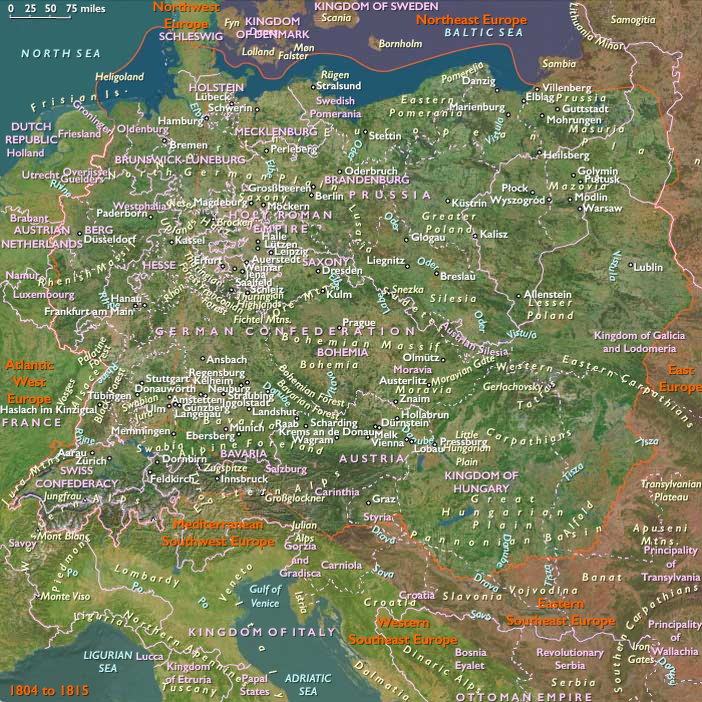
Central Europe
View →Subregions