
Atlantic Southwest Europe (45–34 BCE): Roman Provincial…
45 BCE to 34 BCE
Atlantic Southwest Europe (45–34 BCE): Roman Provincial Consolidation and Persistent Tribal Autonomy
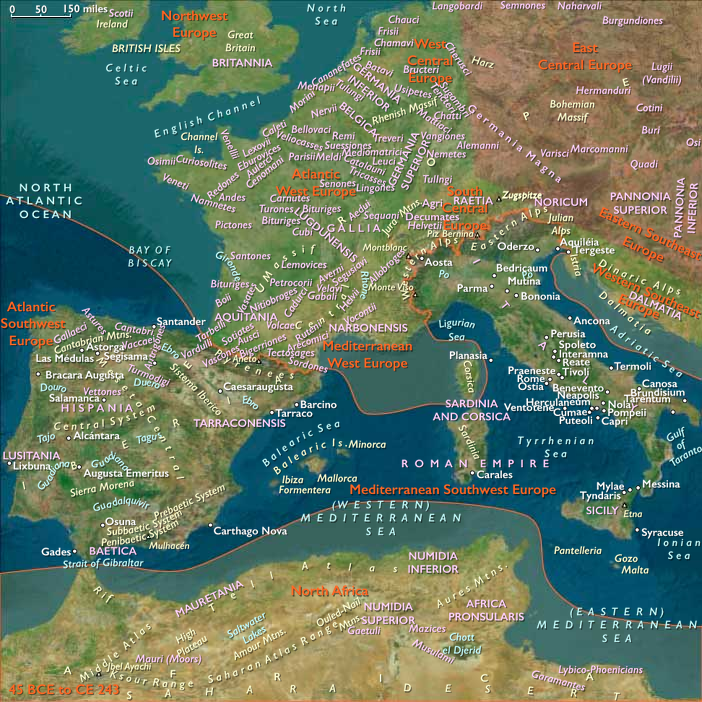
Between 45 and 34 BCE, Atlantic Southwest Europe—covering northern and central Portugal, Galicia, Asturias, Cantabria, and northern Spain south of the Franco-Spanish border (43.05548° N, 1.22924° W)—experienced significant transformation through intensified Roman administrative consolidation, increasing provincial integration, and sustained northern tribal resistance. Lusitanian territories and southern tribes steadily adapted to Roman governance, establishing stable provincial structures, while the fiercely independent northern tribes—Gallaeci, Astures, Cantabri, and the diplomatically cautious Vascones—continued their effective defense of regional autonomy. Economic ties with Mediterranean trade networks deepened further, embedding slavery within the regional economy, while distinct tribal identities remained resilient despite growing external influences.
Political and Military Developments
Formation and Expansion of Roman Provincial Administration
-
Under the late Roman Republic and the early administration of Augustus, Roman authority actively expanded, establishing more rigorous provincial governance in southern and central Lusitanian territories. Roman officials reinforced administrative towns, strategic military garrisons, roads, and trading centers, significantly extending political and economic influence.
-
Diplomatic collaboration between Roman authorities and local tribal elites became the norm, effectively stabilizing the region and ensuring broader acceptance of Roman provincial rule.
Continued Northern Tribal Resistance
-
Northern tribes—including the Gallaeci, Astures, and Cantabri—continued to resist Roman domination, effectively maintaining regional independence through fortified settlements, strategic alliances, and guerrilla-style resistance. Their sustained autonomy notably influenced Rome’s subsequent strategic and military priorities in the region.
-
The Vascones preserved careful diplomatic neutrality, maintaining their territorial integrity, cultural distinctiveness, and internal stability.
Diplomatic Adaptation and Tribal Realignments
-
Tribes like the Lusitanians, alongside the Vettones and Vaccaei, increasingly accommodated Roman governance through diplomatic strategies. Tribal elites maintained significant autonomy, economic privileges, and local influence, fostering a stable integration into Roman provincial administration.
Economic and Technological Developments
Enhanced Mediterranean Trade and Economic Integration
-
Economic integration with Roman-controlled Mediterranean trade intensified markedly. Atlantic Southwest European communities exported metals (silver, copper, tin), agricultural products, timber, salt, livestock products, textiles, and notably slaves, importing luxury items, fine ceramics, wine, olive oil, and advanced iron goods.
-
Economic benefits primarily accrued to tribal elites, reinforcing regional social stratification, economic specialization, and trade dependency on Rome.
Sustained Centrality of Slavery
-
Slavery continued as an essential economic institution, extensively employed in mining operations, agriculture, domestic service, and artisanal activities. The active slave trade reinforced economic integration and solidified slavery’s fundamental role in regional societal structures.
Metallurgical and Technological Innovation
-
Continued advancements in iron metallurgy and artisanal production significantly improved agricultural productivity, military equipment, and regional economies. Tribal artisans among Lusitanians, Vettones, and Gallaeci excelled in crafting sophisticated weapons, armor, agricultural tools, and decorative items, integrating indigenous craftsmanship with Roman techniques.
Cultural and Religious Developments
Persistent Cultural Identity and Artistic Synthesis
-
Regional material culture continued reflecting a dynamic synthesis of indigenous Iberian traditions, Celtic artistic motifs, and pervasive Roman influences. Artistic expressions—including intricate metalwork, decorative jewelry, pottery designs, ceremonial artifacts, and household goods—highlighted resilient cultural identities and strong regional pride.
-
Despite increasing Roman provincial influence, tribal identities—especially among the Gallaeci, Astures, Cantabri, and Vascones—remained robust and culturally independent.
Ritual Complexity and Cultural Continuity
-
Ritual practices sustained complexity by blending indigenous Iberian, Celtic, and Roman religious elements. Prominent sacred landscapes, ritual sites, and communal ceremonies continued actively, reinforcing communal cohesion, cultural continuity, and tribal identities.
-
Ancestral rites, warrior ceremonies, and communal festivals persisted, bolstering regional solidarity and cultural resilience amid increasing Roman administrative presence.
Notable Tribal Groups and Settlements
-
Lusitanians: Further integrated diplomatically with Roman provincial administration, securing local autonomy and economic stability.
-
Vettones and Vaccaei: Strategically maintained territorial integrity, economic prosperity, and internal autonomy through diplomatic cooperation.
-
Gallaeci, Astures, Cantabri: Continued effective territorial resistance, fortifying strategic defenses and maintaining regional independence.
-
Vascones: Skillfully preserved cultural distinctiveness and territorial autonomy through strategic diplomatic neutrality.
Long-Term Significance and Legacy
Between 45 and 34 BCE, Atlantic Southwest Europe:
-
Experienced marked advances in Roman provincial consolidation, fundamentally reshaping regional political, economic, and social landscapes and setting the stage for the subsequent Roman Empire’s comprehensive administration.
-
Continued determined northern tribal resistance, laying crucial foundations for future confrontations, notably the imminent Cantabrian Wars (29–19 BCE).
-
Intensified economic integration with Roman Mediterranean networks, solidifying slavery’s critical role in regional economic structures and social hierarchies.
This crucial era profoundly influenced the region’s historical trajectory, decisively shaping future developments under full Roman imperial rule while underscoring the enduring cultural resilience and regional autonomy of Atlantic Southwest Europe.
Groups
Topics
Commodities
Subjects
Regions
Southwest Europe
View →Subregions
