
Atlantic Southwest Europe (765–622 BCE): Expansion of…
765 BCE to 622 BCE
Atlantic Southwest Europe (765–622 BCE): Expansion of Castro Communities and Increasing Mediterranean Contacts
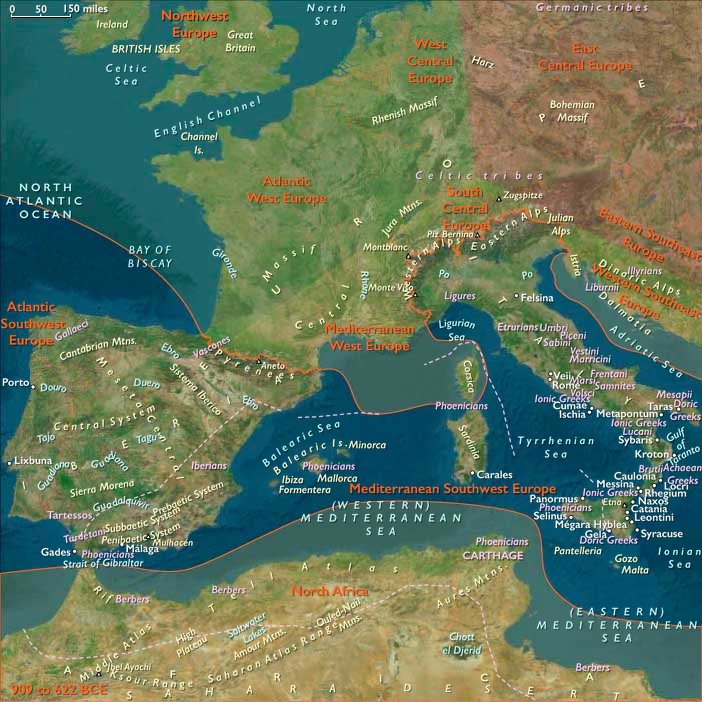
Between 765 and 622 BCE, Atlantic Southwest Europe—encompassing northern and central Portugal, Galicia, Asturias, Cantabria, and parts of northern Spain—saw notable advancements in societal complexity, the spread of the distinctive Castro culture, and deepening interactions with Mediterranean traders, particularly Phoenicians and early Carthaginians. These interactions accelerated cultural exchange, technological advancement, and economic integration, significantly influencing the region’s cultural trajectory.
Political and Societal Developments
Expansion and Consolidation of the Castro Culture
-
The Castro culture flourished throughout northwestern Iberia, characterized by numerous fortified hilltop settlements (castros), featuring circular stone dwellings, defensive walls, and organized street patterns, demonstrating enhanced social organization and growing political sophistication.
-
Increased territorial control and stable agricultural economies enabled Castro communities to become key regional powers, exerting influence over neighboring tribes and trade networks.
Strengthening Proto-Basque Societies
-
The proto-Basque communities continued their gradual consolidation, primarily inhabiting the western Pyrenees region, southwestern Aquitaine, and adjacent northern Iberian territories. They maintained distinct linguistic, cultural, and agricultural practices, reinforcing a strong regional identity separate from Castro-influenced neighbors and early Celtic-speaking groups.
Economic and Technological Advancements
Intensified Mediterranean Trade
-
Direct interactions with Mediterranean traders—especially Phoenicians venturing from southern Iberian ports (such as Gadir/Cádiz)—increased significantly. Atlantic Southwest European communities exchanged valuable local resources, including tin, silver, copper, salt, wool, and agricultural products, for Mediterranean ceramics, wine, oil, jewelry, and iron goods. As societies grew more complex, slavery became more structured, with war captives frequently integrated into agricultural labor, mining, and domestic activities. Slave exchanges likely began occurring via early Mediterranean contacts.
-
Coastal settlements benefited from maritime exchanges, fostering economic specialization and greater regional prosperity.
Advances in Metallurgy and Craftsmanship
-
Bronze metallurgy remained dominant but began to be gradually supplemented by ironworking techniques introduced through Mediterranean trade contacts. Iron technology became increasingly influential in tools, agricultural implements, and weaponry.
-
Skilled craftsmanship expanded, with artisans producing increasingly sophisticated bronze and iron artifacts, pottery, jewelry, and ceremonial items, reflecting both indigenous creativity and Mediterranean influence.
Cultural and Religious Developments
Increased Social Stratification and Cultural Expression
-
Social hierarchies became more pronounced, reflected in elaborate burial customs, distinctive grave goods, and ceremonial artifacts, underscoring elite identity and power.
-
Artistic expression flourished through intricate metalwork, decorative pottery, and stone carvings, integrating local styles with Mediterranean motifs.
Ritual Practices and Communal Identity
-
Ritual and religious sites proliferated across the region, characterized by expanded megalithic constructions, ritual cairns, and sacred natural spaces.
-
Castro communities maintained distinctive religious practices centered around ancestral veneration, nature worship, and communal rituals reinforcing societal cohesion.
Notable Settlements and Tribal Groups
-
Castro Culture Settlements: Large and strategically significant castros, especially in Galicia and northern Portugal, expanded as influential economic, social, and military centers, exercising substantial regional influence.
-
Proto-Basque Settlements: Consolidation continued around the Pyrenees and northern valleys, maintaining distinct identities and strengthening regional autonomy.
Long-Term Significance and Legacy
Between 765 and 622 BCE, Atlantic Southwest Europe:
-
Expanded and solidified the influence of the Castro culture, significantly impacting subsequent settlement patterns and social organization.
-
Intensified direct interactions with Mediterranean traders, accelerating economic integration, technological transfer, and cultural diffusion.
-
Reinforced distinctive regional identities—especially the proto-Basque communities—establishing enduring cultural patterns that shaped later Iberian history.
This formative era further deepened regional diversity, economic prosperity, and cultural complexity, providing foundational elements for subsequent historical developments and interactions with expanding Mediterranean civilizations.
Groups
Topics
Commodities
Subjects
Regions
Southwest Europe
View →Subregions
