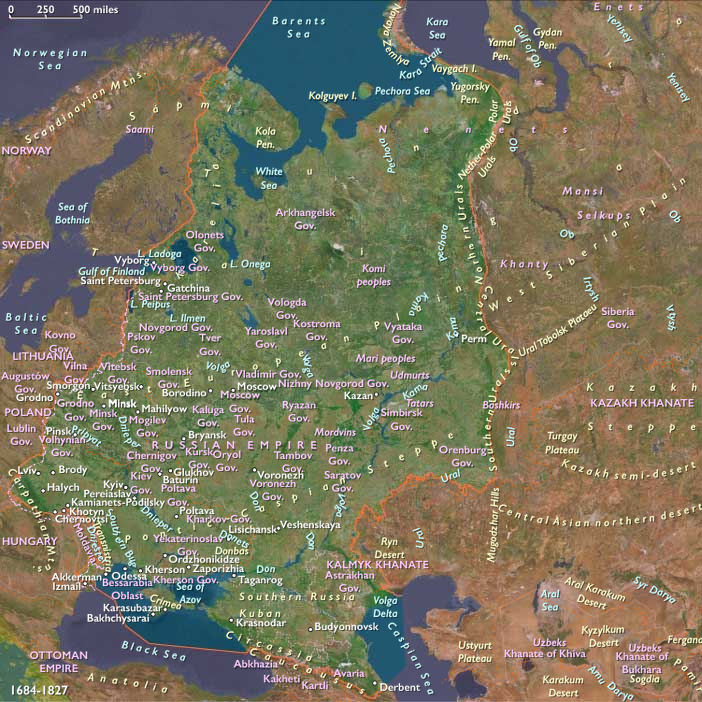
Bulavin, born into a Cossack family, would…
July 1708 CE
Bulavin, born into a Cossack family, would have been old enough to remember Stenka Razin and the revolt of the late seventeenth century.
Little is known about him personally.
He had developed some combat experience fighting the Kuban and Crimean Tatars in his youth.
He was never a particularly great military commander, however, and throughout the rebellion that bears his name, he will forever fall short of becoming an undisputed leader.
He had risen by 1704 to the status of ataman of Bakhmut, a position he had held until 1706.
It was during this stint that he had orchestrated and participated in the destruction of the salt works on the Severski Donets, an act of retaliation for having been evicted by the government as squatters.
This conflict, which had never been entirely resolved, is ultimately absorbed into the greater rebellion as it gains momentum.
Bulavin is most likely illiterate but, like his contemporary revolutionaries, he possesses a talent for appealing to the people and inciting them to action.
Bulavin's rallying cry is simple: the goal is to move against Moscow and destroy the evil influences on the Tsar.
It is important to note that the rebellion is not against the institution of Tsardom but against the figures in power at this time.
It is generally believed that Peter is either not who he claims (i.e., the Antichrist sitting in place of the true Tsar who is hidden away), or that he is indeed the rightful Tsar but is under the control of evil advisers whose destruction would liberate him, and that if given the freedom to act, he would repudiate all of his wicked reforms.
The rebellion suffers from a number of weaknesses.
For one, despite all of his rallying, Bulavin never offers a pretender to the throne or suggests a just tsar to replace Peter.
This blunder condemns the rebellion's end goals to ambiguity and lets slip an immeasurable amount of support he might have mustered.
Second, Bulavin does not coordinate his efforts with any other preexisting Muscovite enemies, so despite being heavily engaged in war with Sweden, the military apparatus under Peter is not as divided as it could be and finds the rebellion to be more of a nuisance than a major conflict.
By means of its vastly superior size and efficiency, the regular army is ultimately capable of stamping out the rebellion at all levels.
In the end, angered by devastating reversals and Bulavin's tiring claims, factions of his own Cossack followers turn against him.
He is found dead on July 7, 1708, having been shot in the head.
It is not known whether the wound was self-inflicted or an act of treachery.
Following Bulavin's death, the rebellion peters out, with pockets of resistance persisting through 1709, but for all intents and purposes, the conflict is over.
In response to the uprising, Peter tightens his grip on the Cossack states, causing some two thousand under Ignat Nekrasov to flee to the protection of the Crimean Khanate.
Descendants of these Nekrasovites will relocate to Anatolia during the Pugachev Uprising and settle near Constantinople, where their traditional culture continues to the present day.
Groups
Commodities
Subjects
Regions
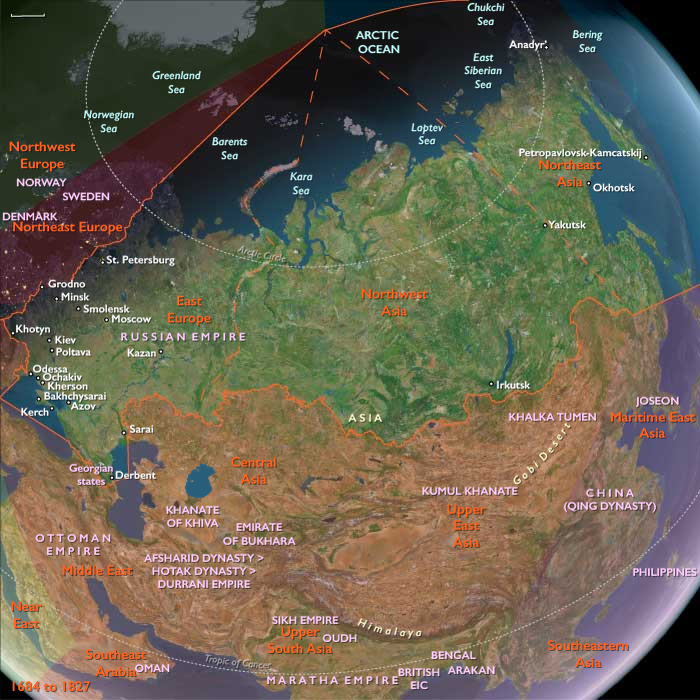
Northeastern Eurasia
View →Subregions