
The Return of Cabral’s Second India Armada…
July 1501 CE
The Return of Cabral’s Second India Armada and the Aftermath (July 1501)
The Second India Armada (1500–1501), led by Pedro Álvares Cabral, returned to Lisbon in July 1501, marking the end of a highly eventful but costly expedition. Although the fleet had secured valuable cargo, the expedition suffered heavy losses, leading to political controversy and a shake-up in Portuguese command.
Staggered Arrivals in Lisbon (July 1501)
- June 23, 1501 – Anunciada, commanded by Nicolau Coelho, was the first ship to return, bringing news of the fleet’s losses and successes.
- July 21, 1501 – Cabral and Simão de Miranda finally arrived in Lisbon with the two largest ships.
- July 25, 1501 – Sancho de Tovar and Pêro de Ataíde arrived.
- July 27, 1501 – Diogo Dias returned with his empty caravel, after having been separated from the fleet and wandering along the African coast.
The Heavy Toll of the Expedition
Of the 13 ships sent out, only five returned with cargo (four belonging to the Crown and one privately owned).
Losses and Casualties
- Five ships lost at sea, including:
- Four ships lost at the Cape of Good Hope, along with their entire crews and captains.
- Among the casualties was Bartolomeu Dias, the first navigator to round the Cape of Good Hope in 1488.
- Three ships returned empty.
- Over 50 Portuguese, including Aires Correia (the Portuguese factor in Calicut), were killed in the Calicut massacre.
Political Fallout and Accusations of Incompetence
- Despite the valuable cargo of spices, the heavy human and material losses raised concerns in the royal court.
- Allegations of incompetence were whispered in government circles, as the expedition had:
- Failed to secure a lasting commercial treaty in Calicut.
- Suffered unexpected losses in naval battles and shipwrecks.
- Been outmaneuvered politically by local rulers.
Cabral’s Humiliating Treatment
- Initially, Cabral was offered command of the Fourth India Armada (1502).
- However, the Crown imposed restrictions on his command, effectively limiting his authority and placing him under supervision.
- Feeling humiliated, Cabral refused the post and withdrew his name.
Vasco da Gama Returns as Supreme Commander (1502)
- Instead of Cabral, King Manuel I reinstated Vasco da Gama as commander of the Fourth Armada (1502).
- Gama’s new fleet would return to India with overwhelming force, determined to punish Calicut, establish stronger Portuguese bases, and secure Portuguese dominance in the Indian Ocean.
Conclusion: A Costly but Pivotal Expedition
- Despite high casualties and ship losses, Cabral’s expedition proved that Portugal could establish long-term trade in India.
- The return of Portuguese ships loaded with spices reaffirmed Portugal’s commitment to the Indian Ocean trade.
- However, the political fallout of the mission reshaped Portuguese leadership, leading to Vasco da Gama’s return to the forefront of exploration and military campaigns.
The Second India Armada (1500–1501) was a turning point in Portugal’s expansion, proving both the immense potential and the dangers of overseas trade, setting the stage for Portugal’s decisive military intervention in India in 1502.
Locations
People
Groups
Hinduism
View →
Arab people
View →
Indian people
View →
Nair
View →
Islam
View →
Kilwa Sultanate
View →
Genoa, (Most Serene) Republic of
View →
Christians, Roman Catholic
View →
Cochin, Kingdom of
View →
Franciscans, or Order of St. Francis
View →
Castile, Crown of
View →
Portugal, Avizan (Joannine) Kingdom of
View →
Tupiniquim people
View →
Gujarat Sultanate
View →
Portuguese Empire
View →
Mutapa, Kingdom of
View →
Florence, Republic of
View →
Portuguese Mozambique
View →
Topics
Commodities
Subjects
Regions
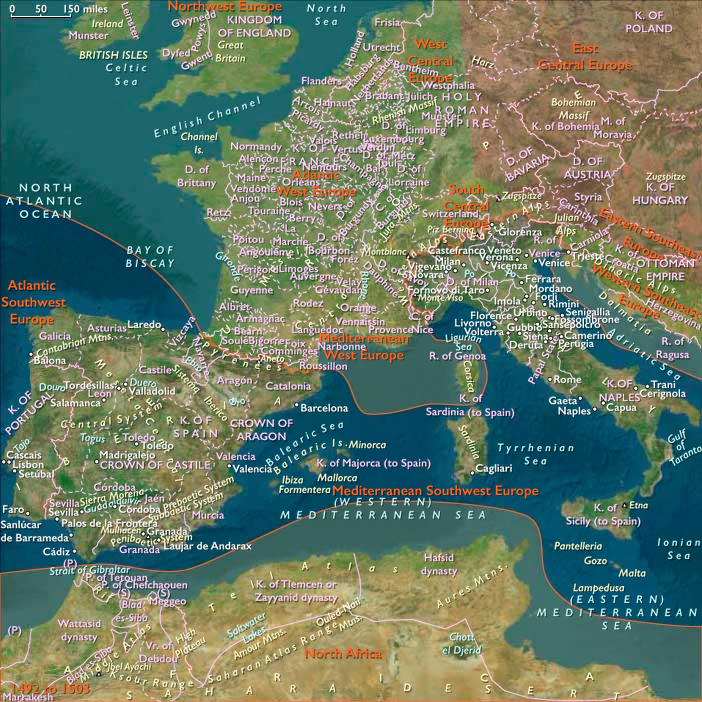
Southwest Europe
View →Subregions
