Castle Rising had been built soon after…
1154 CE
Castle Rising had been built soon after 1138 by William d'Aubigny II, an upwardly mobile Anglo-Norman noble who owned the surrounding manor of Snettisham.
William had married Adeliza of Louvain, the widow of King Henry I in that year, and in 1139 became the Earl of Arundel.
This had transformed his social position, and with his new wealth, William has built Castle Rising and New Buckenham Castle in Norfolk, and expanded Arundel Castle in West Sussex.
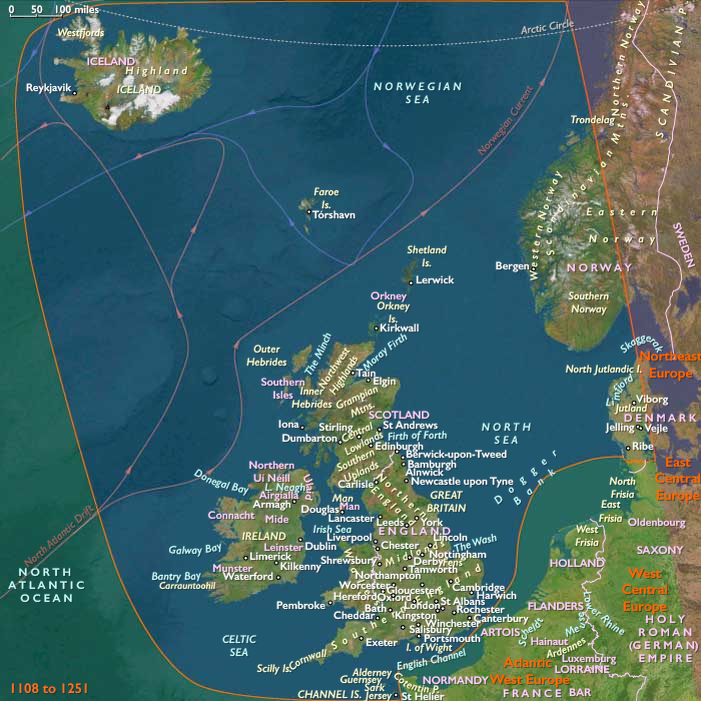
The castle is located five miles (eight kilometers) from the port of King's Lynn.
It would typically be reached in the twelfth century by boat, through a channel in the marshy Babingley River that runs nearby.
Following the Norman conquest of England, the land had been granted to Bishop Odo, the Earl of Kent, who may have used it as an administrative center; there were many Saxo-Norman buildings on the site of the later castle.
Although Norfolk is a prosperous region during this period, the location of the castle is not strategically important: its only militarily significance would have been as a regional muster point, and the surrounding lands are thinly populated, with poor, acidic agricultural soil.
The attraction of the site to William is believed to have been that it was a relatively cheap and easy place in which to build a substantial new building and establish a large hunting park.
Massive resources were required to construct Castle Rising, which includes three baileys with large earthwork defenses and a stone keep, with an adjacent deer park just behind the castle.
As part of the project, the existing settlement was moved away to the north, where it became a planned settlement adjacent to the new castle.
A preexisting Norman chapel on the site, built around 1100, is encircled by the castle defenses, and the new parish church of St. Lawrence had been built in the town instead, although it is possible that this church also predates the castle.
William had received permission from King Stephen to open a mint at the castle in 1145 and, probably linked to this development, had settled a community of Jews in the town.
Despite William having backed Stephen during the war, after the end of the conflict he proves a loyal supporter of Henry and is allowed to retain his possessions.
Henry clamps down on the operation of the regional mints, however, and closes the facility at Castle Rising; the local Jews resettle in King's Lynn.
Groups
Commodities
Subjects
Regions
North Europe
View →Subregions