Event
Central Asia (1108–1251 CE): Khwarazmian Expansion, Mongol…
Central Asia (1108–1251 CE): Khwarazmian Expansion, Mongol Conquest, and Imperial Reorganization
Geographic Parameters
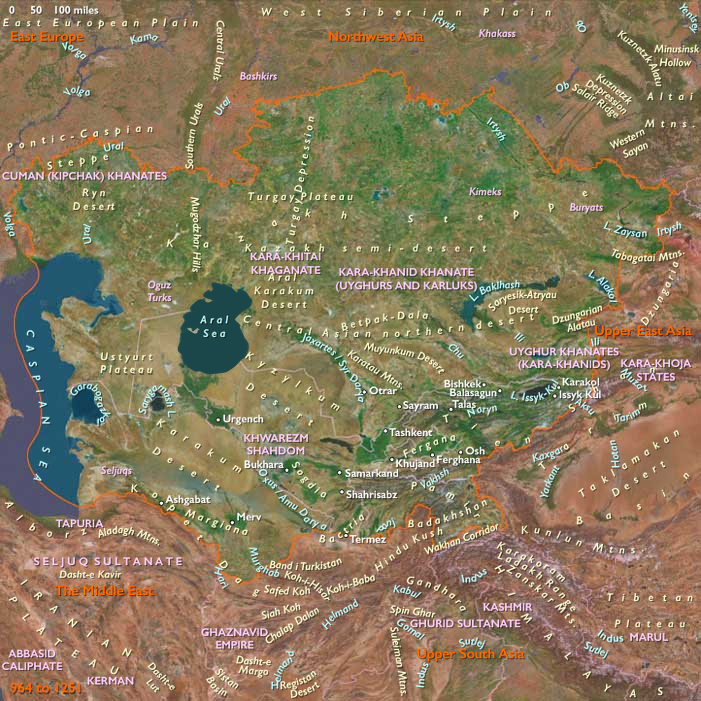
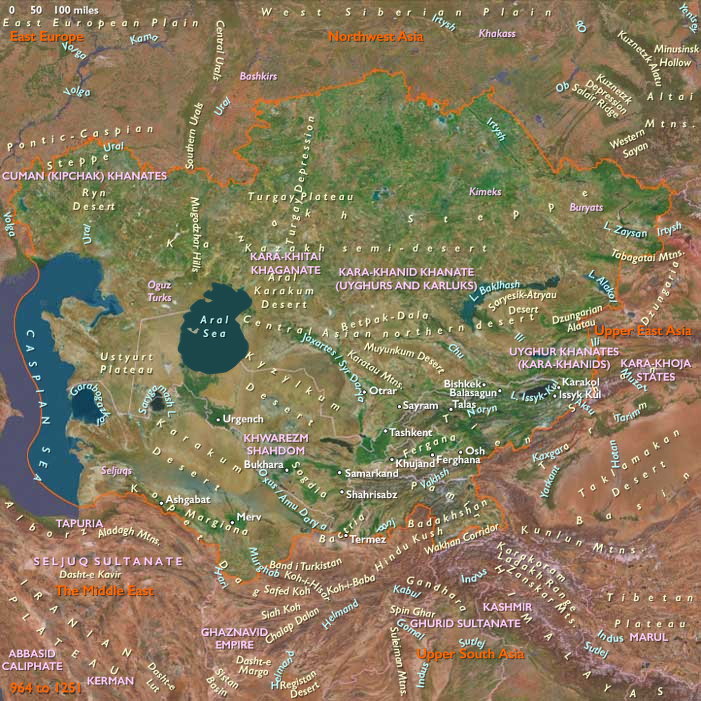
Central Asia retained its ecological division among Transoxiana, Khwarazm, Ferghana, the Kazakh steppe, Zhetysu, and the Tian Shan–Pamir margins. Bukhara, Samarkand, Urgench, Merv, Otrar, and Khujand served as major urban and commercial nodes. The steppe corridors north of the Syr Darya connected these centers to Kipchak territories, while eastern routes passed through Zhetysu and mountain gateways toward Kashgar.
The age was marked by the effort of successive powers to coordinate these territories more tightly. The resulting empires remained dependent upon oasis revenue, pastoral cavalry, caravan taxation, and local administrators, making rapid expansion possible but politically fragile.
Environmental Continuity
Canal agriculture sustained dense populations in Khwarazm, the Zarafshan valley, Ferghana, and the Murghab oasis. Cotton, cereals, fruit, and garden crops supported cities and long-distance trade. Irrigation systems were productive but vulnerable to warfare, neglected maintenance, and river change.
Kipchak and other pastoral communities controlled broad northern and eastern territories. Their horses, sheep, hides, and military labor remained indispensable to regional states. Mountain communities continued mixed agriculture and seasonal herding, maintaining routes between Ferghana, the Pamirs, Zhetysu, and neighboring regions.
Kara-Khitai Supremacy
The Kara-Khitai, or Western Liao, established authority across much of Central Asia after their westward migration from northern China. Their rulers governed through tribute and existing local dynasties rather than attempting cultural uniformity. Muslim oasis populations retained their religious institutions, and local rulers continued much day-to-day administration.
This layered order linked Transoxiana and Zhetysu while preserving political diversity. Karakhanid rulers remained in place as subordinates, and Khwarazm gradually increased its power under nominal dependence upon larger empires.
The Rise of the Khwarazm-Shahs
The Anushteginid Khwarazm-Shahs transformed Khwarazm from a regional state into a major empire. Drawing upon delta agriculture, commercial taxation, cavalry forces, and Persianate administration, they expanded into Transoxiana, Khurasan, and Iran.
Urgench became one of the region’s wealthiest cities. Its markets connected the Amu Darya basin with the Caspian, Volga, steppe, and Iranian worlds. The Khwarazm-Shahs also controlled Bukhara and Samarkand, although their authority often relied upon negotiated relationships with local elites, military commanders, and provincial governors.
The empire expanded faster than it developed stable institutions. Relations with the caliphate, steppe groups, urban populations, and subordinate rulers remained tense. Wealthy cities and caravan routes provided resources but also created vulnerable targets.
Religion and Intellectual Life
Sunni Islamic institutions remained deeply rooted in Transoxiana and Khwarazm. Mosques, madrasas, Sufi lodges, shrines, and legal schools connected cities and villages. The Yasawiyya tradition grew from the teachings associated with Ahmad Yasawi and became especially influential among Turkic-speaking communities. The Kubrawiyya, centered initially in Khwarazm, joined mystical practice to urban scholarship and regional networks.
Religious authority offered continuity amid political instability. Scholars, Sufi teachers, judges, merchants, and charitable endowments maintained education, welfare, arbitration, and communal memory even when dynastic control shifted.
The Mongol Invasion
Conflict between the Khwarazmian government and the Mongol Empire led to Chinggis Khan’s invasion in 1219. Otrar, Bukhara, Samarkand, Urgench, Merv, and other centers experienced siege, massacre, captivity, forced migration, and destruction. The severity differed among places, and some settlements recovered more quickly than others, but the conquest caused a major break in political authority and regional production.
Mongol success rested upon coordinated cavalry armies, intelligence, rapid communication, remount systems, siege specialists, and the incorporation of surrendered troops and technicians. The invaders also exploited divisions within the Khwarazmian state.
Irrigation systems suffered where populations were killed or displaced and canal labor collapsed. Some districts were abandoned; others continued under local agreements or were restored once tribute arrangements stabilized. Skilled artisans and administrators were transferred across the empire, linking Central Asia to new imperial centers while depriving some local communities of labor.
Early Mongol Administration
After conquest, Central Asia entered the territories assigned to the descendants of Chinggis Khan, especially the developing Chagatai Ulus. Military governors, tax collectors, local officials, merchants, and religious authorities negotiated the transition from invasion to administration.
Mongol rulers protected selected caravan routes and encouraged long-distance exchange, but requisitions and competing claims placed heavy burdens upon agricultural communities. Pastoral territories were reorganized as princely appanages and military grazing grounds, intensifying conflict between mobile elites and settled administrators.
Adaptation and Resilience
Cities and villages recovered unevenly. Surviving canal managers, farmers, artisans, merchants, and clerics restored portions of the productive landscape. Sufi institutions and neighborhood communities preserved religious and social continuity.
Pastoral groups adapted more readily to the new imperial order because Mongol authority shared many mobile practices, but they too faced conscription, tribute, altered pasture rights, and dynastic warfare. The conquest reorganized rather than simply liberated the steppe.
Legacy of the Age
By 1251 CE, the Khwarazmian empire had disappeared, and Central Asia had been incorporated into the wider Mongol imperial system. The conquest devastated major cities and agricultural districts, displaced populations, and overturned established political institutions.
The age’s principal new system was the imposition of a transcontinental Mongol military and administrative network. Postal routes, tribute, princely territories, protected commerce, and the movement of people and skills connected Central Asia more directly to the rest of Eurasia. Yet recovery still depended upon older canal systems, village labor, pastoral mobility, Islamic institutions, and local commercial knowledge.

-
{# Image navigates to the detail page; the magnifying-glass chip is the only Fancybox lightbox trigger (kept a separate sibling — anchors can't nest). #}
 The Great Crossroads
World
The Great Crossroads
World
-
{# Image navigates to the detail page; the magnifying-glass chip is the only Fancybox lightbox trigger (kept a separate sibling — anchors can't nest). #}
 Central Asia
Region
Central Asia
Region
-
{# Image navigates to the detail page; the magnifying-glass chip is the only Fancybox lightbox trigger (kept a separate sibling — anchors can't nest). #}
 Central Asia
Subregion
Central Asia
Subregion